Russia has been targeting Ukraine's railways in an effort to disrupt the country's economy and supply lines. How is Russia conducting the attacks? And can the strikes be stopped?
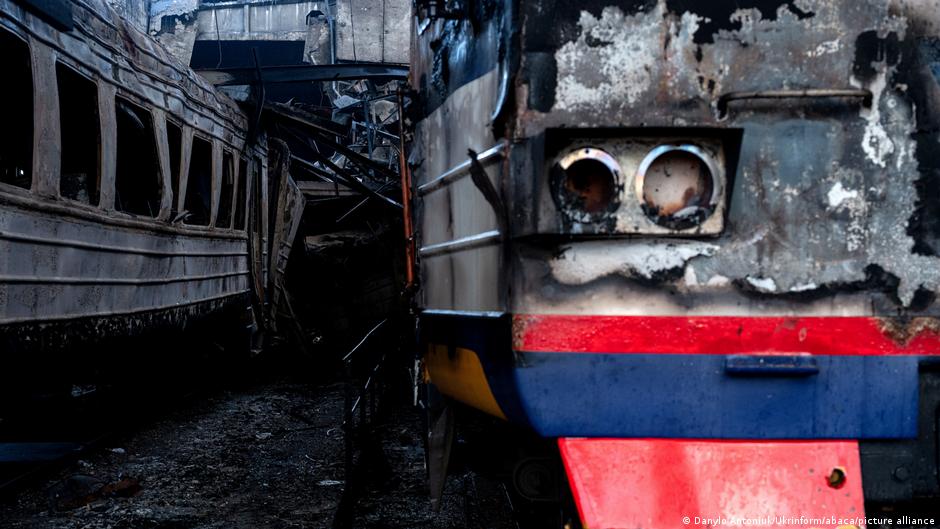
https://p.dw.com/p/5ABXPRussia is targeting Ukrainian train infrastructure, as seen here in the aftermath of an airstrike on Fastiv railway stationImage: Danylo Antoniuk/Ukrinform/abaca/picture allianceAdvertisementIn addition to attacking Ukraine's energy infrastructure, Russia has been intensifying strikes on the country's rail lines. On Sunday, a Russian drone hit a civilian train carrying 200 passengers from Kyiv to Sumy. Nobody was injured, but the locomotive was damaged and had to be replaced before travelers could continue their journey.
Ukraine's public railway company, Ukrzaliznytsia, has reported that engine wagons, freight cars and railway maintenance equipment have come under increased Russian fire since early March. The company has also observed more frequent Russian attacks on bridges and railyards.
Russia weaponizing winter in UkraineTo view this video please enable JavaScript, and consider upgrading to a web browser that supports HTML5 video
Pavlo Narozhnyi, a military expert, told DW that the attacks are not isolated incidents, but part of a wider strategy to strike logistical, export and military supply lines. Narozhnyi said the strikes sought to take out locomotives to slow Ukraine's economy and make it difficult for the government to send forces to the front lines.
"War requires incredible amounts of fuel, munition and equipment,” Narozhnyi said. "All of that needs to be transported. You can use roads, but that's quite expensive and doesn't make financial sense. That's why most military equipment is transported along railways."
Narozhnyi said Russian drone pilots would observe certain rail lines, wait until a train appears and then aim to hit the engine — not only the most expensive part of the train, but also an essential piece of equipment in short supply.
That does not mean that passenger cars are safe. "They'll attack any train,” Narozhnyi said. "If they find one, they'll shoot."
How drones and ground robots are reshaping war in UkraineTo view this video please enable JavaScript, and consider upgrading to a web browser that supports HTML5 video
Experts say the rail lines along Ukraine's borders with Russia and Belarus, as well as southward toward Crimea and Odesa, are at the highest risk. That's because these are areas where Russian armed forces can use so-called mesh networks to deploy and steer drone swarms.
Serhii Beskrestnov, who advises Ukraine's Defense Ministry on drones and electronic warfare, recently outlined the concept of mesh networks for drone warfare, the Ukrainian digital media platform United 24 Media reported. The way he put it, radio-based mesh networks fitted to Shahed drones consisted of modems that do not only send and receive signals, but also act as a relay and signal booster.
"Under such a scheme, all Shahed [drones] in the air are connected by radio to each other,” Beskrestnov said. "As a result, several Shaheds can be shot down and the connection will not be interrupted. It will simply pass through other Shaheds."
Beskrestnov said the mesh networks were controlled through radio signals from high-powered antennas that Russian forces place along the border and in the occupied territories. One such network was recently "neutralized" in Belarus, he said.
"One of these antennas had coverage that extended as far as Kyiv, and reconnaissance drones flying over the city used it to transmit data," he wrote on Facebook. "Another point enabled drone attacks in western Ukraine, particularly along the Kyiv-Kovel rail line."
"We need more resources for air defense," Ivan Kyrychevskyi, a weapons expert at the Ukrainian outlet Defense Express, told DW. He said that meant "establishing a 'small' air-defense system," referring to fast-moving mobile groups with portable air-defense systems.
How Ukraine shoots down Russia's drones on a budgetTo view this video please enable JavaScript, and consider upgrading to a web browser that supports HTML5 video
Special security measures have long been in place along critical Ukrainian borders and front lines. "In the Chernihiv and Sumy regions, along the Kherson-Mykolaiv route, locomotives are being fitted with armored plates known as 'grills' and drone networks,” Kyrychevkyi said. "Sometimes, container wagons are hooked up between the engine and the passenger wagons, so that the rear end of the train isn't damaged in the case of an explosion
Most military experts agree that there is no significantly increased threat level for civilian transport in Ukraine. The railway company Ukrzaliznytsia states that its employees work together with armed forces to monitor the air space above railway lines. Whenever a threat is detected, railway staff change the route, evacuate the passengers and take further safety precautions.
Narozhnyi said Ukraine's electronic defense systems along main railway transportation routes would need to be expanded.
"You could equip every single train with counterdrone devices, or you could use them to protect strategic facilities such as power plants, or gas and electricity infrastructure," he said. "Technically, it's all possible. The question is how much money it will take to secure the entire railway infrastructure."
This article was originally written in Ukrainian.