play Live Sign upShow navigation menuplay Live Click here to searchsearchSign up'Desperate': How Venezuela's power cuts fuel growing public angerPower cuts have spiked since the start of the year, fuelling protests against the government of interim President Delcy Rodriguez.
xwhatsapp-strokecopylinkgoogleAdd Al Jazeera on GoogleinfoThe hum of the kidney dialysis machine that Onasis Munoz is connected to suddenly stops. The fluorescent lights overhead flicker out, and his room at a clinic in Valencia, Venezuela, is plunged into darkness.
It is not the first time a power cut has interrupted one of the three weekly sessions Munoz needs to do the work his failing kidneys can no longer do, filtering waste and excess fluid from his blood.
For years, electricity would go out every couple of days across parts of Venezuela's Carabobo state.
But in recent months, Munoz said, the outages have grown to be daily, lasting around seven hours. The clinic's emergency batteries have since been depleted, and its backup generator no longer works.
He explained that the frequent power failures have disrupted his treatment. His health has slumped as a result.
"I arrive home, exhausted, as if I had run a marathon," the 34-year-old said.
But often there is no electricity there either, and recent weeks have been sweltering. "I can't switch on the air conditioning. I cannot rest because of the heat and the mosquitoes. There's no relief," Munoz said.
Across Venezuela, the prolonged outages are riling locals, as the electricity supply to homes, businesses and essential services becomes unstable.
Some of the cuts are deliberate, as the government of interim President Delcy Rodriguez rations electricity.
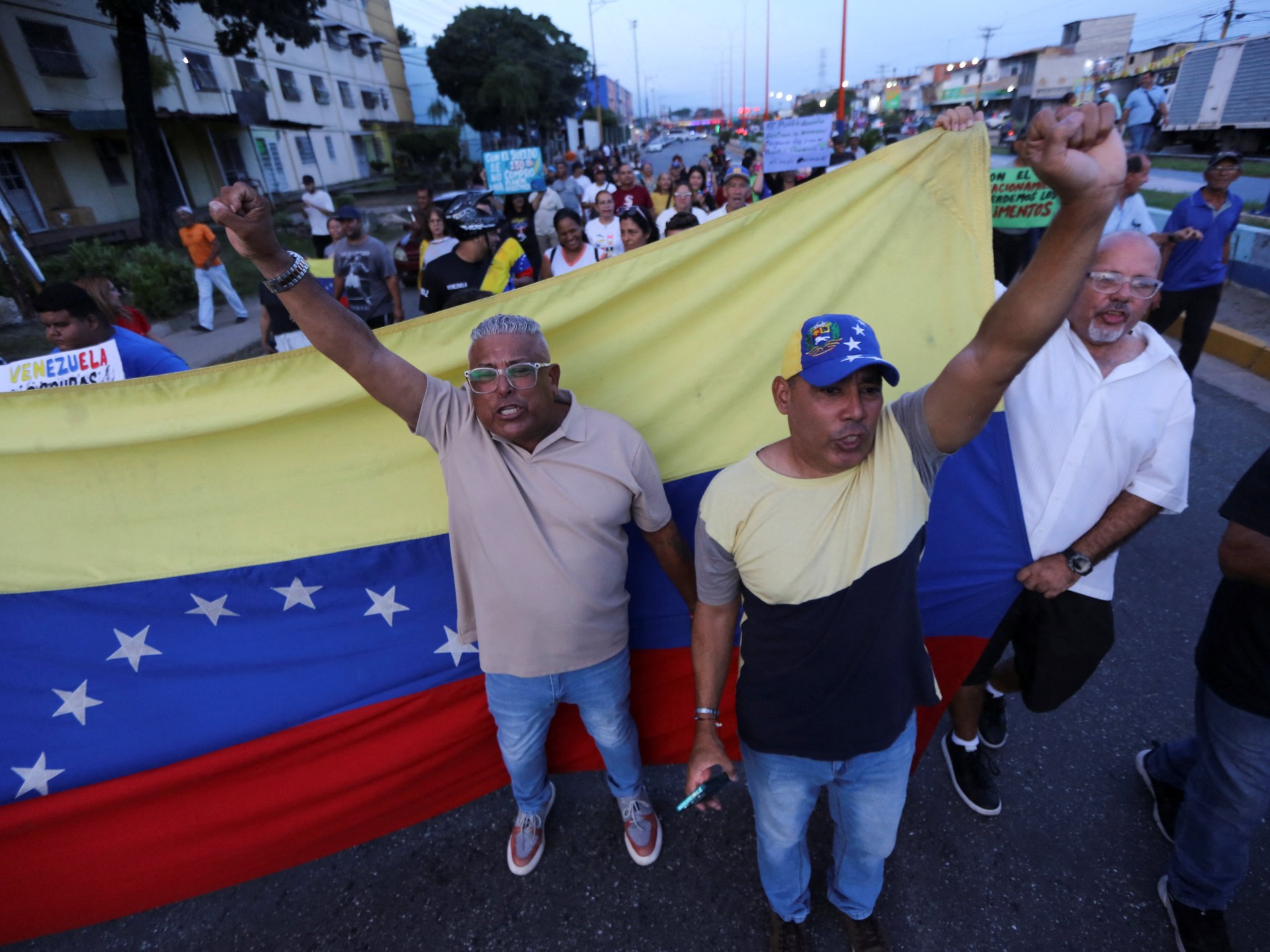
The resulting frustration has spilled onto the streets, where demonstrators hold "cacerolazos" – a traditional form of protest that involves banging pots and pans.
Some have gone as far as blocking roadways and setting tyres on fire. The electricity crisis has also raised concerns about how the government is managing the country's vast oil supply, a key source of income for the country.
"We are desperate. We cannot understand how a country so rich in resources can be practically left in the dark," said Patricia Cueva, a lawyer from Maracaibo, the capital of oil-rich Zulia state.
"We cannot rest. We cannot work. Our children cry."
Demonstrators march to protest against the lengthy power outages and electricity rationing in Valencia, Venezuela, on October 2 [Juan Carlos Hernandez/Reuters]Demonstrators march to protest against the lengthy power outages and electricity rationing in Valencia, Venezuela, on October 2 [Juan Carlos Hernandez/Reuters]A recent study by ANOVA Policy Research, a consultancy firm, found that 62.8 percent of Venezuelan households – or nearly two out of every three families – experienced daily electricity cuts in 2026, compared with 37.1 percent in 2024.
Only 6.9 percent reported a continuous supply of electricity.
The energy crisis has its roots in multiple causes. Previous governments have blamed foreign sanctions for weakening Venezuela's economy.
The Rodriguez administration, meanwhile, has cited the climate phenomenon El Niño for the crisis. Some 90 percent of Venezuela's electricity is generated by hydropower, making the system vulnerable to extreme heat and drought.
But energy specialist Nelson Hernandez is among the Venezuelans pointing a finger at the government for this year's surge in outages.
Hernandez acknowledges that climate conditions can have an impact on electricity production. But he underscored that Venezuela's electricity crisis is not a "random event".
"Practically the entire crisis stems from the systematic neglect of the infrastructure," he told Al Jazeera, pointing to what he called "profound failures" in management, lack of strategic planning and ageing technology.
He also signalled that shifting government policies towards oil extraction plays a key role.
Motorcyclists pass by a burning roadblock during a protest over power outages in Guacara, Venezuela, on September 30 [Juan Carlos Hernandez/Reuters]Motorcyclists pass by a burning roadblock during a protest over power outages in Guacara, Venezuela, on September 30 [Juan Carlos Hernandez/Reuters]Venezuela sits on the largest proven oil reserves in the world.
Much of the oil industry was nationalised, but that started to change in January, after the US conducted a military operation to abduct and imprison Venezuela's then-President Nicolas Maduro.
Since then, relations between Washington and Caracas have shifted. Under pressure from US President Donald Trump, Rodriguez – Maduro's former vice president – has implemented reforms to allow greater foreign investment in the country's oil sector.
Trump, meanwhile, has eased restrictions on the oil's export and expanded the US role in the industry.
The result has been an uptick in output. Oil production in Venezuela has risen by almost 30 percent this year, from 924,000 barrels per day in January to 1.201 million in August, according to the Organization of the Petroleum Exporting Countries (OPEC).
As Venezuela revives its dilapidated oil industry, Hernandez says increased production is putting pressure on an already strained electricity system.
"Because electricity supplies to oil fields cannot be rationed without jeopardising oil production, the burden of adjustment and the power cuts fall directly on the residential and commercial sectors," he said.
Hernandez estimates the oil industry requires around 1,600 megawatts or more for extraction, pumping, transportation and refining.
The Rodriguez government says it is working to stabilise the system, with plans to add 1,300 megawatts of generation in the final quarter of the year.
It has also put in place legal measures that compel energy companies to invest in their own electrical infrastructure, to lessen the strain on the public power grid.
Demonstrators in Valencia, Venezuela, chant in protest against the power outages gripping their country on October 2 [Juan Carlos Hernandez/Reuters]Demonstrators in Valencia, Venezuela, chant in protest against the power outages gripping their country on October 2 [Juan Carlos Hernandez/Reuters]But industry experts say lasting solutions require major investments to repair ageing power plants, while building more locally generated and renewable power.
For families and businesses who can afford them, backup generators provide some respite during outages. But many cannot afford them and are forced to find other ways to cope.
"My family owns a bakery, and with the constant power cuts, it is impossible to maintain consistent production," said Manuel Reyes of Naguanagua, in Venezuela's Carabobo state.
"There are days when we stay open until after midnight to make the most of the hours when there is electricity and produce something to sell."
Residents across several states who spoke to Al Jazeera said the prolonged power cuts were taking a toll on their mental health.
Mileidy Blanco, who lives in Maracay in the state of Aragua, gets up before dawn at 4am to prepare the day's food for her family before the electricity goes out.
But she said she is increasingly worried about her six-year-old daughter, who is showing signs of stress.
Recently, the electricity went out at her daughter's school, then at home and again at her dance class.
"She broke down; she couldn't take it anymore. She started crying, asking how long the lights were going to be out and how long this would last," Blanco told Al Jazeera.
Blanco took her daughter to a psychologist, who advised her to keep the child occupied during outages with board games and trips to the park.
"Her only concern should be getting good grades, studying, doing her homework, cleaning her room," Blanco said.
Instead, when the power goes out, she has noticed that her six-year-old reaches for pots and pans. She bangs along with the cacerolazo demonstrations outside in the streets – protests that show no sign of stopping.