Every year, thousands of Rohingya attempt to flee Myanmar and Bangladesh by sea. The escape effort kills hundreds of people per year.
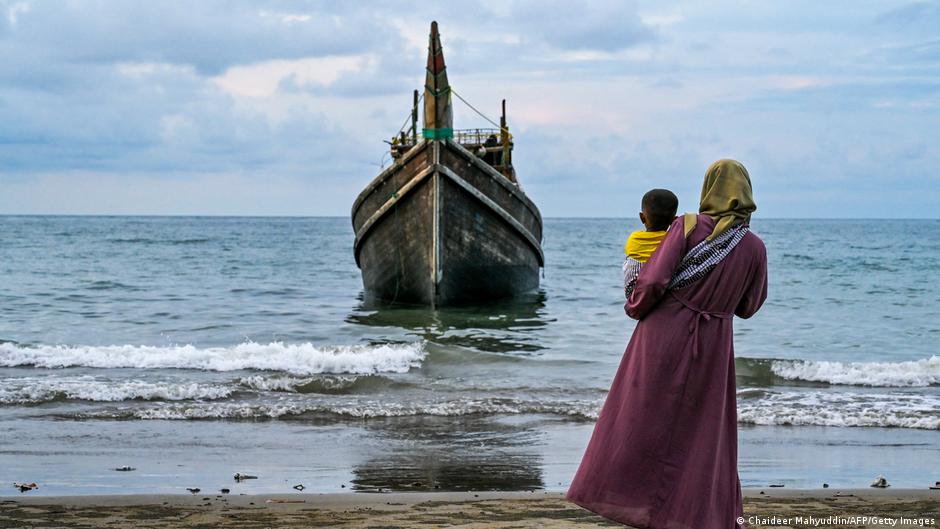
https://p.dw.com/p/5AAybNearly 900 Rohingya either died or went missing last year trying to flee Bangladesh and Myanmar by boat, according to the UNHCR [File: December 10, 2023]Image: Chaideer Mahyuddin/AFP/Getty ImagesAdvertisementIt was late November when Nur Begum, an ethnic Rohingya from Myanmar living in the sprawling refugee camps of Cox's Bazar in Bangladesh, received the call that her eldest daughter, Nur Kayas, was dead.
The call came from her former husband's father, who had recently landed illegally in Malaysia aboard a smuggler's boat near the island of Langkawi.
"He said their boat sank close to Langkawi," Nur Begum told DW. He said he was in the same boat with her and that he and a few others were rescued by another boat and taken away, but everyone else died.
Her 10-year-old daughter was among those who drowned, one of the 892 Rohingya who died or went missing in 2025 while attempting the sea crossing from Bangladesh or Myanmar in hopes of finding better lives abroad, most often in Malaysia.
That grim figure, recorded by the UN refugee agency UNHCR, seems to be the highest death toll in well over a decade. In 2013, the UN estimated 890 Rohingya died or went missing while attempting the same journey.
Rohingya caught in the middle of Myanmar's civil warTo view this video please enable JavaScript, and consider upgrading to a web browser that supports HTML5 video
"The dire humanitarian situation in both Myanmar and Bangladesh, exacerbated by funding cuts, is having a devastating impact on the lives of Rohingya people. More and more are resorting to dangerous journeys to seek safety, protection and a dignified life for themselves and their families," Mariko Hall, the UNHCR's spokesperson for Asia and the Pacific, told DW.
Nur Begum and her daughter were among the roughly 700,000 Rohingya who fled their homes in Myanmar to escape the campaign of arson, rape and murder unleashed on the Muslim minority by the predominantly Buddhist Myanmar soldiers in 2017. That exodus, combined with a similar move in 2024, has pushed the population of the Cox's Bazar refugee camps in Bangladesh well past 1 million.
Inside the camps, jobs are scarce and food rations, funded by a dwindling pool of foreign aid, are falling. Gangs prowl the settlements for children to hold ransom or young men to recruit for the civil war back in Myanmar, where the military ousted a democratically elected government in 2021.
In Myanmar itself, the Rohingya are caught between the military and the Arakan Army, one of the many armed groups fighting the junta, persecuted by both and forced into fighting for either side.
"Vulnerability to exploitation and despair is increasing, and more people are resorting to harmful coping mechanisms," said Hall.
Faced with these pressures, an increasing number of people are putting their lives on the line to reach Malaysia by sea, aided by a well-worn network of smugglers and human traffickers.
UNICEF funding cut could end education for Rohingya kidsTo view this video please enable JavaScript, and consider upgrading to a web browser that supports HTML5 video
Despite the dangers and grinding poverty of the Cox's Bazar camps, Nur Begum said she had no intention of sending her daughter away. She believes she may have been tricked. "I never, ever wanted my daughter to go to Malaysia. It was not my decision, and I don't think it was my daughter's decision. Maybe the human traffickers around here took her. I still don't know how she got onto the boat," she said.
"I can't sleep or eat when I think about her. I miss her most of the time. Whenever I see her friends, they ask me about her, but I can't tell them that she's dead. I'm always depressed."
Nur Begum said she did not know why the boat sank.
Media outlets offered conflicting narratives over the fate of nearly 300 people believed to be on the boatthat reportedly capsized when the sea turned suddenly choppy.
Some accounts say it was one of the smaller boats that capsized while ferrying passengers to shore, rather than the larger ship that made the bulk of the journey to Langkawi.
A Rohingya news outlet, which interviewed one of the survivors, reported that some 200 passengers had already disembarked before the last of the smaller boats sank.
The UN, however, estimates 266 people died or went missing in the tragedy.
The Arakan Project, a non-government group that tracks the Rohingyas' boat journeys, told DW that its own research corroborates the news outlet's account, which would bring the UNHCR's figure for the year down.
Rohingya women in Bangladeshi camps lack toiletsTo view this video please enable JavaScript, and consider upgrading to a web browser that supports HTML5 video
Even with the accounts of the November tragedy still being clarified, it is clear that thousands of Rohingya are fleeing Bangladesh and Myanmar by boat each year, and hundreds of them continue to die or go missing along the way.
Many of the boats the smugglers use are old and ill-equipped for the journeys, which can take more than a week.
Setting off during the margins of the monsoon season, as some boats do, only adds to the risks, said Chris Lewa, director of the Arakan Project.
But what makes the journeys most dangerous, she pointed out, is how the authorities of the countries the boats are trying to reach — mainly Indonesia, Malaysia and Thailand — react to those arrivals.
According to rights groups and survivors, the authorities often ignore distress calls from the boats or push them out of their national waters when spotted.
Lewa said that forces boats to spend more time at sea, even after provisions of food and potable water have run out. Some smugglers, she added, also try fooling patrols by hiding their passengers below decks in cargo holds meant for storing fish, where they have little air to breathe and can suffocate.
"So, to me, the most dangerous thing in this situation is … the reaction of states to try to counteract the boats," said Lewa.
She and other advocates have urged the authorities of the countries the boats are trying to reach to do what they can to help.
Until they do, and while conditions in Bangladesh and Myanmar keep driving desperate Rohingya across the sea, activists say accidents like the one that cost Nur Kayas her young life will continue to happen.
"There is always extreme risk if taking a boat," Lewa said. "And especially if the number of departures is increasing, there [are] also more chances that there will be more incidents like this in the future."