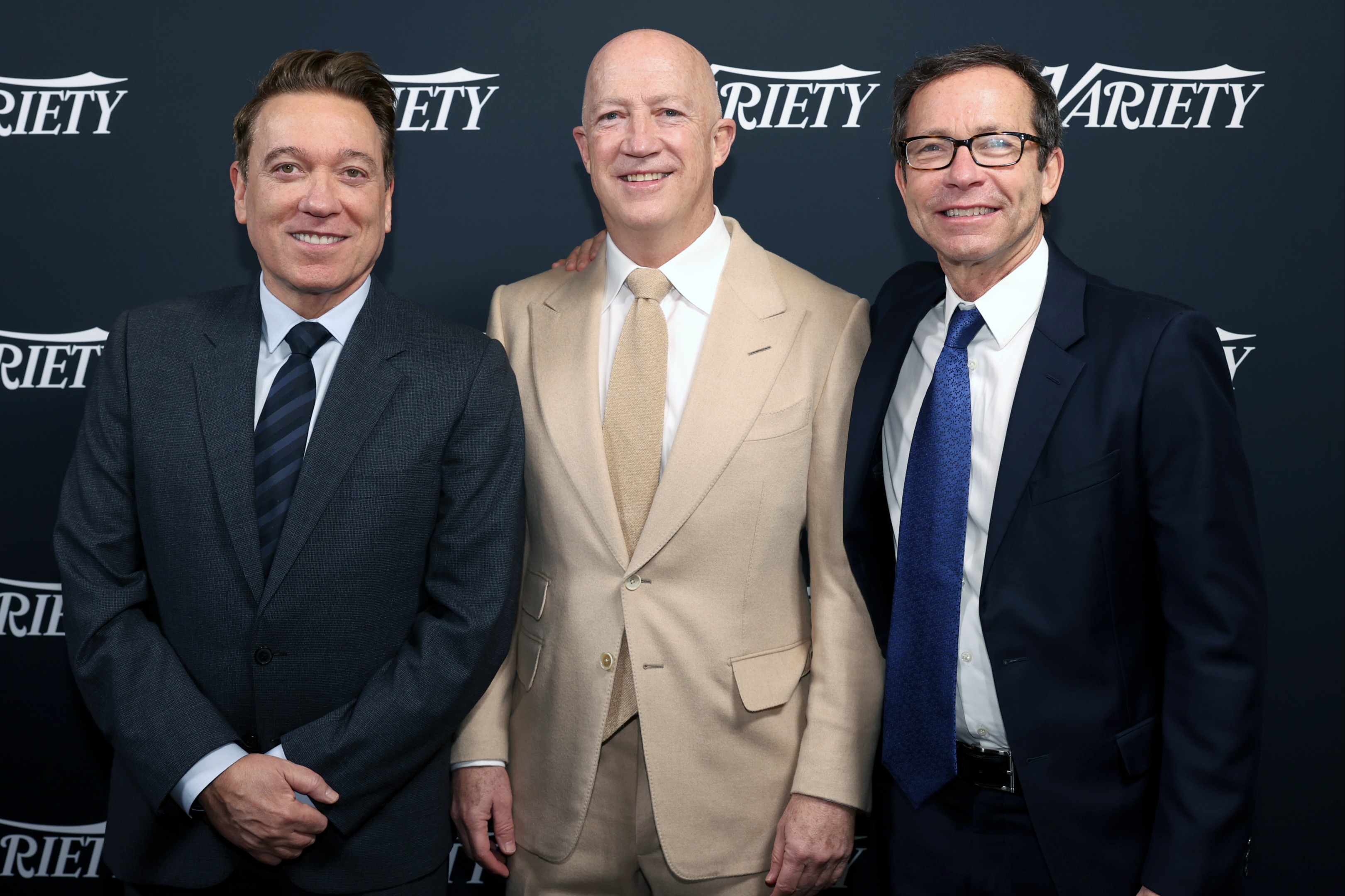
CAA co-chairs Kevin Huvane, Bryan Lourd and Richard Lovett. Variety via Getty Images It’s the story everyone in Hollywood is talking about. Tens of millions are at stake, and in a town where schadenfreude is a bloodsport, even agents inside venerable CAA are rooting against the house.
With a drip-drop of leaks from the ongoing arbitration, it’s becoming clear that CAA principals Bryan Lourd, Kevin Huvane and Richard Lovett drastically overplayed their hand in their bid to make an example of four former employees who broke off to start the management company, Range Media Partners, six years ago — even as the appeal in their ongoing legal saga continues to play out.
Two years after launching Range, Jack Whigham, Dave Bugliari, Michael Cooper and Mick Sullivan — all of whom were longtime agents — initiated arbitration proceedings against their former employer after their equity was stripped from them in the wake of their departures from CAA. While it’s still ongoing, an initial ruling from the arbitration panel was delivered last month and elements of that ruling have started to leak. Over the weekend, CAA’s principals sent out a staff email trying to assuage concerns regarding those leaks which signaled to several insiders that, in fact, they are concerned.
The arbitration proceedings, which took place behind-closed-doors have been described as drawn-out and bruising. Last month a three-judge panel issued a ruling which was devastating to CAA and its three principals. CAA is currently appealing. Additionally, a civil suit in state court in which CAA alleges breach of fiduciary duty and tortious interference is still playing out (the four former employees deny the charges and have countersued). As it stands, per the arbitration ruling, CAA now has to pay $36 million to the four former employees, which was the amount of the total sum of the stripped equity that the judges settled on. But that’s not all. According to the ruling, CAA is also required to pay the cost of Range’s legal fees which is an additional $6 million. Subject to appeal, CAA is on the hook for well over $40 million and that figure doesn’t even include the agency’s own legal fees, which sources peg at somewhere between $10 million-to-$15 million.
One of the most consequential parts of the ruling, however, was the determination of how that $36 million sum must be paid out. Instead of just reinstating their equity and slotting the Range founders back into their capitalization table — a move which CAA and its lawyers argued for — the arbitration panel held that the agency has to pay out the $36 million in cash which has widespread implications, none of which are good for the CAA principals.
Ever since investment firm Artémis, which is owned by French billionaire François-Henri Pinault, acquired a majority stake in CAA in 2023 (which valued the company at $7 billion), the question of who is allowed to cash out their CAA equity has been a brewing source of resentment both inside and outside the Century City juggernaut.
Following the Artémis acquisition, current and former employees were upset at the caps that were placed on the amount of vested equity a person could liquidate which was somewhere between 10 percent and 15 percent according to multiple reports including one I wrote for The Ankler. That the four Range founders are about to have the entirety of their CAA equity liquidated (which, by the way, CAA could have avoided had they just let them walk away with the equity, or found a way to settle their legal dispute) has re-stoked those resentments and a growing number of CAA equity holders are wondering when — if ever — they will get paid.
“If the people who weren’t loyal — and those are their words, not mine — got their money, how do you look at those of us who have been loyal and didn’t get their money and expect us to live with that,” said a CAA source. “There’s something not right about this.”
A person close to the company disputes that characterization, arguing that CAA has provided equity holders with several liquidity events — four in total — over the past 12 years and that the caps have been a function of the soaring value of the company over that same period of time.
At its core, the legal dispute centers on the role equity has played in allowing talent managers to move freely within Hollywood’s labor market. Switching from one agency to another (or in the case of the Range founders switching from being a talent agent to a talent manager) always comes with risks. An agency’s value is built on the power and prestige of its client list, which in CAA’s case is second to none. But clients are not contractually bound to an agency meaning they can pick up and leave at any moment. What has kept an A-list client secure has been their allegiance to both the agency and to their actual agent. When an agent leaves UTA, CAA or WME they are gambling that their clients will remain loyal to them and follow them to their new firm or venture but often the client opts to remain with the company.
Starting around 2010 another dynamic was introduced which impeded the flow of agents moving from one firm to another. When private equity firms like TPG and Silverlake started taking ownership stakes in CAA and WME respectively, equity was introduced as an alternative form of compensation to base salary + discretionary end-of-year bonus (Investcorp took a stake in UTA in 2018, and then later sold that stake to EQT in 2022). Agents, depending upon their performance, were given ownership stakes and in some cases that equity ballooned in value with some agents accruing tens of millions of dollars of equity. Owning equity in a privately held company usually requires some sort of liquidity event — typically a public offering or an acquisition — for employees to cash out, which is why the Artémis acquisition of CAA struck many employees as the pivotal moment.
By and large, CAA has allowed agents who leave the firm to keep their equity, with some very public exceptions. In 2015, eight CAA agents including a number of top comedy reps defected to UTA which resulted in a drawn-out legal battle between CAA and those agents. The two sides ultimately reached a private settlement which included a number of the defectors’ CAA equity being revoked, according to several sources. Whether it was intentional or not, the “Lawless Midnight Raid” lawsuit, as it came to be known, sent a message to other CAA employees: Leave on our terms, or we could make your life very difficult. Five years later, the Range founders left, had their CAA equity stripped, fought back and won.
The Range arbitration ruling does several things. It sets a legal precedent and signals to other agents at CAA and elsewhere that you cannot be stripped of your equity if you decide to leave. (Though it’s worth noting that in 2023 California passed a law prohibiting employers from entering into or attempting to enforce noncompete agreements. Employers were legally required to inform their employees of the change in the law.) That could lead to an exodus of agents who have been pondering a move to another agency or to a management company.
“A lot of people inside of here have been waiting to see what happens with the Range guys,” said a CAA employee, who is sitting on a low-seven figure sum of CAA equity.
Said another CAA source more bluntly: “There are only three people inside [CAA] who weren’t rooting for the Range Guys.”
What CAA has in their favor are deep pockets and the will to exhaust the appeals process with a source close to the company telling P6H that a final resolution is still years away. “They are prepared to fight for as long as it takes,” says the source. (Although court-imposed interest fees could get expensive for CAA if it drags on for long, potentially costing them millions.)
But more than the ruling itself, the language the panel of judges used in their determination could instigate further legal peril for CAA. As Puck and Deadline reported, (and Page Six Hollywood has confirmed, too), the judges determined that the CAA principals may have breached their fiduciary duty as corporate officers overseeing an employee stock program for a multibillion dollar company. The inclusion of that language along with the opacity surrounding how the principals managed the employee stock program reportedly opens the door for additional potential legal action — a mass suit that could include dozens of plaintiffs — against CAA’s principals over how they managed the employee stock program.
A CAA spokesperson declined to comment.
Bryan Freedman, who represents the four Range founders, says potential plaintiffs have already started reaching out to him and Page Six Hollywood has spoken to several people who confirmed they are considering it.
“We are currently in the process of representing former and current CAA talent agents who have been forced to sign illegal non-competes as a condition of their membership in CAA’s equity programs,” Freedman says in a statement. “These agents number anywhere between dozens to hundreds of past and present equity holders in CAA who have been illegally restrained from competing through threats of losing their equity.”
Adding to CAA’s headaches, contracts for several top agents are up in 2028, which means the equity question will almost certainly be broached.
WME and UTA — CAA’s two biggest rivals — have introduced employee stock programs of their own. UTA is said to have one of the most equitable programs among the “Big 3” talent agencies. When Endeavor went private a year ago, WME equity holders were allowed to liquidate 100 percent of their holdings, a fact that WME sources have been extremely eager to share with P6H and other outlets.
“You gotta hand it to Bryan, Richard and Kevin — they’ve done the impossible,” said one industry source. “They’ve actually made Ari [Emanuel] look like a good guy.”