Video 30 years later, America is still watching Fox News thanks viewers for watching through tragedy and triumph since 1996.
I started reporting for Fox News in 1997, shortly after its launch in October 1996, while based in Moscow. Russian President Boris Yeltsin had just undergone heart surgery in November when I arrived, and the Mir Space Station, a Soviet-Russian station, with American astronauts on board, caught fire — the first fire on an international space station.
Every Monday, Yeltsin seemed to fire his cabinet, sending shock waves through the Western world. Vladimir Putin had moved to Moscow in 1996. In March 1997, Yeltsin appointed him deputy chief of the Presidential Staff and chief of the Main Control Directorate to work as an auditor in the Kremlin and to get close to Yeltsin.
He later took over as head of the FSB, the successor to the KGB, and staged what independent critics, intelligence officials, and dissidents long alleged were a series of false flag operations that involved blowing up four apartment buildings filled with women and children sleeping in their beds to justify an invasion of Chechnya.
During that time, in Moscow and St. Petersburg, bankers were gunned down, their bodies found in the streets as the ruble crashed and the rising Russian mafia and oligarchs began dividing up Russian state enterprises and assets.
FOX NEWS' JENNIFER GRIFFIN AWARDED 2024 PRIZE OF PROFESSIONAL EXCELLENCE AT THE FOREIGN PRESS AWARDS
After starting with Fox in 1997, I remember standing on an icy-cold bridge on New Year’s Eve with the snow at times blowing upwards over the Moskva River and St. Basil’s onion dome cathedral lit up in the background as drunken Russians careened toward our camera position and fireworks lit the midnight sky over the Kremlin.
I was learning on the job how to do stand-up and live shots for this new American cable television network, which hoped to compete with CNN.
I was working for Simon Marks, a former ITN correspondent, who hired me as the Fox News correspondent in Moscow to work for Feature Story Productions, which had a contract to provide coverage for the new channel. I was trained in print and radio, not television. I had to learn on the job.
Soon I was assigned by Fox to cover the Kosovo War from NATO headquarters in Brussels during its bombing campaign in March 1999. Gen. Wesley Clark was NATO’s Supreme Allied Commander, and I will never forget the mood at NATO headquarters when a U.S. B-2 Spirit dropped five satellite-guided bombs (JDAMs) on the Chinese Embassy in Belgrade, killing three Chinese journalists and injuring dozens.
MARTHA MACCALLUM: AFTER 22 YEARS, HERE'S WHY I'M GRATEFUL TO CALL FOX HOME
The mistake was the result of a CIA miscalculation of coordinates associated with the intended target: a Yugoslav weapons storage facility. Months later, after the Serbs were forced to withdraw, I flew to Kosovo, joining Fox’s Greg Palkot on the ground. We took over from David Lee Miller and the Jerusalem team, including Yaniv Turgeman and Eli Fastman, who had remained in Belgrade during the NATO bombing campaign. We divided up shifts, and I talked my way into a Russian base by offering cigarettes to a Russian soldier after the Russians surprised the U.S. military by landing in the Kosovo capital.
Chief National Security Correspondent Jennifer Griffin’s sits down for an exclusive interview with Navy Under Secretary Erik Raven on the AUKUS agreement and submarine industrial base at the Pentagon on April 12, 2024. (Fox News)
I talked my way onto an American Black Hawk helicopter that was delivering 82nd Airborne troops to observe the Serbian soldiers withdrawing. We got the footage of the withdrawal and dashed back to make it on air for "Fox Report." I remember our cameraman, Mal James, lifting his camera to shoot the arrival of the Apache helicopters above Pristina with their nose-mounted sensors and night vision. I spoke into the microphone with the new Fox mic flag: "Here come the Apaches!" They were a fierce symbol of American technology and air supremacy.
Fast-forward to the end of 1999. Fox hired me full time as its Jerusalem correspondent. My husband and I moved from Moscow. It was the tail end of the Oslo Peace Accords, which were on life support. President Clinton was trying to rescue them before leaving office by meeting frequently with Israeli Prime Minister Ehud Barak and Palestinian Chairman Yasser Arafat.
DANA PERINO: THE UNTOLD STORY OF THE REMARKABLE PEOPLE WHO MAKE FOX NEWS POSSIBLE
We thought this would be our most boring assignment after having lived in South Africa at the end of apartheid, Islamabad as the Taliban were being formed, and Kabul amid the civil war among the Mujahideen.
We decided to start our family. Months later, on September 28, 2000, Ariel Sharon, who had served as Israel’s defense minister and was challenging Bibi Netanyahu as the leader of the Likud Party, decided to take a walk up to the Temple Mount.
I had just found out I was pregnant and had morning sickness as I covered the first rocks being thrown down onto Jews praying at the Western Wall. Friday prayers erupted at the Haram al-Sharif. There was tear gas and injured Palestinians were taken away on stretchers. The Second Intifada began and lasted for the next seven-and-a-half years while I was posted in Jerusalem.
I had two daughters born in Jerusalem during that time, when my Fox team and I responded to every suicide bombing, every incursion into the West Bank and Gaza.
JUAN WILLIAMS: MY WIFE THOUGHT I WAS CRAZY TO JOIN FOX NEWS. I'M GLAD I DID
I wore a flak jacket and remember where I was at an Israeli checkpoint in Ramallah in the West Bank, doing a stand-up, when the first plane slammed into a World Trade Center tower on 9/11.
That night, I reported outside our Jerusalem bureau for Fox’s "America’s Most Wanted" to talk about the likely suspects, including Osama bin Laden. I profiled the shadowy Hezbollah military commander Imad Mughniyah, who had until that point had the blood of more Americans on his hands than any other terrorist following his role in the Marine barracks bombing in Beirut.
Our bureau chief was Uri Dan, who wrote for years for the New York Post and had started as a defense reporter in the Yom Kippur War. Eli Fastman ran the bureau and deployed our cameras, producers and correspondents.
DR. MARC SIEGEL: WHAT 18 YEARS AT FOX TAUGHT ME ABOUT COURAGE AND FAITH
Soon, as the Intifada wore on, more Fox correspondents and anchors came to help with our coverage. In those days and since, we were part of a family. There was not the usual competition among reporters that you might find at other television networks. We were young, scrappy, often outgunned, but we liked to compete from the get-go, even with limited resources and fewer teams.
We beat the competition often through ingenuity, contacts and gutsy camera crews. There was plenty of work to go around, and everyone got plenty of airtime.
I covered the siege of Bethlehem with Geraldo when armed Palestinian gunmen holed up in the Church of the Nativity and conducted the first interviews in Tulkarm with the Al-Aqsa Martyrs Brigades, a new armed wing linked to the Palestinian Authority that competed with Hamas.
Palestinian politician Marwan Barghouti was believed to be helping distribute weapons. I interviewed him before he was arrested and sent to an Israeli prison, where he remains today, 24 years later.
I had one of the last interviews with the wheelchair-bound Sheikh Ahmed Yassin, the founder and spiritual leader of Hamas, before he was killed by an Israeli missile as he left a mosque.
I covered Yasser Arafat’s funeral from a rooftop in Ramallah as his coffin was tossed in the air above the heads of a sea of Palestinians.
FOX NEWS MEDIA'S SPOTLIGHT AWARDS CELEBRATE BEHIND-THE-SCENES STARS AS NETWORK NEARS 30 YEARS
The day after Christmas in 2004, with two young children still surrounded by wrapping paper and toys, I was sent by Fox to cover the tsunami, the worst natural disaster to ever hit Thailand and Indonesia. More than 200,000 people were dead after waves up to 100 feet high hit the coasts of 14 countries.
My Israeli team and I arrived quickly because there was a direct flight to Phuket from Tel Aviv. We took motorcycles up the coast to get to the epicenter of the damage in Khao Lak, north of Phuket.
An ocean front hotel is seen collapsed into the sea close to the pier on December 28, 2004 on Kho Phi Phi, Thailand. The Taunamis that ripped through South East Asia ultimately left a death toll of more than 227,000 people. (Paula Bronstein/Getty Images)
There were still bodies in the trees, thrown there by the wave, and bloated corpses rotting in the sun. It was an emotional rollercoaster as we reported and searched the temples where bodies were stacked like cordwood.
That New Year’s Eve, I broke down on air as I stood in front of the endless photos of the missing, an image that until that point had been a symbol of those lost during 9/11.
Later, I reported live from the living rooms of settlers being pulled from their homes by young Israeli soldiers with tears running down their faces during the withdrawal from 21 Jewish settlements in Gaza ordered by Prime Minister Sharon in 2005. It was an early use of LiveU technology, which eventually transformed where we could report from live — giving us the ability to take our viewers into the middle of some of the most explosive news stories of the last 20 years.
WATCH: FOX NEWS CELEBRATES 30 YEARS OF HEADLINES, DEBATES, LAUGHS AND MORE
Fast-forward to the summer of 2006 and the 34-day war between Israel and Hezbollah in Lebanon after Hezbollah ambushed and kidnapped several Israeli soldiers along the northern border.
I stood on a rooftop with Shepard Smith and his team, including our now-president of Fox News, Jay Wallace, as Katyusha rockets flew over the border into northern Israel. There is a photo of us reporting live and ducking from the incoming rockets during one particularly heavy volley.
At dawn, after the ceasefire was declared, we got a call from Gaza that our Fox colleagues Steve Centanni and Olaf Wiig had been kidnapped by an armed Palestinian faction.
Rather than going home from Kiryat Shmona, Eli Fastman and I drove straight to Gaza. Olaf’s then-wife, Anita McKnight, joined us a day later, along with an executive from Fox.
From L-R, Fox News' Liz Friden, Lucas Tomlinson, Jay Wallace, Jennifer Griffin, Bryan Boughton, NuNu Japaridze, Krista Garvin at the Foreign Press Awards ceremony on December 4, 2024. (Fox News Media)
We pounded the pavement and met with every wanted Palestinian militia commander and Hamas leader to seek their release. The clan who kidnapped them was affiliated with a shadowy criminal, Mumtaz Daghmoush. They made videos of our colleagues that looked like the videos ISIS made before beheading other journalists.
Fox used every resource at its disposal to get our colleagues released safely — and they were — after two terrifying weeks.
After that, I decided it was time for my family and me to return to the United States. The dangers and the exhaustion from covering the Middle East were mounting.
CLICK HERE FOR MORE FOX NEWS OPINION
Fox assigned me to the Pentagon, where I have served as national security correspondent since 2007.
I arrived with Defense Secretary Robert Gates as Gen. David Petraeus took over in Iraq and began "the surge." I had hoped to stay out of the Middle East for a while, but within a month I was flying to Baghdad.
I have covered eight defense secretaries during my time at the Pentagon. I flew all over the world on the E-4B Doomsday plane, the Cold War-era plane capable of conducting a war during a nuclear strike, with nearly all of these Pentagon chiefs.
I have spent the past 19 years covering the Pentagon and the U.S. military for Fox, and it has been the honor of a lifetime.
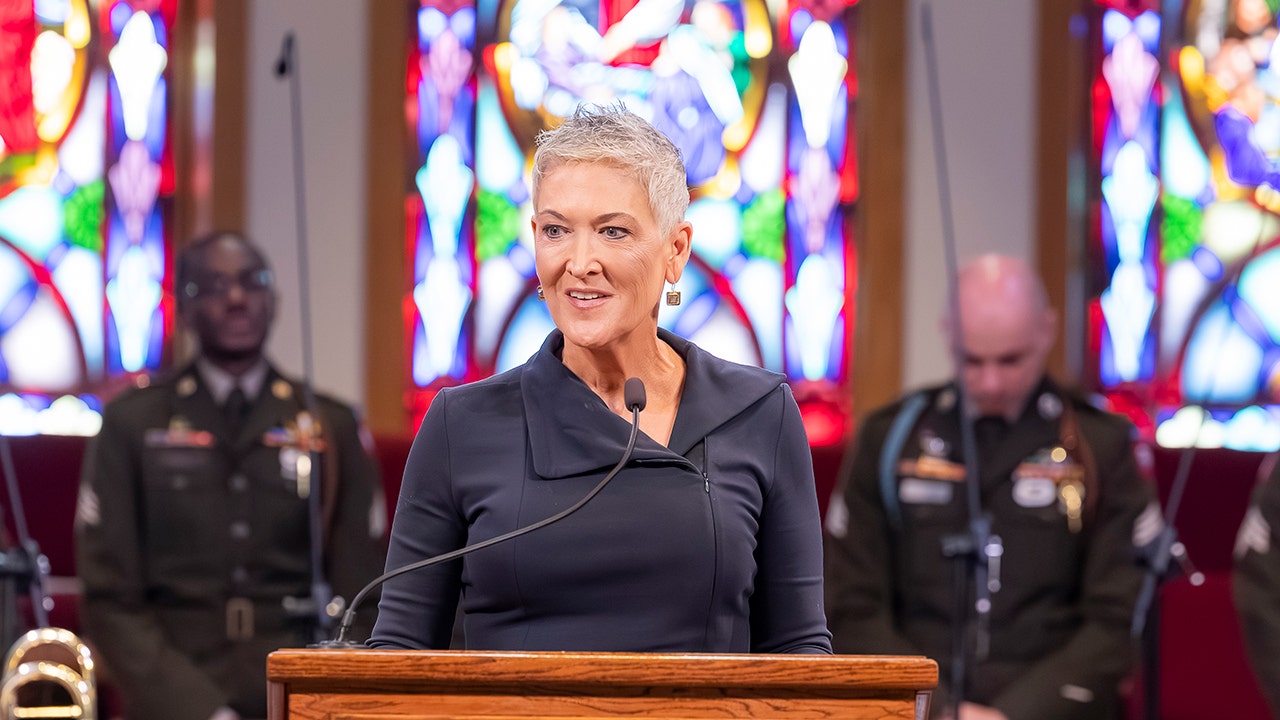
Fox News' Chief National Security Correspondent Jennifer Griffin speaks at the funeral of retired Army Sgt. Michael Verardo on September 2, 2025, at Weddington Methodist Church in North Carolina. (Courtesy of Morgan Amanda Photography)
Fox is family, and as we look back over these past 30 years, I am proud to work at a place where many of those who started when the network was launched are still putting the news on the air each day. I have had the same voices in my ear since those early days.
I have had wonderful producers — Liz Friden, Lucas Tomlinson, Serafin Gomez, Justin Fishel, Yonat Friling and Yael Kuriel, to name a few — who became close friends.
CLICK HERE TO DOWNLOAD THE FOX NEWS APP
When I had breast cancer 17 years ago, shortly after my son was born, colleagues and those who run the company in New York contributed to a meal train delivered to my home while I went through chemo.
I will never forget their kindness, and I will always be grateful for being given a front-row seat to witness history.
CLICK HERE FOR MORE FROM JENNIFER GRIFFIN
Jennifer Griffin currently serves as a national security correspondent for FOX News Channel (FNC) and is based out of the Washington D.C. bureau. She joined the network in October 1999 as a Jerusalem-based correspondent.