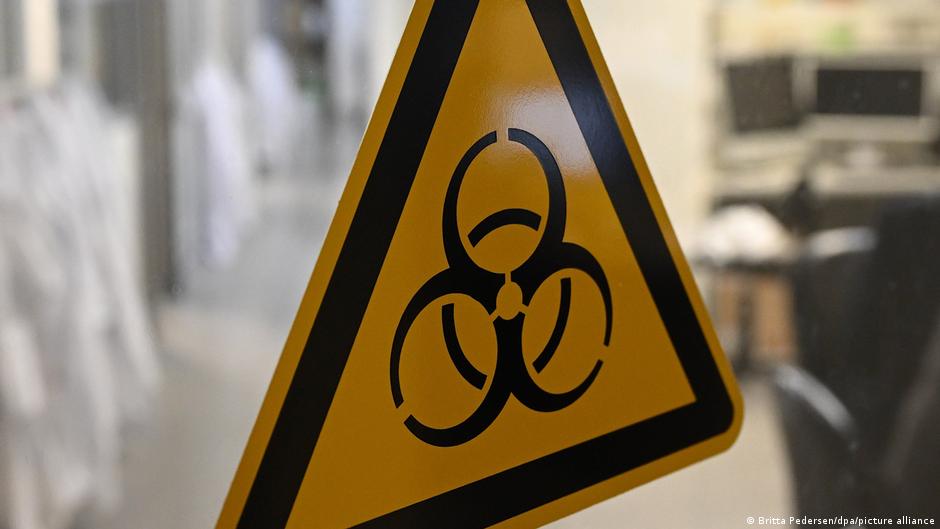
A worker at a plague research institute in Siberia has died, and nearly 200 of her contacts are under medical observation. Russian authorities deny a link to the bacterial infection. The US is monitoring the situation.
https://p.dw.com/p/5Nm2xImage: Britta Pedersen/dpa/picture allianceAdvertisementWhat you need to know about plague There are three forms of plague, all caused by the bacterium Yersinia pestis. The three forms of plague are bubonic, septicemic and pneumonic. Bubonic plague is the most common form, it does not spread from person to person. If untreated, the bacteria can move through the body and bloodstream, causing septicemic plague, which causes internal bleeding and organ failure. If the the bacteria reach the lungs, they cause pneumonic plague. Pneumonic plague is highly contagious as it can pass from person to person through the air, via coughing, for example. If untreated, bubonic plague kills between 30-60% of patients. The septicemic and pneumonic forms are always fatal without treatment. Speculation over the death in a Russian plague laboratory Following the death of a Russian laboratory worker, there is speculation about an outbreak of pneumonic plague, a highly contagious bacterial infection of the lungs. Russia denies there is a broader risk to the community.
Russian officials have said the laboratory worker's death was not caused by a plague pathogen. The 28-year-old died of "pneumonia of unknown origin," according to Russia's Interfax news agency, citing Rospotrebnadzor, Russia's disease-control agency. According to that agency, samples taken from the woman showed no microorganisms "related to her professional activities." This contradicts earlier information.
Local media had previously reported that the woman, who worked at an institute dedicated to fighting plague, had dropped a test tube.
She reportedly died on Friday, October 2, 2026, at the district hospital in Shelekhov, a town near Irkutsk in Siberia.
According to official Russian figures, two hospitals and a children's clinic were placed under quarantine. Local reports said staff at the institute were being quarantined at their workplace. The US news site Axios has reported that around 200 people who had been in contact with the woman had been placed under observation. There were no further reported infections.
Even so, distrust of how Russia handles information persists. On one of DW's Russian-language social media channels, a user wrote: "It wouldn't surprise me if this turns into a disaster now, both in terms of the spread and the quarantine measures."
All that is known for certain, at time of writing and first publication (October 5, 2026), is that pneumonic plague is highly contagious.
Pneumonic plague is a form of plague that infects the lungs. Like every form of the disease, it is caused by Yersinia pestis, a bacterium usually found in small mammals, such as rodents and in the fleas that feed on them.
The World Health Organization describes the pneumonic form as the most virulent type of plague.
Its incubation period can be as short as 24 hours, and it is the only form that passes easily from person to person through respiratory particles released when a sick patient coughs. This is why, according to the WHO, it can trigger severe epidemics.
Symptoms appear quickly: high fever, headache and weakness, followed by a rapidly worsening pneumonia with shortness of breath, chest pain and a cough that often brings up blood.
A person can catch pneumonic plague by breathing in the bacteria directly, or by developing it when bubonic and/or septicemic plague go untreated and spread to the lungs.
Pneumonic plague is not a separate disease. It is one of three forms of plague: bubonic, septicemic and pneumonic.
What sets them apart is where the infection settles in the body, and that shapes how the disease spreads and how deadly it is.
Bubonic plague is the most common form and the one most people think of when they hear the word "plague." It usually follows a flea bite. The bacteria travel to the nearest lymph node, which swells into a painful lump known as a bubo. According to the WHO, it rarely spreads between people.
If bubonic plague goes untreated, the bacteria can move further through the body. If they spread into the bloodstream, the disease can become septicemic plague, which causes bleeding under the skin, tissue death in the fingers and toes, and organ failure. If the bacteria reach the lungs, the illness becomes pneumonic plague, the form that can pass from person to person through the air. Both septicemic and pneumonic plague can also develop directly, without a bubo appearing first.
Left untreated, bubonic plague kills between 30-60% of patients. The septicemic and pneumonic forms are always fatal without treatment.
Pneumonic plague is curable, but only if treatment starts quickly. The WHO warns that without treatment it can kill within 18 to 24 hours of the first symptoms.
Common antibiotics can cure the infection, and recovery rates are high when patients are treated within about a day of falling ill.
Speed is what decides the outcome. Doctors are advised not to wait for laboratory confirmation and to start antibiotics as soon as plague is suspected, according to the US Centers for Disease Control and Prevention (CDC).
The drugs themselves are not rare or specialized. They are standard, widely used antibiotics, and patients usually need a course of up to two weeks. To stop the infection spreading, patients are kept in isolation, and wearing masks helps protect those around them, the WHO says.
People close to a patient are treated as well, even if they have no symptoms. Both the WHO and the CDC recommend a seven-day course of preventive antibiotics for close contacts of anyone with pneumonic plague.
The WHO does not recommend a plague vaccine for the public. It reserves vaccination for high-risk groups, such as laboratory staff who work with the bacterium and health workers.