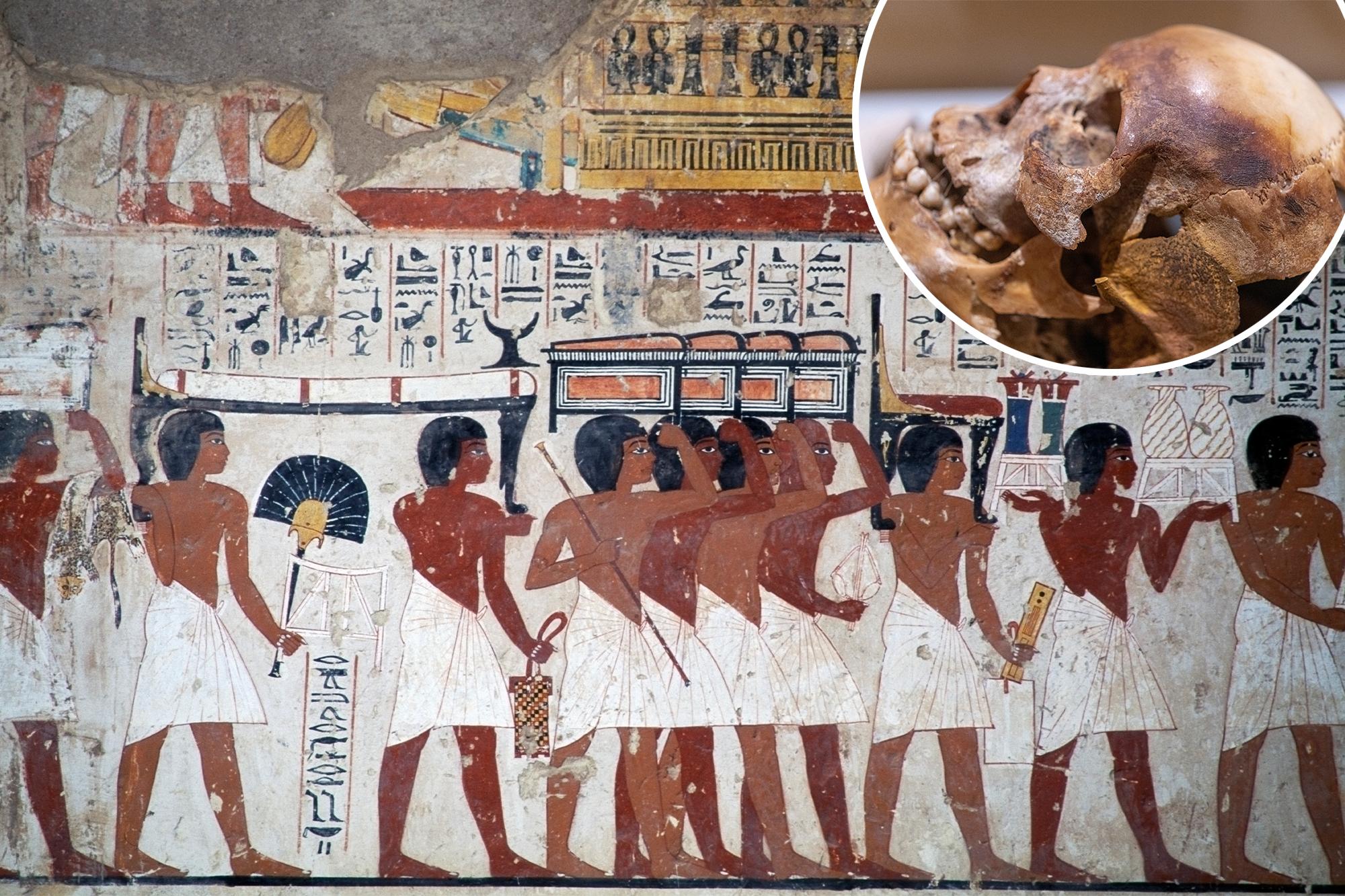
Make New York Post a Preferred Source A fresco depicting a funeral procession is seen in the Tomb of Ramose in the Theban Necropolis, Egypt, on Feb. 14. De Agostini via Getty Images They literally followed their leader into hell.
The idea of servants being sacrificed to honor Egyptian leaders is no old wives’ tale. A forensic analysis of 5,000-year-old skulls suggests that royal retainers were killed so they could follow the pharaoh into the afterlife, per a macabre study in Frontiers in Environmental Archaeology.
“Some retainers might have volunteered to die to achieve eternal life or honor; others may have been chosen or even forced,” the study’s lead author Dr. Roselyn Campbell, an Egyptologist at Purdue University in Alabama, wrote in a statement.
A stone relief depicting Queen Kawit at her toilet, from the sarcophagus of Queen Kawit, dating to the Middle Kingdom, c.2061-2010 BC, is housed at the Egyptian National Museum in Cairo, Egypt. Art Images via Getty Images She and her team were building upon research by British archaeologist Flinders Petrie, who had discovered a complex of Pharaohs’ tombs and secondary graves in Abydos in Eastern Egypt, Popular Science reported.
These sprawling burial chambers date back to the First Dynasty between 3150 BC and 2890 BC, which marked the first time Egypt became unified under a centralized monarchy.
Many of the satellite graves were marked with names and official titles, denoting that they were occupied by lower- or mid-level officials, or artisans.
Based on the sheer numbers of burials, Petrie postulated that they were victims of ritual sacrifice — a possibility that intrigued Campbell.
“Retainer sacrifice is a type of human sacrifice where those close to a ruler are killed when the ruler dies,” she explained. “In many cultures, retainer sacrifice is practiced because of beliefs that the sacrificed individuals will continue to serve the ruler in some kind of afterlife, but retainer sacrifice can also be a visceral display of the ruler’s power.”
The skull of Nakht, a young working man from ancient Egypt, is seen in the “Egyptian Mummies: Ancient Lives. New Discoveries” exhibit at the Royal Ontario Museum in Toronto, Ontario, Canada, on Thursday, August 20, 2020. LightRocket via Getty Images While many retainers volunteered, others were slain and interred against their will, making for a helluva retirement plan.
Unfortunately, there wasn’t any evidence to support this mass sacrifice hypothesis — until now. Thankfully, Campbell and her team were finally able to crack this ancient cold case file thanks to the dozens of skulls that were excavated from the repository and stored at Cambridge University.
By examining these ancient crania using modern forensic techniques, Campbell discovered that 18 of the 46 noggins bore signs of blunt force trauma that Petrie had initially chalked up to natural causes.
“The injuries on the preserved crania are generally linear fractures, which would likely cause rapid unconsciousness, internal bleeding, and death,” she wrote, noting a chopping injury to one of the victims’ eyes.
These mortal wounds suggested the royal retinue was killed with a sharp object of sorts, although the exact type of weapon remains unclear.
While ancient paintings depicted Pharaohs dispatching enemies with maces, these melee weapons would’ve caused blunt fractures and not the linear wounds seen on the skulls.
It is also possible that the victims’ tickets to the afterlife were punched via asphyxiation or other methods not visible on a skeleton.
Unfortunately, Petrie reburied many of the bodies he had initially dug up, negating the possibility of an ancient autopsy.
“If I had unlimited resources, I would love to figure out where the bodies of these individuals might be and analyze them!” said Campbell.
The expert also wanted to shed light on who the subordinates were and how they viewed “the ruler and their own role in his or her life and death.”