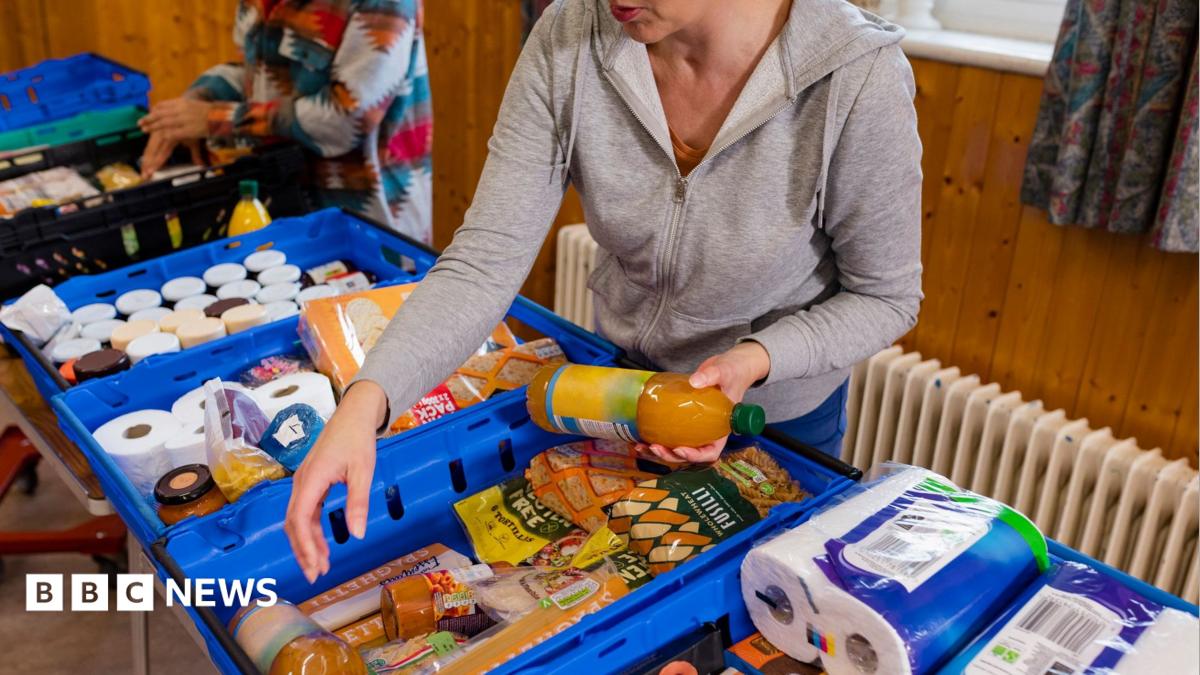
Image source, Getty ImagesByJames CookScotland editorPublished2 hours agoScotland is on course to miss legally-binding targets to cut child poverty "by a wide margin", according to a report from a leading social reform charity.
The Joseph Rowntree Foundation (JRF) said one in five children was in poverty and "radical change" was needed to put the Scottish government's pledges back on track.
It urged ministers to craft a "much bolder and properly-funded plan to reduce poverty" by rewiring local government, public services and the tax system.
The Scottish government said it had made great strides, with its policies keeping 100,000 children out of poverty this year, but accepted there was more to do.
In 2017, MSPs passed a law requiring ministers to hit four targets, external, including pushing the share of children in relative poverty below 10% by 2030.
But the JRF's Poverty in Scotland report, external found the figure remained stubbornly high, averaging 21% from 2022 to 2025. The UK average is 28%.
Relative poverty means a household has disposable income after housing costs below 60% of the UK median, adjusted for family size and composition.
Overall, the report concluded, 940,000 people in Scotland were in relative poverty – 17% of the population.
Reasons for the failure were "complex", it said, but could include UK government austerity, a cost of living crisis, and "a dysfunctional relationship between local and national government in Scotland."
Scotland's Social Justice and Housing Secretary, Shirley-Anne Somerville, is currently overseeing a review of the poverty reduction goals after some interim targets were missed and data collection was adjusted, complicating the ability to assess progress.
The targets are based on annual figures which can be volatile but JRF and the Scottish government agree that three-year averages are more useful, external.
The JRF urged Somerville not to weaken the goals but to set "stretching, statutory, income-based poverty-reduction targets, with strong accountability measures".
From day one in the job, the issue has been at the heart of John Swinney's personal political project.
"My overriding priority will be to work to eradicate child poverty in Scotland," he told me in his first interview as first minister, minutes after being sworn in at the Court of Session in Edinburgh in 2024.
In his successful campaign to retain power at this year's Holyrood election, the Scottish National Party leader repeated his "determination to eradicate child poverty."
But the JRF says there is now an "increasing disconnect" between such rhetoric and "the reality of life for families in poverty across Scotland."
Its report said relative poverty rates were highest – at 47% – for children in ethnic minority families.
It added that 11% of Scotland's overall population was defined as being in deep poverty and 7% in very deep poverty.
In a statement issued in advance of the report's publication, Shirley-Anne Somerville said the Scottish child payment was "providing unparalleled financial support to the families of over 320,000 children."
The Scottish government would do more, she said, by expanding breakfast clubs for children and investing more than £40m in improving access to transport and skills for parents.
"Overall in 2026-27 we are committing around £3.5bn to policies that tackle poverty and the cost of living," she added.
The JRF report suggests the following policies can help to reduce poverty.
Create flexible, well-paid jobs, especially in parts of Scotland where people cannot find work within easy reach of their homes
Expand access to high-quality, affordable childcare with the flexibility to allow parents in low-income families to work
Ensure adequate levels of social security payments, especially for people with disabilities who may have to fund their own care
Maintain and improve provision of social and affordable housing, which has helped Scotland keep its poverty rate below the UK average
Image source, PA MediaImage caption, The Scottish government has a legal target to reduce the rate of child poverty below 18% by the end of the financial year
The report focused on the "critical role" of Scotland's 32 councils in reducing poverty, noting that local government is in the early stages of a big shake up.
"Councils are not doing enough," it concludes, "with people on low incomes and living in more deprived areas reporting worse experiences of services and higher levels of disaffection."
The report urges Swinney's government to embrace the opportunity to craft "refitted" councils which can play a fuller role in poverty reduction, in partnership with the third sector.
This, it says, requires reform not just of local government's structure but of its funding, including the "regressive" council tax which "takes up a much larger proportion of low-income households' budgets than better-off households'."
Funding of councils, says the JRF, is "stretched to breaking point", with the current model "increasingly unfit for purpose" and "hampering local efforts to reduce poverty".
"Years of austerity, shifting goalposts from the Scottish government, single-year budgets and an ever-blooming number of strategies and action plans mean councils are often acting with one hand tied behind their back," says the report.
In her statement, Somerville said tackling poverty was at the heart of the Scottish government's plans for public service reform including tailoring services for individual needs in an approach known as "whole-family support".
"The time to go further is now," she said. "That means changing how services work together, ensuring they are joined up and designed around need, so that families can get the right support, at the right time and in the right place."
The JRF describes the current roll-out and funding for whole-family support as "wholly inadequate."
In a statement, Cosla, which represents local authorities, said its members took the report seriously and would do everything possible to cut poverty.
But its resources spokesperson, Kelly Parry, said councils were being constrained by funding shortages and rising demand for services.
Opinion polling conducted by the Diffley Partnership for the JRF suggests that two thirds of people think their council is underfunded, with just 4% saying the opposite.
It also indicates that people significantly underestimate the 61% share of local government funding which comes directly from the Scottish government. Council tax, by contrast, accounts for just 17%.
The pollster surveyed 3,381 adults in Scotland between 22 and 26 June.
"Councils are ready to be held accountable for the contribution we make," added Parry.
"But responsibility must be matched by the powers, fair and flexible multi-year funding, and genuine partnership needed to deliver lasting change."
'Ending child poverty remains complex issue for Swinney'
Scotland's struggle to tackle poverty while cutting services