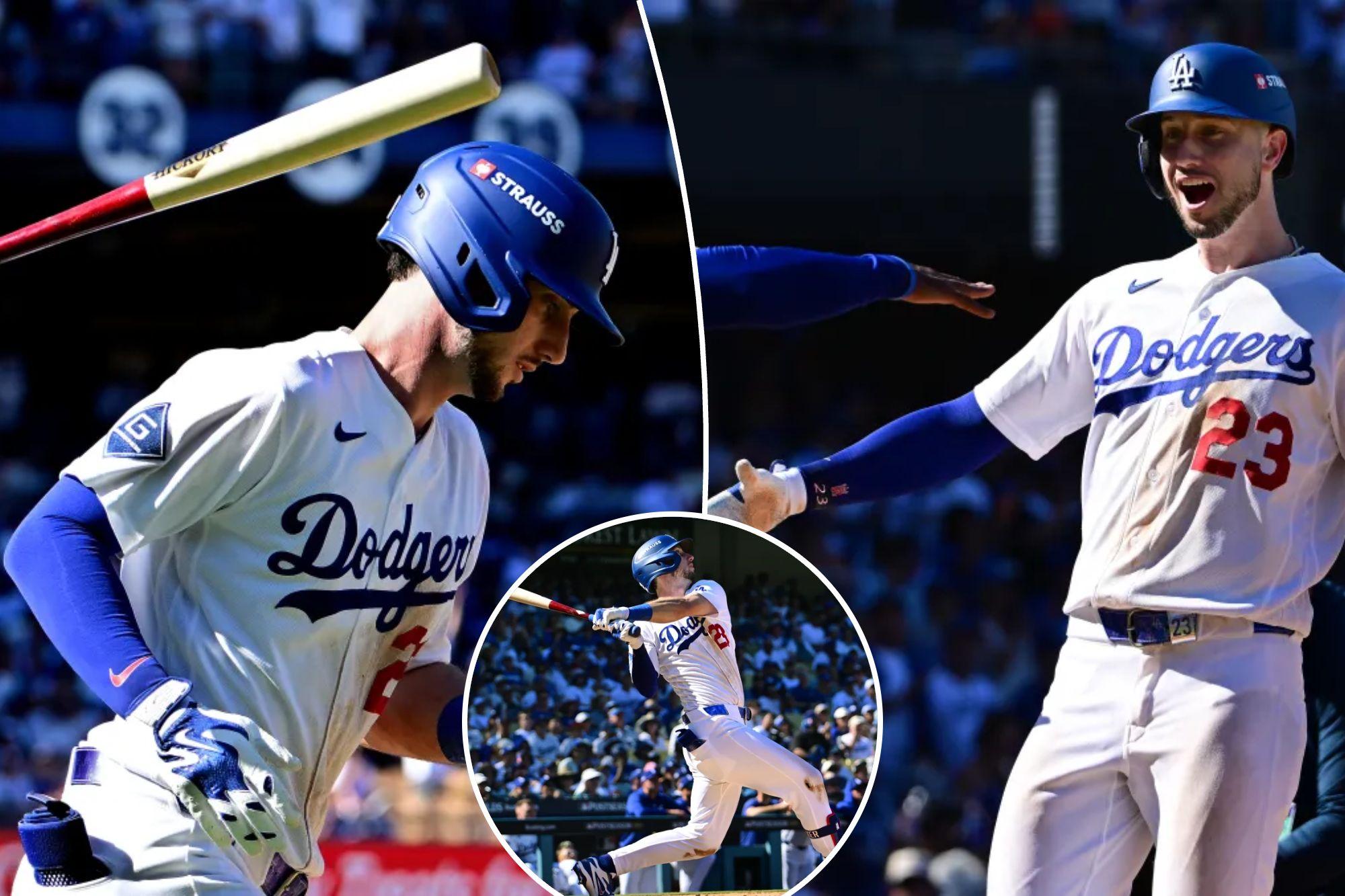
Make California Post a Preferred Source Kyle Tucker started the season as the Dodgers’ No. 2 hitter.
There’s a chance he ends it batting in that spot.
That probably won’t happen over the remainder of the National League Division Series against the Braves. But making the $240 million disappointment a focal part of the offense will be something the Dodgers might have to eventually consider, especially if their two best left-handed hitters prove to be physically compromised.
Shohei Ohtani isn’t expected to be close to full strength in these playoffs because of discomfort in his right arm and left knee. Freddie Freeman is dealing with a right knee problem.
Ohtani batted second for the Dodgers in the first two games of the NLDS, and Freeman batted cleanup. Each of them collected a single on Saturday in their 5-3 win in Game 1, with Freeman also drawing a key fourth-inning walk that set up a two-run home run by Teoscar Hernandez.
Manager Dave Roberts isn’t about to drop Ohtani or Freeman in the order. The more games the Dodgers play, however, the more Ohtani’s and Freeman’s bodies could feel it, and that could require Roberts to rethink whether Tucker should continue batting in the bottom half of the lineup.
Batting sixth, Tucker was 2 for 4 with a two-run home run that was ultimately the difference for the Dodgers in Game 1, but the idea of him taking a more prominent role in the offense shouldn’t be viewed as an overreaction to an isolated incident.
This was the version of Tucker who quietly emerged over the second half of September as the Dodgers cruised into the postseason.
Over his final 17 regular-season games, Tucker batted .333 with five home runs and 11 RBIs. He registered an OPS of 1.072.
Tucker had a number of teases over a grueling regular season, showing flashes of the hitter he used to be, only to immediately revert back to his season-long slump. Statistically, he finished with his worst regular-season numbers since becoming a full-time player, as he batted .233 with 17 home runs and 70 RBIs.
Because they had a bye in the wild-card round, the Dodgers had a five-day break between their regular-season finale in San Francisco and their opening game of the NLDS. Considering how many stop-and-gos Tucker experienced in the regular season, the fact he was able to maintain his form over five days of inactivity was a promising sign.
“Everyone stayed ready,” Tucker said. “Just did some intrasquads and live BPs, just practice in general. Everyone was prepared for what we needed to do once these games started. They’ve been doing it for a while now. Everyone kind of has an idea of what they need to do once these games roll around.”
Tucker wasn’t the same after breaking his right hand while playing for the Cubs last year, and Dodgers coaches think they have unlocked something to offset the physical changes that he might have undergone then. If they did, they might have found a luxurious insurance policy for Ohtani and Freeman.
Given where Ohtani and Freeman are physically, Tucker could be positioned to provide something they might not be able to: power.
The Dodgers are generally a home run-dependent team, and the low-scoring environment of the postseason will make them even more so. To that point, every run they scored in Game 1 was scored via the home run.
Regardless of whether Tucker moves up in the order or just adds length to the lineup, the Dodgers will be delighted if he continues to hit — delighted for not only the team but also for Tucker individually.
“I think we all know the struggles he had this year,” Roberts said. “I give him a lot of credit for grinding through it, not running from it, always posting and kind of getting to the other side of it.”
He might now be ready to deliver for the Dodgers when they need it most.