Make New York Post a Preferred Source Pressure is building on Gov. Kathy Hochul to call the state legislature into emergency session to close a key legal loophole that favors accused rapists such as the “Cornell 7.’’
The so-called “voluntary intoxication loophole” refers to how current New York law does not allegedly adequately protect rape victims who chose to drink or get high before they were attacked, even if they were too incapacitated to consent to sex.
A bill to tighten the law has been circulating since 2018 but has not passed the Democratic-run state assembly.
“If the governor were sincere in supporting victims, she could call the legislature back into session today,” fumed Gary Greenberg, CEO of ProtectNYKids Inc., to The Post.
“This is a travesty that could’ve been prevented, and now with the public uproar and an election coming up in five weeks, New York state politicians are scrambling like they support victims. Shameful.”
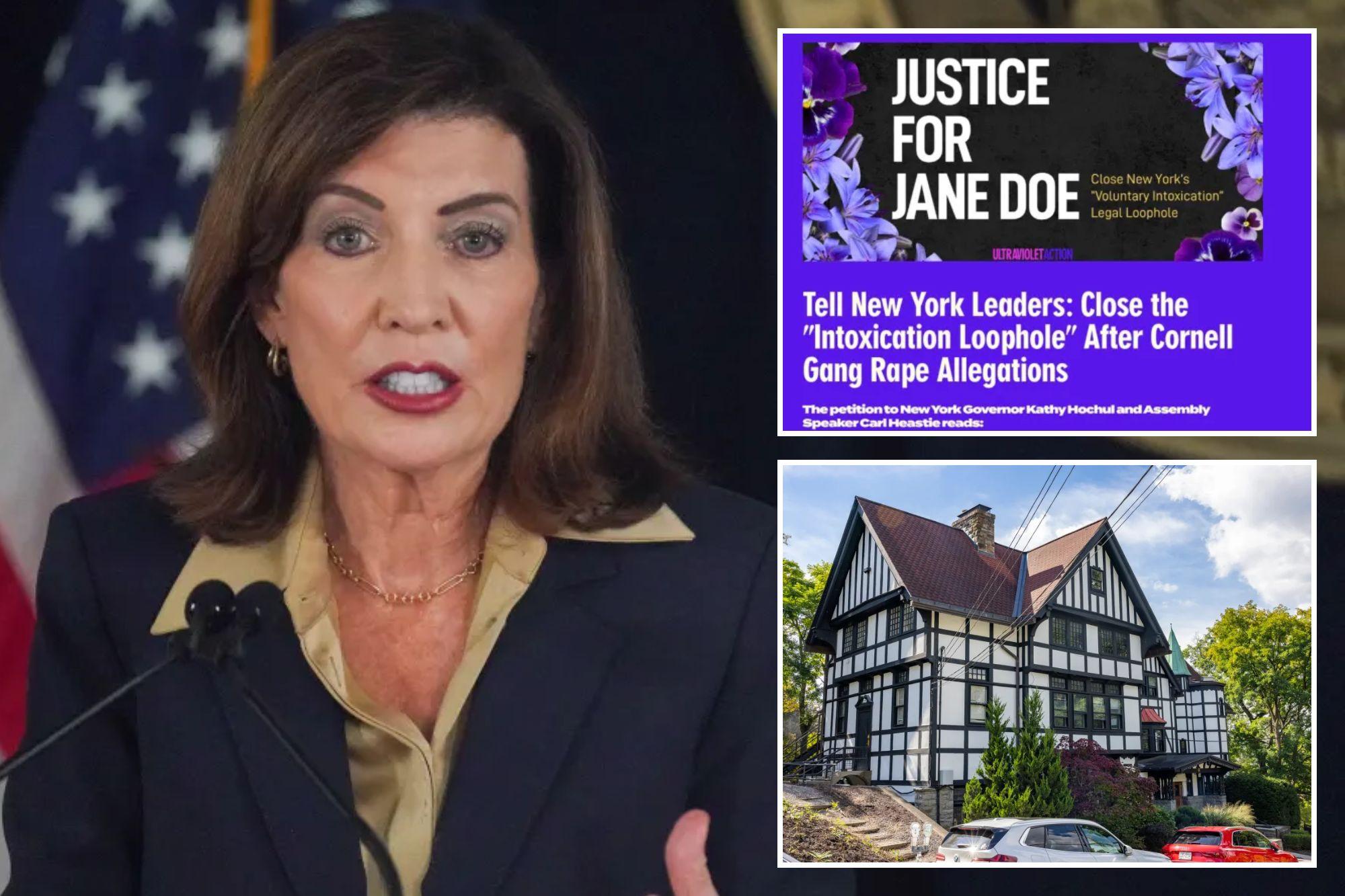
The women’s rights group ULTRAVIOLETACTION is circulating a petition destined for Hochul and state Assembly Speaker Carl Heastie (D-Bronx) demanding that the gov call lawmakers back into session now to fix the rape law.
“Let us be clear: there is no valid consent when someone is intoxicated,’’ the petition says.
“New York state law, as it is today, in essence, lays the blame and shame on survivors and lets perpetrators off the hook, which is completely unacceptable.
“We count on you, Governor Hochul and Speaker Heastie, to correct this injustice and call for an extraordinary session of the New York State Assembly to pass Assembly Bill A101, which would close the voluntary intoxication exclusion and bring Jane Doe closer to the justice she deserves.”
The pressure campaign comes amid fury surrounding seven male Cornell University fraternity brothers accused in a recent civil case alleging the 2024 gang-rape of a drugged-up female student, only referred to in court papers as Jane Doe.
The young men have not been criminally charged thanks to what the woman’s lawyer and critics call a comedy of errors involving campus police, the upstate Tompkins County prosecutor and the prestigious Ivy League school.
Matthew Van Houten, Tompkins’ embattled DA, acknowledged the state’s legal loophole in a lengthy statement last week when explaining why he did not bring charges against the men in 2024. He announced last week that he would reopen a probe into the woman’s accusations.
Greenberg said Hochul, a Democrat running for re-election to a second term Nov. 3, has failed to show the leadership needed to persuade fellow Democrats in the state Assembly to close the loophole.
The Democratic-led state senate has passed the bill numerous times, only to be blocked in the assembly.
“Hochul has been asked to close the loophole since she became governor, and she refused to do it,” Greenberg said of the gov — who first rose to the highest office in the state when Gov. Andrew Cuomo was forced to resign over sex-harass allegations, which he continues to deny.
The advocate also called the Democratic-led assembly “pro-criminal socialists.”
Hochul’s office, when asked for comment by The Post on Sunday, declined to say anything except to note the governor Friday urged Albany lawmakers to close the loophole, although she balked at the notion of calling an emergency session for it.
The legislature adjourned its Albany session for the year in June.
“Here in New York, we’ll work with the legislature. The timing will be resolved, but at minimum, I would say this is something we could easily take up early in the session,” Hochul said Friday, referring to the regular 2027 legislative session.
“There’s legislation that has passed one of the houses. We can take a look at that, talk to the sponsors, but find out, in light of what we’ve learned: Are there any other glaring deficiencies in state law?”
Lacking confidence in Van Houten, Hochul also has appointed state Attorney General Letitia James to review the Cornell case for potential prosecution.
Heastie meanwhile last week announced the formation of a special “working group” to consider legislation in reaction to the “truly horrifying” Cornell case.
Unlike New York, 25 states — from conservative Texas to liberal California — as well as Washington, DC, have laws in place that protect the accuser if their ability to consent to sex was compromised even by voluntary intoxication.
Nineteen states, including New York, have rape or sexual-assault laws that consider intoxicated victims to be mentally incapacitated — but only if they became drunk or drugged without their knowledge or consent.
Start your day with all you need to know Morning Report delivers the latest news, videos, photos and more.
Opposition to closing New York’s loophole has come from criminal defense lawyers who believe the bill under consideration is “simply too vague to be fairly enforced” and “fails to provide” objective guidance as to when a partner is “too intoxicated to legally agree to engage in sexual conduct,” said the NYS Association of Criminal Defense Lawyers in a recent statement to the Washington Post.
But state Assemblyman Jeffrey Dinowitz (D-Bronx), who sponsored the proposed legislation in the lower house to close the voluntary intoxication loophole, said he’s been hearing from more lawmakers now willing to support his bill since the wrenching Cornell scandal has gone public.
The state’s legislative leaders have a dual responsibility in the Cornell case.
Aside from their governmental duties, Hochul, Senate Majority Leader Andrea Stewart-Cousins (D-Yonkers) and Heastie are ex-officio members of Cornell’s Board of Trustees.
Cornell is not just an elite Ivy League institution.
It operates four different SUNY, or public, state colleges dealing with agriculture, labor relations, veterinary medicine and ecology and gets about $200 million in state funding per year.
Hochul did call the legislature into an emergency session in June of 2022 to pass gun safety laws responding to a US Supreme Court ruling that concluded New York’s conceal-and-carry restrictions violated the 2nd Amendment.