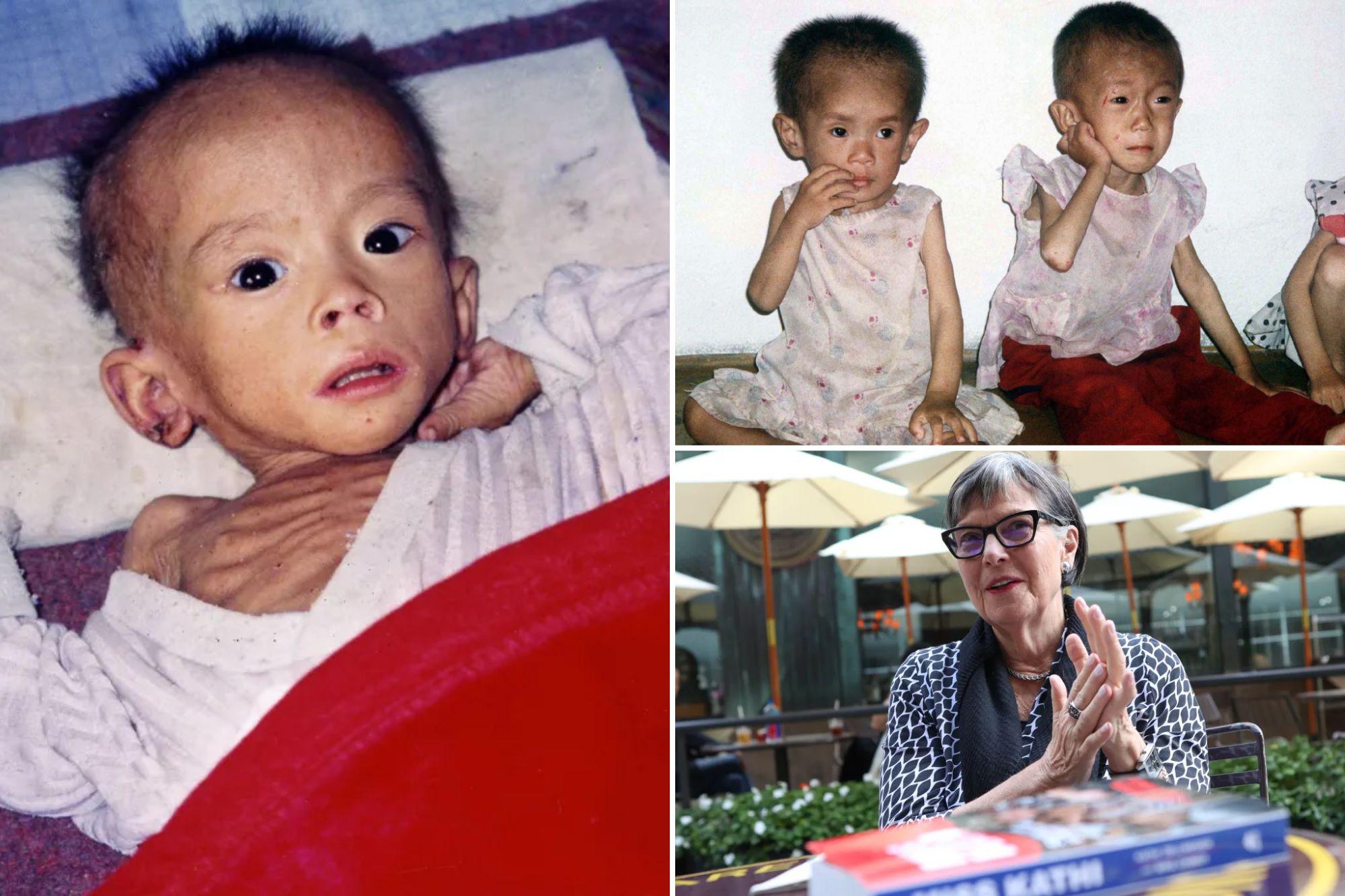
Make New York Post a Preferred Source Harrowing images from inside North Korea revealed the abject poverty and widespread starvation that hit the Hermit Kingdom during the 1990s famine — including children who wasted away quietly inside their homes.
The photos, captured by humanitarian Kathi Zellweger and journalist Mike Chinoy, included images of orphans so malnourished that their ribs were clearly visible and limbs were as scrawny as twigs.
“I used to call it a hidden famine because it wasn’t in the streets, people were suffering at home,” Zellweger told The Post.
The images stand as one of the world’s first looks into the famine that overtook North Korea following the breakup of the Soviet Union and collapse of Pyongyang’s communist Public Distribution System, which provided food rations across the nation.
Without help from their own government, the people were left to fend for themselves, Zellweger and Chinoy said in their new book, “Miss Kathi: Saving Lives in North Korea.”
The North Korea government has done its best to cover up the famine, claiming 225,000 people died. However, one USAID administrator estimated that the number could be as high as 3.5 million — 10 to 19% of the nation’s population at the time.
The famine hit North Korea’s most vulnerable population the hardest, with orphanages struggling to take care of the children without help from the government, which had been the sole source of food for many residents.
“In orphanages or children’s homes, they would say, ‘We don’t know what to do with these hungry children. We never had to deal with hungry children,'” Zellweger recalled.
“In these children’s homes, I would visit, at the same time you saw these starving children, I was always impressed how the staff there cared for them because they also had a difficult life themselves,” she said.
The book contains interviews with families that Zellweger met during her work, including one family who appeared to be well-off on the surface with several luxury goods at the time, including a cassette recorder playing the music of country music legend Kenny Rogers.
The family, however, was surviving off the last bit of rations they received through the Public Distribution system, with only rice and bean curd left from North Korea’s National Day.
The low supplies also meant the family had no baby food, with a mother in the family saying she would breastfeed her sick toddler as long as possible because she had nothing else to feed him.
“Is this the end of the Great Leader taking care of us?” the mother asked Zellweger at the time.
Zellweger was based in Pyongyang as the North Korea country director for the Swiss Agency for Development and Cooperation (SDC), an office of the Swiss Ministry of Foreign Affairs.
Zellweger, who made 75 humanitarian trips to North Korea, had unprecedented access to the region because of the trust she built with locals, Chinoy explained.
“Kathi talks about (how) you go to this place and you see these desperately hungry, emaciated kids, just not knowing whether they would be alive by the next time she visited, and that’s heartbreaking,” Chinoy added.
While journalists like him were largely kept in Pyongyang, where military parades and gleaming infrastructure would mask the severity of the famine — Zellweger got to see the real state of the country during its darkest time.
“The North Koreans kind of kept the famine and the worst scenes out of our reach,” Chinoy said. “But as a humanitarian aid worker, she was able to get to places we as journalists couldn’t get, and was able to bring back information which the North Koreans were uncomfortable about having the world see.”
That included images of children wasting away inside the country, with the situation getting so out of hand that Pyongyang had no choice but to accept international aid to avoid even more deaths.
The crisis was also exacerbated by floods that hit the country in the summer of 1995, with Zellweger seeing entire villages wiped off the map, leaving little evidence that life was ever there.
“Those pictures or images from those floods are horrible because I was there – there might be one picture in the book – whole villages were all gone, and I would only see the big kimchi pot still looking out of the sand,” she said.
“They had tidal waves and all that. It was mind-boggling. I mean, all the villages were just erased,” Zellweger added.
The humanitarian noted that North Korea has recovered since the days of the floods and famine, as evident by the “5 Ms” she saw during her later visits: “money, markets, mobiles, motor cars, and middle class.”
The new millennium brought an age of modernization to the Hermit Kingdom that challenges the stereotypical view of North Korea, Zellweger noted, but it also brought a bigger change that she saw during her last five years between 2006 and 2011.
“Later on, I added another M, and that is ‘mindsets,’ and that is particularly among the younger generation born during the famine or afterwards, because they hadn’t experienced depending on the government totally,” she said.
“They realized fairly soon that they had to fend for themselves and find a way to make ends meet.”