Make New York Post a Preferred Source From the moment American Airlines Flight 11 struck the North Tower of the World Trade Center, on Sept. 11, 2001, to the first US airstrikes in Afghanistan, on Oct. 7 — the official start of the allied War on Terror — 26 days elapsed. This was the immediate aftermath of 9/11.
Fresh off the “American Century,” having partied like it was 1999 and sailed through Y2K, the public now felt unprecedented vulnerability.
Widely mocked for his struggles with the English language, President George W. Bush rose to his moment. In a variety of communications settings — impromptu remarks and set speeches, solo and joint appearances — his oratory acknowledged our pain, lifted our spirits, mobilized us for war and reaffirmed our core values.
In the annals of the modern presidency, this was a performance for which Bush has never received appropriate recognition, either from contemporaries or the historical record.
“I didn’t want us,” the former president said in a recent appearance at the SMU center that bears his name in Dallas, Texas, “to lose our soul.”
Most memorable was the Bullhorn Statement, delivered amid the rubble of Ground Zero on Sept. 14, arm around firefighter Bob Beckwith.
“I can’t hear you,” a first responder shouted.
“I can hear you,” Bush replied to applause.
“The rest of the world hears you. And the people who knocked these buildings down will hear all of us soon!”
Bush was given to malapropisms — most notably “misunderestimated,” uttered during an Arkansas swing in the 2000 campaign, though never “strategery,” a non-word conceived for an SNL sketch in which Will Ferrell portrayed him — and his connection with the electorate was, until then, tenuous: the first president inaugurated since 1889 without having won the popular vote.
But the Bullhorn Moment showed Bush, a child of privilege, knew how to connect with ordinary people. A day earlier, he had abruptly left an Oval Office gaggle after a question about “where your heart is,” which the father of twin girls answered while choking back tears: “I don’t think about myself right now. I think about the families, the children. I am a loving guy, and I am also someone, however, who has got a job to do, and I intend to do it.”
The cracked voice conveyed not weakness but humanity, and the quick exit showed sound instincts for knowing when to stop speaking.
Bush’s only stumbles came in his first remarks, from the Emma T. Booker Elementary School in Sarasota, where he vowed “to hunt down and to find those folks who committed this act,” and in his Pentagon visit of Sept. 17. There the commander-in-chief, speaking about Osama bin Laden in a half-in-jest tone, ill-suited to the moment, recalled Old West posters reading “WANTED: DEAD OR ALIVE.”
Nearly everything else was pitch-perfect, starting with the primetime address the night of the attacks: “Today our nation saw evil, the very worst of human nature, and we responded with the best of America.” He pledged the US and its allies would “win the war against terrorism” and set forth the Bush Doctrine: “We will make no distinction between the terrorists who committed these acts and those who harbor them.”
In somber remarks at the National Cathedral on Sept. 14, the president praised the passengers aboard United Airlines Flight 93, “who defied their murderers and prevented the murder of others,” and warned: “This conflict was begun on the timing and terms of others. It will end in a way and at an hour of our choosing.”
And when Muslim Americans faced violence and discrimination, the president, appearing on Sept. 17 at the Islamic Center of Washington, once the Western Hemisphere’s largest mosque, summoned our better angels: “The face of terror is not the true faith of Islam … Moms who wear cover must not be intimidated in America. That’s not the America I know.”
In no other single appearance did Bush do more to ensure that we Americans did not “lose our soul.”
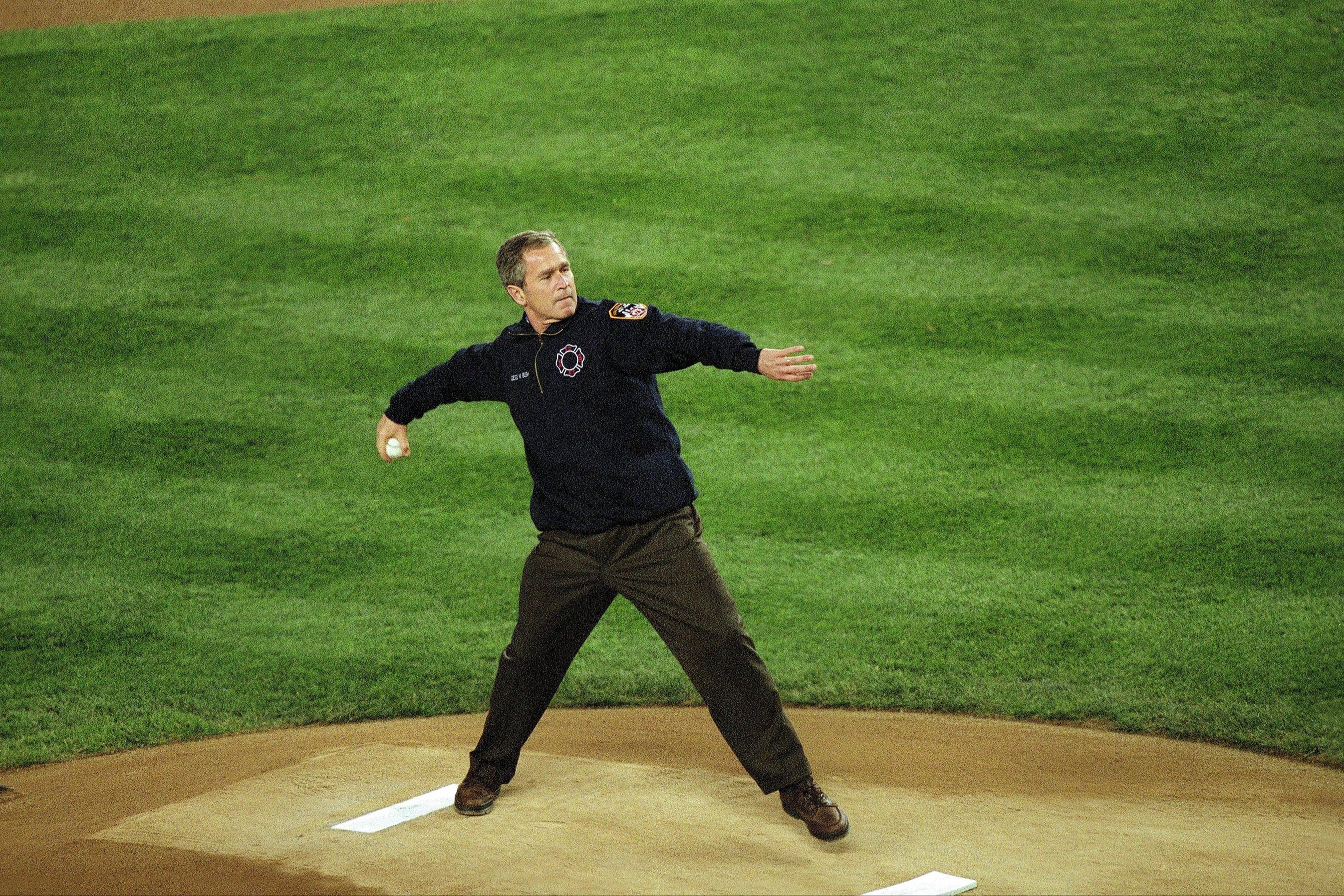
Bush even threw an actual perfect pitch: from the pitcher’s mound of Yankee Stadium, a strike to open Game Three of the World Series. That simple demonstration of athletic ability, of physical grace, spoke volumes.
As the Twin Towers collapsed, Vice President Dick Cheney managed the response from a White House bunker while Bush, advised against returning immediately to Washington, hopscotched the country aboard Air Force One. The two spoke frequently, though not every discussion they cited when they later testified before the 9/11 commission, jointly, could be matched to phone logs.
One duty Cheney knew not to assume, he told me in 2014, was responsibility for public communications, because he recognized that “the president needed to be … seen as he’s in command, he’s in charge, he’s the commander-in-chief.”
After ousting the Taliban from power in Afghanistan, the commander-in-chief, as urged by Cheney, chose to invade Iraq. History has condemned that decision as a mistake.
Yet it is undeniable that George W. Bush and Dick Cheney, maligned today by the titular head of the party they once led, together fashioned the national-security architecture that has served, in the quarter-century since Sept. 11, to prevent another mass-casualty attack on our homeland.
James Rosen is chief Washington correspondent at Newsmax and the author, most recently, of “Scalia: Supreme Court Years, 1986-2001.“