Make New York Post a Preferred Source We live in a time of dizzying change. Our society is polarized by warring political and cultural beliefs. Violence stalks our streets and even our schools. It feels like we are at the edge of a precipice.
One hundred and seventy years ago, San Francisco, the epicenter of today’s artificial-intelligence boom, was also spinning out of control. Less than a decade before, massive amounts of gold had been discovered in the foothills of the Sierra Nevada mountains. Almost instantly what had once been a tiny trading post beside a quiet cove had become a booming city of 50,000.
Twice a month a steamship departed for the East with a shipment of gold worth as much as $2 million (almost $80 million today). Fast-sailing clipper ships, their holds stuffed with the luxuries of life, continually came and went through the appropriately named Golden Gate.
“Money traveled fast and free,” a Californian remembered. “People became intoxicated with prosperity. They overbuilt, overbought, threw money around in a reckless manner, and indulged to excess in all the harmful things of life.”
And then, with no warning, the golden tide started to recede. The supply of precious metals leveled off as new technologies such as hydraulic mining — industrial-scale firehoses capable of sweeping away entire hillsides — enriched a handful of corporations instead of thousands of individual miners. Many former prospectors turned to wheat farming, which reduced imports of grain. Warehouses along the waterfront sat empty, and dockworkers lost their jobs. “The ripples of disaster spread wider and wider,” a San Franciscan remembered, “manifested by tenantless houses, declining wages and revenue.” The following year, banks started to fail. The California Gold Rush had come to a screeching halt.
In this terrifying new world of insecurity and doubt, a failed banker with the unusual name James King of William emerged as one of the San Francisco’s most widely read journalists. King cast himself as an indignant truth-teller in a city plagued by lawlessness and corruption.
“Look at your mayor, imbecile for any good, encouraging rogues and scoundrels by his leniency,” King thundered. King had a deep-seated hatred of the Catholic Church and foreigners in general. An Italian gambler named Charles Cora had recently shot and killed a US marshal. Cora’s first trial had ended in a hung jury (there was evidence of self-defense), but King was hopeful the next trial would have a different result. “Cora must be hung!” he wrote. “Nothing short of that will satisfy the claim of justice.”
Not all San Franciscans regarded King as an oracle. A rival newspaper published an anonymous letter suggesting King’s unusually positive coverage of the city’s Custom House was influenced by the fact that his brother Tom worked there. The thin-skinned King demanded to know who wrote the letter. When the newspaper’s publisher, James Casey, refused to reveal the author’s identity, King printed a story revealing Casey had once served time in a New York prison. Furious, Casey warned King that if the two of them ever crossed paths, he should be prepared to defend himself. In a city where many, if not most, male citizens were armed, this was no idle threat.
That evening, as King walked home from work, Casey emerged from behind a wagon, threw back his cloak and fired a revolver. King staggered into a nearby building with a bullet in the abdomen, and Casey surrendered to the police.
As doctors attended to King, angry crowds filled the streets, demanding vengeance. And on the third floor of a building on Sacramento Street, a group of businessmen met in secret to organize what would become known as the San Francisco Vigilance Committee of 1856.
From the start, the committee’s leaders insisted their purpose was the “purification” of San Francisco that James King of William had called for. It was time, they believed, to crack down on the city’s political boss, Irish Catholic David Broderick, and his legion of enforcers known as “shoulder-strikers.” But first they would have to attend to James Casey and Charles Cora, who were being held in the county jail. To do that, they needed an army capable of seizing control of San Francisco.
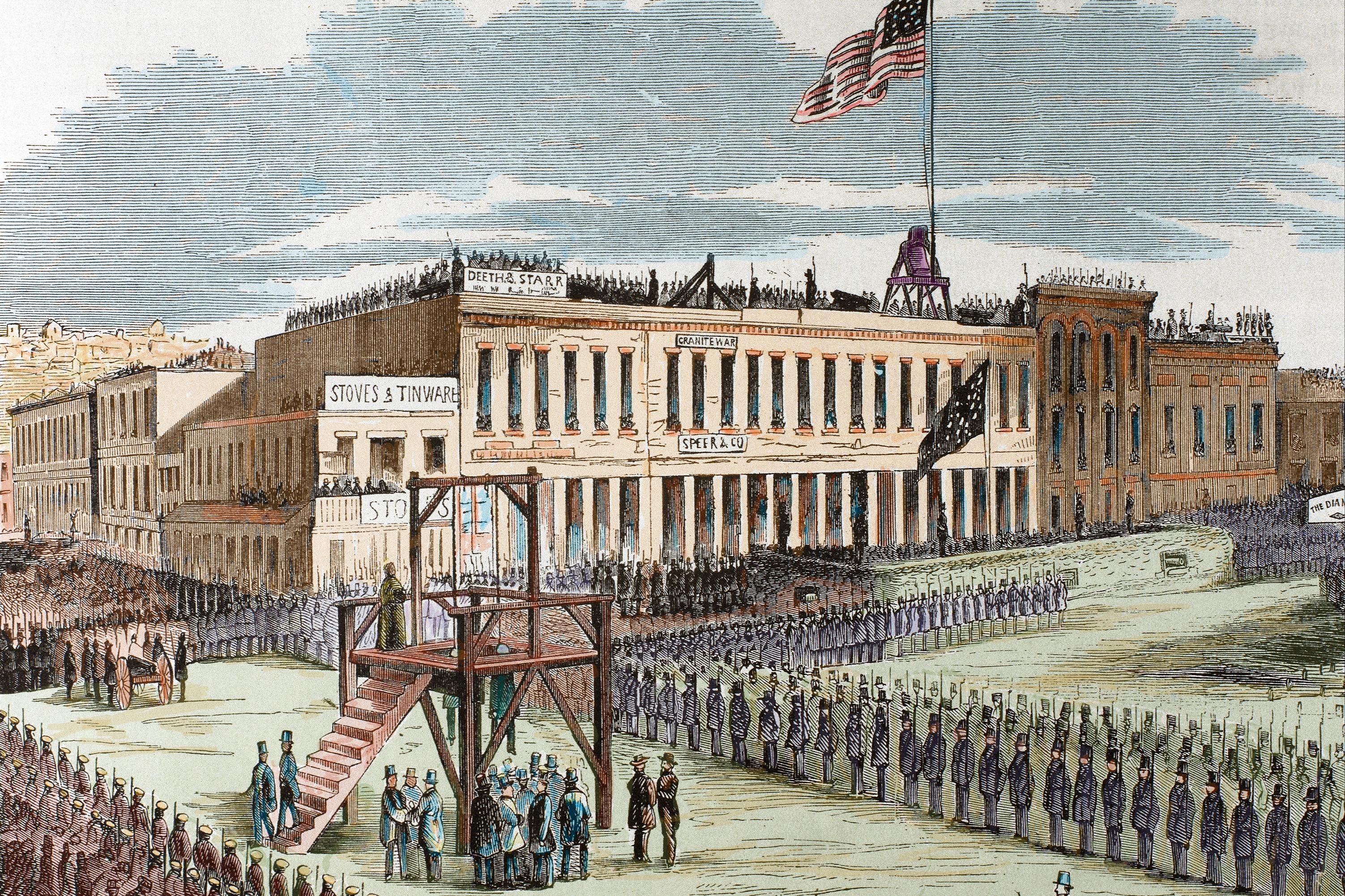
Just four days after Casey’s arrest, 5,000 vigilantes, many of them armed with muskets and rifles, began marching toward the jail. By the time they’d positioned a cannon in front of the building’s entrance, a vast crowd had gathered around the jail as thousands more watched from Telegraph Hill to the north. Watching helplessly from the roof of a nearby hotel were California Gov. J. Neely Johnson and the newly appointed commander of the state’s militia, a former army officer turned banker named William Tecumseh Sherman. Sherman didn’t know how he was going to do it, but he was determined to oppose what he called “an irresponsible organization claiming to be armed with absolute power.”
For the present moment, however, Sherman had no choice but to surrender Casey and Cora to the vigilantes. Four days later, by which time James King of William had died, Casey and Cora were hanged from beams projecting from the roof of the committee’s headquarters. Over the course of the next two months, two more men would be hanged while dozens of David Broderick’s supporters, most of them Irish Catholics, were placed under arrest and deported to the East Coast.
When the editor of the San Francisco Herald wrote that “we rest now beneath the shadow of a vast and ominous despotism,” all available copies of the paper were burned in a bonfire and advertisers were intimidated into moving their business to a more compliant paper.
And then, on June 21, a state Supreme Court justice named David Terry dared to interfere in an arrest on Jackson Street. Terry, a veteran of the war with Mexico, was known for his temper and soon found himself in a struggle with the committee’s police chief, Sterling Hopkins. In the midst of the melee, Terry pulled out a bowie knife and stabbed Hopkins in the neck. By the end of the day, Terry was confined to a cell in the committee’s headquarters.
The arrest of a Supreme Court justice proved to be the undoing of the Vigilance Committee. As one of its members said, “We started to hunt coyotes; but we’ve got a grizzly bear on our hands, and we don’t know what to do with him.” By early August, Terry had been released and the committee’s army disbanded.
By then, William Tecumseh Sherman had resigned as general of the state’s militia and returned to the bank that still stands in historic Jackson Square. In his memoirs, Sherman had little good to say about the Vigilance Committee: “As they controlled the press, they wrote their own history, and the world generally gives them the credit of having purged San Francisco of rowdies and roughs, but their success has given great stimulus to a dangerous principle, that would at any time justify the mob in seizing all power of the government; and who is to say that the Vigilance Committee may not be composed of the worst, instead of the best, elements of a community.”
Five years after he stood against the San Francisco Vigilance Committee, Sherman chose to oppose yet another attempt to overthrow a duly elected government, this time as a general in the Union army.
Nathaniel Philbrick is the author of “The Rush: California Gold, the Civil War, and the Making of the Modern World” (Viking, Oct. 6).