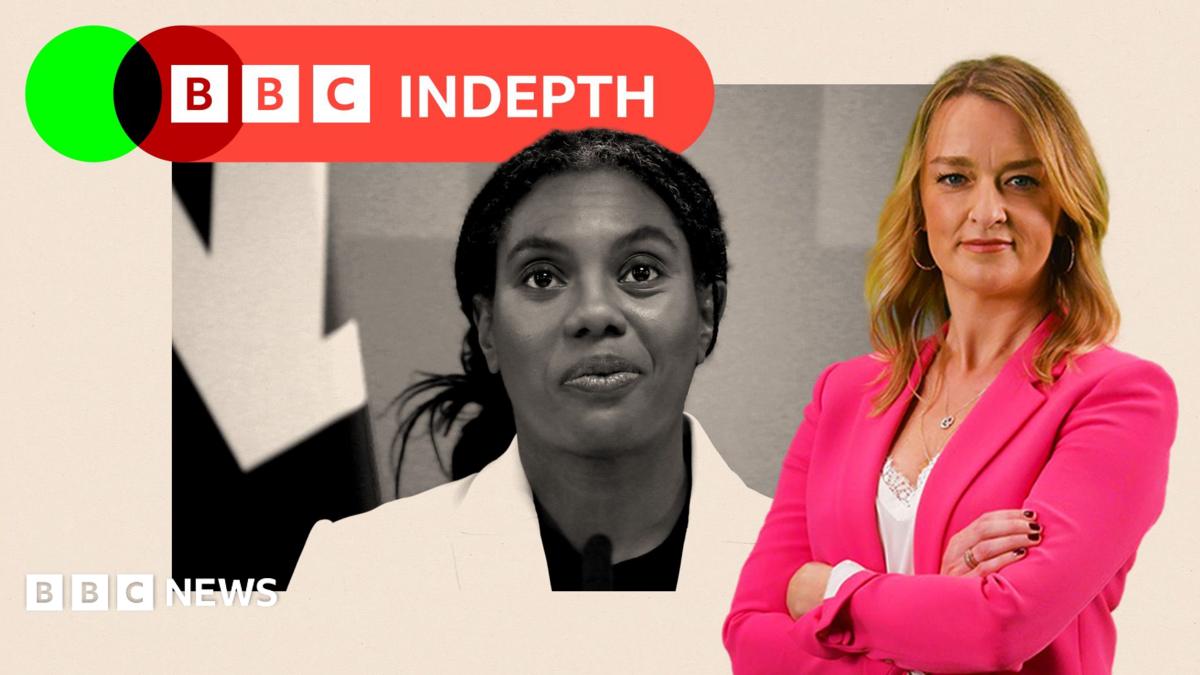
Kemi Badenoch has cemented her image. Now she wants to put her party back on the big stage
Image source, GettyByLaura KuenssbergSunday with Laura KeunssbergThe 2026 Conservative conference is big enough to justify using Birmingham's Symphony Hall as its main stage again.
So, Kemi Badenoch will tread the same stage ageing rockers Marillion took last month - and where sequinned soprano Katherine Jenkins will perform next week. She'll also avoid the humiliation of a national party leader being squashed into a side room at a corporate conference centre (with drapes portioning off the empty space). Simply, the party is able to put bums on seats again - and by that measure, things are looking up.
Badenoch goes into the conference with her own position secure in the party. One senior Tory says "she has actually defied cynics like me" who initially disapproved of her leadership. Her standing with the public has improved and she is now, again on a very simple but crucial measure, much better known. Her allies are sure she has developed a clear identity among the public, confiding: "People now know who she is and they enjoy her interventions - the thing we hear most is I don't always agree with her but I know where she stands."
Image source, PABut Conservative MPs are aware that the party itself still has a much bigger issue - in the words of one shadow cabinet member: "The problem we still have is trust of the party and the brand". The shadow of the years of chaos still looms. And while Badenoch has made good progress since she took the job, most of that was up against an unpopular prime minister, Sir Keir Starmer, on whom she landed plenty of political punches. She has to show "what being Conservative is now", says another senior Tory, taking on a different, more popular, rival in Andy Burnham.
The Tories' warm-up to conference has been so far, so traditional. A proposed dramatic expansion of prison places kicks off Badenoch's second big party get-together. With it, a message that echoes the well-known mantra of the early 1990s Tories, issued by former leader Michael Howard at party conference: "Prison works". They are not just talking about adding on a few cells here and there, but spelling out a monumental increase in the numbers of people that the country locks up.
Image source, PAThat follows the announcement of a new "tough love" approach for young people trying to claim benefits. Don't expect the shadow work and pensions secretary, Helen Whateley, to produce a moment as controversial as when the then-welfare secretary, Peter Lilley, proclaimed from the stage that he had "a little list" of benefit claimants he wanted to root out. But the Conservatives are determined to keep concentrating on the size of the welfare bill – believing it's right to do so for financial and moral reasons.
You can expect to hear more in the week about fundamental conservative principles: people keeping more of their own money, government only stepping in when really required to, pointed concern about the level of the country's debt and public spending. And again, of course, that means Kemi Badenoch disavowing much of what the Conservatives did in office between 2010 and 2024, when the civil service grew, the tax burden grew, a law was passed to try to combat climate change, the list goes on.
She'll set out at some length in the coming days what she sees as classic conservative first principles: the core beliefs the party was founded on and drifted from, she reckons, in the years gone by. If anything, Badenoch told interviewers this week the party was "finally saying what we believe" and "should be more aggressive" in displaying the party's core.
Image source, GettyImage caption, The frontbench at last year's Conservative conference
She believes the arrival of Andy Burnham makes that easier. There's a clearer contrast between the two. A senior ally of Badenoch says Burnham has "opened the door to it quite well, as he has harked back to the '70s in a way that I'm astonished by". Suggesting the pleasing atmospherics of Burnham's Labour are just that, atmospherics, the ally adds: "It's like a fairy story where he has come to the rescue of Britain and he has a wand in his hand and nothing else".
As we talked about a couple of weeks ago, the contrasts between Labour and the Conservatives are sharper now Burnham is in post, and the conference season is only serving to exaggerate that. They are both only too happy to emphasise it with their messages, retro or not, designed to show the true souls of their tribes.
Image source, GettyBut while Badenoch might find it easier to argue clearly with Burnham, rather than tangle with Starmer over process, it is harder to face an opponent who, at least for now, is proving more appealing to the public. And while plenty of Conservatives are hopeful in private that Reform might have peaked, they can't be sure that's true, or that the swathes of voters who abandoned the Tories for Farage's party will return.
Badenoch has always seemed allergic to the idea of doing any kind of deal with Reform, who she dismisses as a party of protest. And her allies hope, and some believe, that Reform's appeal will fade, making the Conservatives again the obvious alternative government. But fundamental arithmetic displays that, for as long as millions of voters on the right are tempted by Farage, it's harder for the Tories to triumph. One shadow minister admits "we've still got a whole battle on the right" even though "Kemi's boldness" is beginning to break through.
Image source, GettySo, in the coming next days, prepare for a "classic showing of Tory wares": an attempt by the party's leader to set out their fundamental beliefs about the country and how it should be governed.
There are pockets of nerves that Kemi Badenoch risks rewinding to an previous era. One when another newly confident leader, David Cameron, ushered in the modern Tory party on the conference stage in front of digitally produced green foliage and sunlight. One former cabinet minister warns that it's "the big risk – so easy to slip into an alienating divisive manner – nasty party stuff".
When it comes to policy, and striking the right tone, they warn that Badenoch must "be mindful that she has to win Cheltenham and Maidenhead as well as Clacton".
But Kemi Badenoch is visibly more confident and is aware of the chance in front of her – seemingly unworried about the possible downsides of making an increasingly direct argument to you, eager to stride that mercifully bigger Birmingham stage.
Are you personally affected by the issues raised in this story?