Make New York Post a Preferred Source Launched in 2022, with a sister ship on it's way, Kemet is the most unique and luxurious way to cruise the world's longest river. Yahya El Hosafy Mention that you’re cruising the Nile and you’ll hear it: “Like ‘Death on the Nile’?”
Agatha Christie’s 1937 whodunnit made us imagine Egypt aboard a chintzy cruise with cream teas. That’s a relic. Today there’s a better, more authentic way to see the ancient tombs and palaces along the Nile’s shores. Just step aboard a dahabiya.
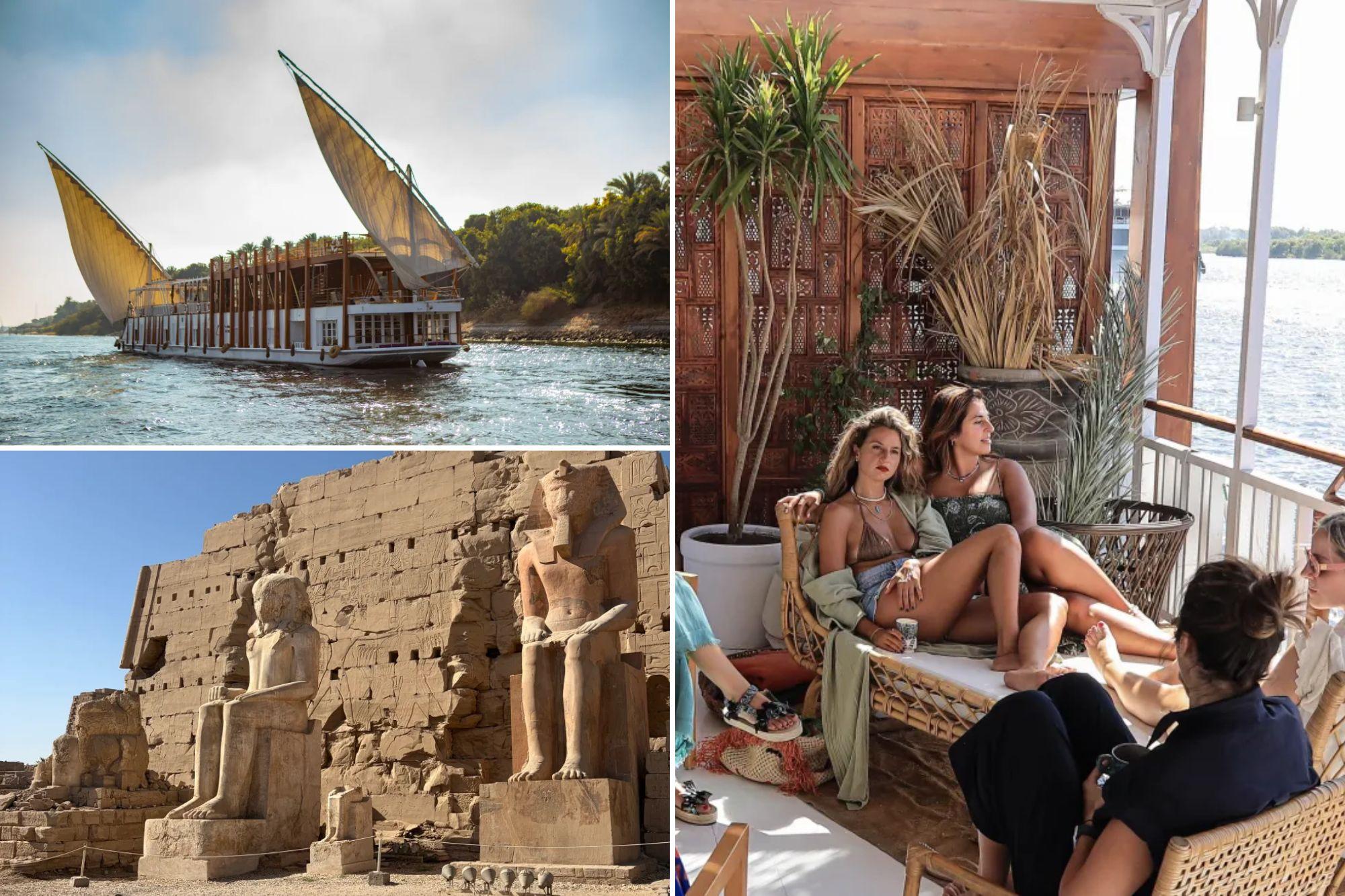
They’re strange looking shallow sailing vessels, with two big masts at each end that date back to the pharaohs. Now, an Egyptian travel company, Kemetale, is updating the experience for the 21st century.
The idea began when Ahmed El Leissy — who ran a travel company dedicated to yoga, meditation, and wellness in Egypt’s lesser-traveled landscapes — met businessman Mohamed Hassan while exploring a remote part of the southern Red Sea coast. They shared a vision for off-the-beaten path travel, focused on authenticity and connection. So together, they custom-built the dahabiya, Kemet, which launched in 2022. (Kemet means “black land” and is the ancient indigenous name of Egypt.)
Crossing over the gangplank is like stepping into a boutique hotel. Central to the boat — designed by the award winning Cairo firm Eklego Design — is a bar and dining area, lined with comfy chairs and cushions.
A back deck has plush daybeds for watching the river go by, while a glassed-in area is air-conditioned should the heat get too intense.
Similarly a downstairs library/living room is the perfect place to cool off, read or make yourself a cup of tea. Should you prefer the sun — or the night sky — the top deck has loungers and panoramic views.
All the areas are artfully curated, thanks to the collector’s eye of Hassan, who has a passion for interior design. He leaned into local artisans and sources to bring what Kemetale calls “1,000 stories” to the boat. Look around and there’s always a nugget to discover, like the representation of the Nile on the plates and the local art on the walls (oh, how we begged for a chance to buy!)
Below deck, Kemet has eight cabins for up to 16 guests, some balconied, and some with adaptable sleeping arrangements — handy, since the trips are often bought out for private groups.
Our four-night journey is titled “a sandstone summer drift” (from $4,077 per person). It starts in Aswan, an hour’s flight from Cairo, where we are whisked into the magical world of ancient Egypt with a trip across the river to the Philae Temple, dedicated to the goddess Isis. The cruises include the services of an onboard Egyptologist for the duration — in our case the eminently knowledgeable and ebullient Amr Wifky, who also acts as our translator and market barterer.
There is, of course, a lot of ancient Egypt to see.
At the temple of Kom Ombo, dedicated to the crocodile god Sobek and the falcon god Horus, there are depictions of strangely modern medicinal implements that became lost to time. And it’s not just for pharaohs — the museum next door houses 300 mummified crocodiles. In Esna, the Temple of Khnum has ceiling hieroglyphics that are being restored to their original colors. In Gebel el-Silsila, we see the sandstone mines from which the temples of the valley were built.
But as fabulous as these are, they are also the usual suspects, visited by the myriad cruises and land packages that ply the Nile. What makes a Kemetale trip so special is the local immersion, thanks to the deep connections of the owners and crew (some of whom are so local that they can leave the boat and go home at night.)
After docking at El Kab, we go where few visitors dare, climbing into rustic vans bound for the outskirts of town, passing roadside markets and donkeys laden with bales of straw to a line of rock-cut, cliff-face tombs. Inside are the remains of locals rather than royalty and there are some bones lined up for us to see. Colorful hieroglyphics protected from the sun show small snippets of everyday life: One of the deceased was remembered for having a particularly unruly horse.
Because we are in a small vessel, we can also pitch up at remote spots along the Nile, ones that El Leissy, who accompanies most sailings and wrangles the 13 crew, has scoped out. After a short sail, we pull up at an island for a refreshing swim in the Nile — much colder than expected, but thankfully crocodile free since the arrival of the Aswan High Dam in the 1960s, which keeps them all on the other side. It’s one of Hassan’s favorite parts of the trip.
“We usually arrive with some light still in the sky,” he said. “Guests swim, walk around a bit, and then we set up dinner on the shore and cook over the fire. Nothing about it is polished. That is exactly why it works, and it is the evening people tend to remember.”
As dusk fell, locals rowed us out in fishing boats for sunset bird watching. It’s best not to look at the missing planks beneath your feet but instead take in the ibis and kingfishers.
The shoreside barbecue experience is second to none. In fact, the food on this trip is seriously exceptional, brought to us by the smiling chef, Atef Mahmoud. He’s a Sufi (a Muslim mystic associated with the whirling dervish meditative dance) and part of his protocol is the belief that food should be “from the heart.”
This is true farm-to-table. It’s not unusual to see a rowing boat pull up in the middle of nowhere and wait for fresh produce to be hurled on board.
Plentiful meals include regional dishes, mostly served family style, including local delicacies like gebna beltamatem (salad made by mashing white cheese with diced fresh tomatoes), feteer meshaltit (bread made with layers of dough soaked in ghee), labneh (creamy, thick Middle Eastern yogurt cheese) and gebna areesh (soft, white, low-fat curd cheese made from skimmed water buffalo milk).
One afternoon, we head to the island of Battau, where, after a walk through the lush orchards, a local family welcomes us in and bakes fresh bread for us in their rustic oven, which is enjoyed on the roof terrace along with the juicy homegrown mangoes and mint tea.
Other highlights include a stop at a stretch of riverbank that looks like Tatooine, where we trek up the escarpment to a Sufi shrine and watch the sunset over the Nile. Another evening brings local entertainment to the boat with dancing and singing, with the crew in full-on sheikh’s robes (midnight at the oasis!).
In Esna, after a stroll through the market, we dine at Okra, a women-led community kitchen that started in 2024. Part of a regeneration initiative, Noura and Asmaa head up the cozy restaurant, where local women bring their family recipes and skills to the table. Our breakfast spread is bountiful and delicious.
We picked up the boat back at the harbor for a cruise through the Esna lock before our final stop at Luxor, the grand ancient town that gave us the word “luxury” for a reason, since the kings at Karnak Temple went overboard with sphinxes and towering palace walls. Kemet is pulling up here until the season gets back underway in the fall. Next year, though, she’ll have a sister ship to drift the Nile with.
Coming in June 2027, a second boat, Deshret, will join the fleet. (Deshret is the name of the red crown that represented Lower Ancient Egypt.)
Like Kemet, she is being built by local shipwrights, employing the same modernized steel hull matched with traditional techniques.
Deshret, however, will add a whole new dimension. A wellness perspective, leaning into El Leissy’s expertise, means the boat will boast a bigger back deck with a sauna and massage space, with local wellness folk available for treatments, while the top deck will feature a pool. It will be a truly unique vessel on the Nile.
“People come for the temples and leave talking about the river, the crew, and the family who gave them tea on an island. ”
“On Kemet we noticed something — guests would arrive exhausted, spend two days unwinding, and only then start to actually see Egypt,” said El Leissy. “With Deshret, we want to remove those two days.”
For Hassan, the new build was a chance to add to the aesthetic of their first venture.
“With Kemet we were trying to prove something: that a boat could be built entirely by Egyptian craftspeople and stand against anything on the river. With Deshret we have stopped proving and started refining,” he said. “Deshret will be unapologetically maximalist. But where Kemet is about the river, Deshret takes the slow sail somewhere else and links it to wellness – the spa, the library, the quiet spaces are not amenities we bolted on; those are the reasons Deshret is shaped the way it is. Kemet is a boat you sail on. Deshret is a boat you slow down on.”
Whichever sailing you take, a trip with Kemetale is an immersion into the Egypt of the past, and the present.
“The Nile is not scenery,” said El Leissy. “People come for the temples and leave talking about the river, the crew, and the family who gave them tea on an island. The monuments are extraordinary, but they are not what anyone writes to us about afterward. It’s the encounters guests had while traveling with us.”