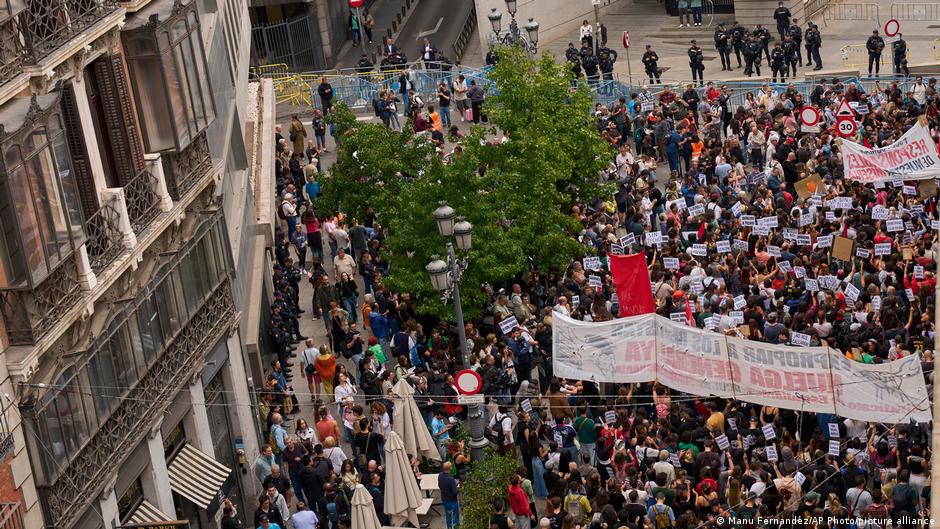
Protesters near the Spanish parliament demand 'Fair rents NOW' after lawmakers rejected emergency housing measures on Friday. Photograph: Alejandro Martinez Velez/ReutersView image in fullscreenProtesters near the Spanish parliament demand 'Fair rents NOW' after lawmakers rejected emergency housing measures on Friday. Photograph: Alejandro Martinez Velez/ReutersSpanish right wing votes down housing crisis plans as protest movement growsOpposition lawmakers joined forces to defeat proposals made by Socialist-led coalition after eviction of 87-year-old
Rightwing lawmakers in Spain have joined forces to reject emergency measures put forward to tackle the country’s housing crisis, pitting a fractured parliament against the widespread protest movement that has swelled in recent days.
As protesters outside the parliament building in Madrid held up homemade signs bearing images of vultures, the conservative People’s party, the far-right Vox and the Catalan pro-independence party Junts voted against a package of decrees by Pedro Sánchez’s Socialist-led coalition that included a ban on evictions until 2030 and the regulation of temporary lettings and lettings by room.
The People’s party said it had voted in line with its belief that building, rather than regulating, was the best way to address the crisis. “Housing doesn’t become more affordable through decrees; it becomes more affordable by building more homes,” said lawmaker Juan Bravo.
Read moreNews of the package’s rejection was met with boos outside. “Your profits, our misery,” the protesters chanted.
The long-simmering anger over soaring housing costs boiled over late last month, when 87-year-old Maricarmen Abascal, who uses a wheelchair, was evicted from the home she had lived in for 70 years. The octogenarian said she was unable to afford the 230% rent hike demanded by the investment fund that bought her apartment.
On Friday, as a new poll suggested that two-thirds of people in Spain support the idea of government intervention in the housing market to limit prices, sources told news site Eldiario.es that the Socialists were mulling whether to bring forward next year’s elections, potentially to this November.
Late on Thursday, as news broke of that several rightwing parties were planning to vote against the proposed measures, Sánchez said the parliamentary vote would go ahead as planned. “You’re with the social majority or with speculators,” the Spanish prime minister said on social media, adding that the vote would reveal the “true colours” of the rightwing parties.
View image in fullscreenA sprawling protest camp in Puerta del Sol, Madrid, where demonstrators are demanding affordable housing. Photograph: Ignacio Lopez Isasmendi/ZUMA Press Wire/ShutterstockFor many, Abascal’s eviction was a tipping point for feelings about Spain’s housing market, where rents have surged 80% within a decade and the cost of homes climbed by 63%, resulting in significant hardship for many.
Earlier this year, the Youth Council of Spain said the average rent in Spain had climbed to €1,176 ($1,323) a month – an amount equivalent to 98.7% of the average salary for under-30s.
The protests that began with Abascal’s eviction have continued even after the investment firm that bought her apartment said it had struck a deal that would allow her to return to her home, with her rent returning to a level closer to that she had paid in the past.
Read moreThe government decrees presented in parliament on Friday were intended to quell some of this public uproar. As they were rejected, campaigners vowed to continue their push to improve access to housing.
“They’re not going to stop us,” the Confederation of Tenants’ Unions said in a statement, as it called on people across the country to take to the streets this weekend. “In the face of a parliament that is out of touch, the answer is more organisation and mobilisation. The next step: a general strike.”
Saturday will mark one week since a small group of protesters, intent on making their demands heard, set up 10 tents in Madrid’s central Puerta del Sol plaza, a short walk from parliament. Since then, the encampment had swelled to more than 1,500 tents – a peaceful settlement in the heart of the capital with its own street names, a medical centre and even a co-working space.
Such demonstrations have dominated the national conversation, breathing new life into Sánchez’s beleaguered government and shifting attention away from the lingering impact of recent events in Ceuta.
As news of the vote reached the camp on Friday, one protester, Marta García, said: “People here are disappointed. We had thought that at least one of the decrees would be approved.”