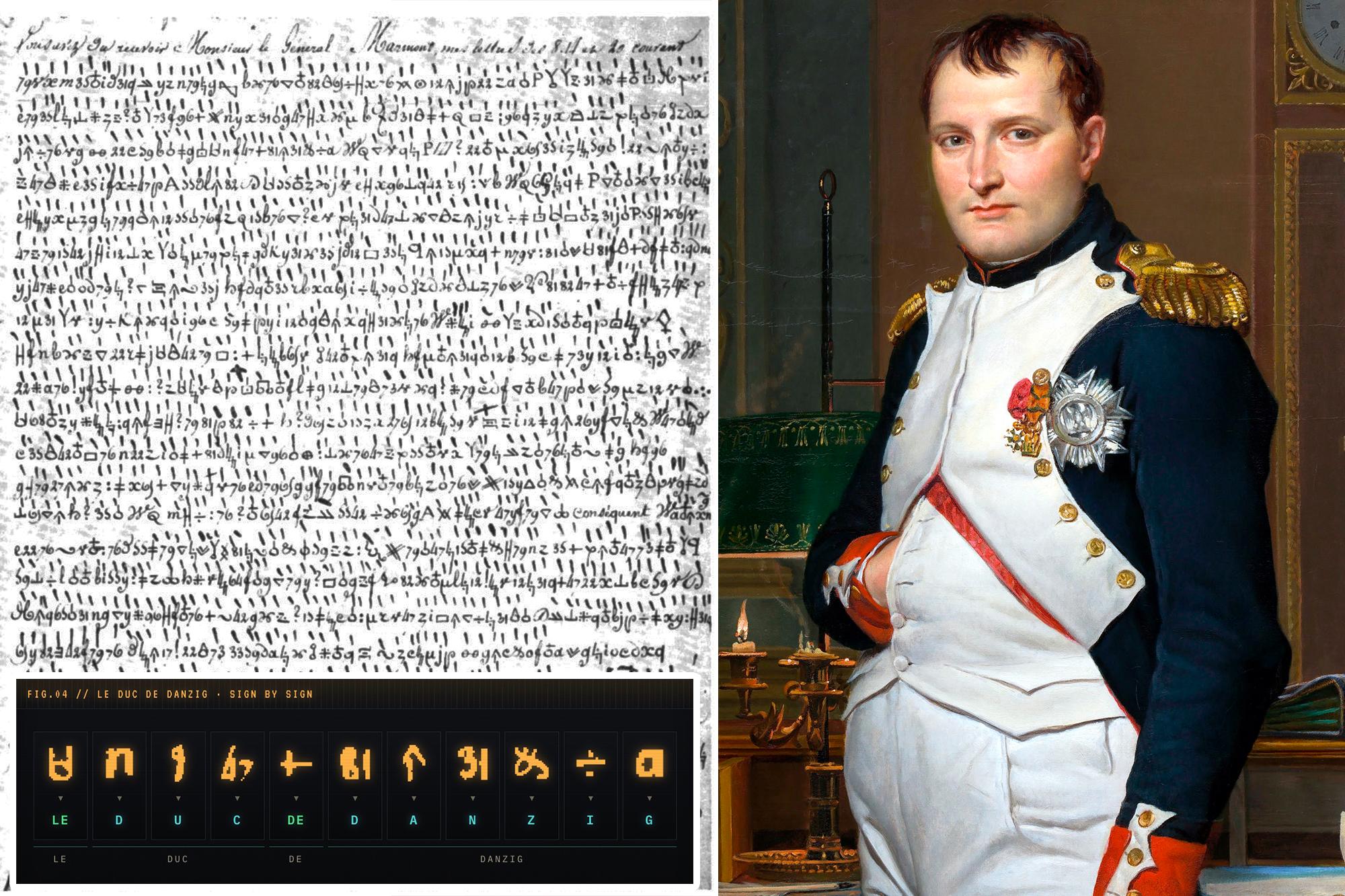
Make New York Post a Preferred Source After more than 200 years, a coded letter written by petite, problematic Napoleon Bonaparte has been deciphered.
Napoleon’s stepson, Eugene, the Viceroy of Italy, sent the original letter to French general Auguste de Marmont in March of 1809 amid France’s ongoing conflict with Austria.
At the time, Marmont, a close companion of the emperor, was positioned with his troops in Dalmatia, on the far side of the Adriatic, where he was totally isolated from other French forces and their allies.
While the opening line of Napoleon’ correspondence is in his native French, the next 24 are an incomprehensible mix of symbols, letters, and numbers.
Experts believe the OG correspondence would have come with a deciphering key, but that key has been lost to the mists of time, until now.
Carter Church, an engineer at cybersecurity company SentinelOne, has cracked the centuries-old code with the aid of AI.
‘I used GPT–6 Astra to break an unsolved cipher to one of Napoleon’s generals that had gone unread for 217 years. What makes this impressive isn’t actually the codebreaking, but that Astra completed the entire multi-modal workflow in six hours from a single image and goal,’ he explained on X.
The first line reads: ‘Vous avez dû recevoir, Monsieur le Général Marmont, mes lettres des 8, 14 et 20 courant,’ which translates to: ‘You must have received, General Marmont, my letters of the 8th, 14th, and 20th of this month.’
The contents of the rest of the coded letter remained unknown until Church set AI to decode it, a process that took about six hours.
“‘Astra cut the 1,202 by 1,836 plate into rows, read the signs, decided which of 175 hand–drawn marks were the same sign written twice, and only then began breaking the cipher,’ Church explained in a blog post.
As the AI deciphering revealed, the letter outlined the locations of every other French and allied army, urged him not to lose hope or be “intimidated” by his isolated position, and assured him that Austria was speeding toward doom.
“The Russians are marching against Austria, and the army [of] Friuli today numbers eighty thousand men,” it reads.
“Add the Dalmatian corps, without counting the reserves being organized everywhere in the rear, and you see that Austria will be attacked at once on every side. She is consequently hastening toward her ruin,” he wrote.
‘When you receive the order to march, you must not allow yourself to be intimidated by a few troops or a gathering of rabble.”
He added, “I continue to await news from you with impatience.”
Just two months later, on May 21, 1809, during the Battle of Aspern–Essling near Vienna, Austria, Napoleon suffered his first personal defeat, which resulted in the death of 23,000 French soldiers.
In the wake of that loss, Napoleon regrouped his forces and defeated Archduke Charles in July of 1809 at the Battle of Wagram. That battle led to the dissolution of the Fifth Coalition, the Austrian and British-led alliance against France.
Church maintains that cracking the cipher wasn’t particularly challenging, but the task would have taken human minds much longer than the six hours AI required.
“The cipher itself isn’t difficult, and cryptographers could have cracked this easily given the time/energy, but the work to transcribe, catalog, translate, then crack is involved and multi-disciplinary,” he said, noting that every field contains a litany of problems that specialists don’t have the capacity to tackle.
“The takeaway here is that the people shortening those lists will increasingly be outsiders who were simply curious.”