The Unpromotables: Germany's league champions who can't go up
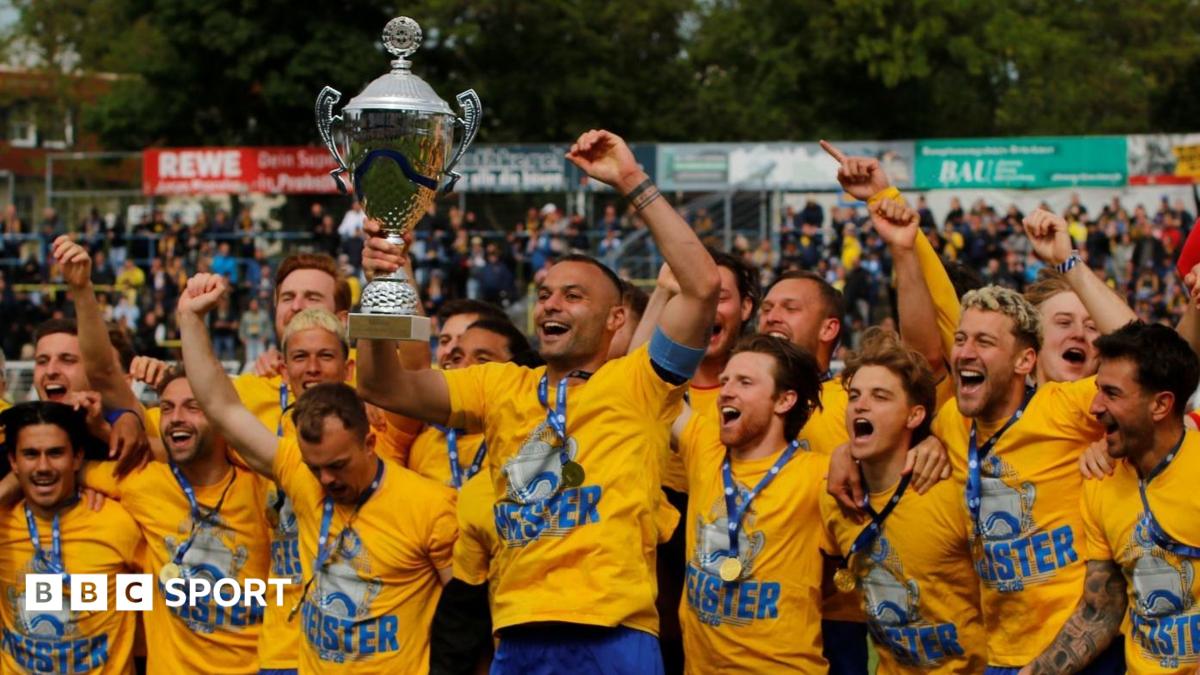
Image source, 1. FC Lok LeipzigByMatt FordBBC SportDjamal Ziane is a three-time league champion – but he does not always feel like it.
This summer, for the second year in a row and for the third time in seven seasons, the Lokomotive Leipzig captain hoisted the trophy into the air having led his team to the title in the Regional League Northeast, the fourth tier of German football.
But the memory is tinged with frustration because, just as in 2025 and 2020, Lokomotive's league title did not lead to promotion.
While the other regional champions in the German fourth division were promoted to the nationwide 3. Liga, "Lok" faced a play-off against a representative of the Regional League Bavaria, Wurzburger Kickers. Ziane scored, but an injury-ravaged Leipzig lost 3-1 on aggregate.
"Euer System ist krank," read a simple protest banner displayed by the 2,000 travelling supporters – "your system is sick".
"It's the worst thing – injury aside – that you can experience as a footballer," Ziane tells BBC Sport.
"Catastrophe doesn't cut it. It doesn't make any sense. If they really wanted to change it, they could do tomorrow."
Image source, Matt FordImage caption, A banner reading 'Your system is sick' was displayed at this year's promotion play-off
Beneath the Bundesliga, 2. Bundesliga and 3. Liga, the fourth tier is split into five regional divisions (North, West, Southwest, Northeast and Bavaria), each of which produces a league champion.
So far, so good. But with only four teams being relegated from the 3. Liga each season, the sums don't add up.
An unsatisfactory solution is currently in place: the champions in the West and Southwest go up automatically while a third automatic promotion spot is rotated among the other three leagues in a three-year cycle. The fourth spot is allocated via a play-off between the winners of the remaining two leagues.
One champion always misses out and, increasingly, it's the champion from the Regional League Northeast, covering the territory of the former eastern German Democratic Republic (GDR).
In addition to Lok Leipzig's triple tragedy, former serial GDR Oberliga winners Dynamo Berlin fell short in 2022 and Energie Cottbus drew the short straw in 2023. This season, there is only one eastern German club in the 3. Liga: Hansa Rostock.
The struggles of the regions' football clubs are, to some degree, a result of continuing socio-economic disparities between east and west, which were also reflected in the success of the far-right Alternative for Germany (AfD) party in recent state elections.
Even in 2026, not one of the 40 leading companies listed on Germany's DAX stock exchange is based in the former east (outside Berlin). Salaries remain lower, unemployment remains higher and the population is older and shrinking as young people move west.
The reason that automatic promotion spots are handed to the champions in the West and Southwest is simply because there are more men's football teams registered in those jurisdictions - because more people live there.
"In that case, you might as well give us the automatic promotion spot because we attract bigger crowds," he says.
Indeed, the average attendance in the Regional League Northeast last season (3,125) was around twice as high as that in the other leagues. Lok Leipzig themselves had the fourth highest (6,352). More than 11,000 attended the local derby against city rivals Chemie Leipzig.
"Unfortunately, you don't get any points for tradition, crowds and history," says 39-year-old Lok chief executive Toni Wachsmuth, who does not have access to sponsors with the same financial firepower as his counterparts further west.
"The [western] leagues do have better economic foundations but everyone agrees that the current system is nonsense. Everyone needs to compromise but some officials are clearly putting their own interests and positions above the general good of German football."
It comes as little surprise, therefore, that the latest push for change has come from the east, with clubs launching a new campaign in March 2025 with the slogan: "Meister mussen aufsteigen!" – champions must go up!
Their proposal: a reduction from five leagues to four, with the precise geographical borders to be determined anew each season with the help of artificial intelligence, taking into account factors such as distance of travel to away games and attractive derbies.
They call it the compass model. Because it can go in all directions. In return, the Regional League Northeast is prepared to compromise by giving up its emotional attachment to the territory of the former East Germany.
"I want to get away from this east-west debate," says Tommy Haeder, the 35-year-old chief executive of Chemnitzer FC and figurehead of the reform campaign. "We've had a change of generation. Many older officials have retired and been replaced by younger people who don't have this nostalgia for the GDR."
Haeder also emphasises the benefits that a fairer promotion system would bring for German football as a whole, arguing that eastern clubs would be better equipped to continue nurturing youth talent.
"It's not in the interest of talent development when young footballers from Chemnitz are torn away from their homes and families at the age of 10 to join academies in Hamburg, Dortmund or Stuttgart," he tells BBC Sport.
"The compass model is a model in which every region sacrifices a little bit to solve a much bigger problem. We're organised, we have a plan, we've made suggestions. Now it's up to the federations to act."
The campaign has since gained the support of more than 80 clubs across Germany, from east to west and up and down the pyramid.
Union Berlin, who were playing in the fourth tier as recently as the 2000s, became the first Bundesliga club to officially back the initiative, with club president Dirk Zingler saying: "The current set-up contradicts our understanding of sporting competition."
Borussia Dortmund president – and Bundesliga chairman – Hans-Joachim Watzke added his influential voice, stating: "Champions must go up and we think the compass model with four regional leagues is the best option."
Support also has also come from Bournemouth head coach Marco Rose who, drawing on his past as both a player and coach at Lok Leipzig, said: "I know what it's like for clubs trying to work within their means, or lack of means, at that level. Everything is on a knife edge.
"You have to give the clubs and their fans the belief that their efforts and sacrifices will be rewarded with promotion."
Momentum was growing before a key vote at the end of June when, after months of discussions, clubs were finally set to vote on the compass model – but the ballot descended into farce when, at the last minute, the regional federations conducting the vote announced two key changes:
Suddenly, the four new leagues would consist of only 18 teams rather than 20 (thus making the compass model less attractive because 10 more teams would miss out), and a stipulation was added that a majority be reached in each of the five regions for the model to pass.
An overall majority (50.9%) in favour of the compass model was still reached (including 60.9% in the West, 61.5% in the North and 76.3% in the Northeast) but the Southwest voted for an alternative option in which the northeastern league would be dissolved and its clubs reallocated, while the Southwest and West would simply remain the same.
"The move from a functioning system to a complex, insecure and economically riskier model without an obvious benefit doesn't make any sense to me," Robert Lempka, chief executive of Regional League Southwest side FSV Frankfurt told local public broadcaster Hessischer Rundfunk this summer. "I find it unsettling that an untransparent algorithm should decide a club's future."
The Bavarians, meanwhile, voted vaguely for "further talks", with Bavarian Football Federation (BFV) President Christoph Kern telling Munich's Abendzeitung newspaper in August: "We've gathered our clubs together on several occasions and none of the suggested models have majority support. I'm not prepared to simply give up the Regional League Bavaria like that."
For Haeder in Chemnitz, the vote was "an absolute catastrophe – completely amateurish". And he's not alone.
This season, protests have erupted across German football. In the Regional League Northeast, almost every game has begun with a delay as players have simply refused to play for the first minute.
On the opening day, Lok Leipzig supporters, their team still stranded in the same division, threw hundreds of plastic trophies on to the pitch, symbolising the worthlessness of their club's back-to-back titles.
Down in Bavaria, Bayern Munich's ultras attended a reserve team game in the regional league and produced an intricate choreography criticising the Bavarian Football Federation (BFV) for what they perceive to be an unco-operative stance.
"You've taken us for fools long enough," read a banner beneath a display depicting BFV officials using a magnet to pull a compass needle towards them. The ultras then set off red pyrotechnics which turned the compass needle back in the direction of the fans.
And before the international break, fans of clubs across the Bundesliga used their platform to call for reform with co-ordinated banners reading: "Clubs and fans betrayed! Champions must go up! Compass model now!"
The compass, it would appear, may finally be pointing towards a resolution after the German Football Federation (DFB) announced the convening of an extraordinary general meeting on 18 December.
"[The issue] must be resolved," said President Bernd Neuendorf. "The compass model received the most votes and offers the best chance for a concentration of elite performance and therefore better development of talent."
Any changes would only be implemented in the 2028-29 season – too late for Ziane who, now 34, has embarked on his 13th season with Lok Leipzig. Back-to-back champions, but still in the fourth division.
"You can never completely get over it because, at our level, the 3. Liga is probably the pinnacle. Promotion with my hometown club would have been the most wonderful thing in the world for me," he says before heading out for training.
"It's a shame that we have to force ourselves to remember what we've achieved. It's so hard to win this league and we did it twice in a row! You can't take that for granted."
The part-timers who won three Wembley finals in a row