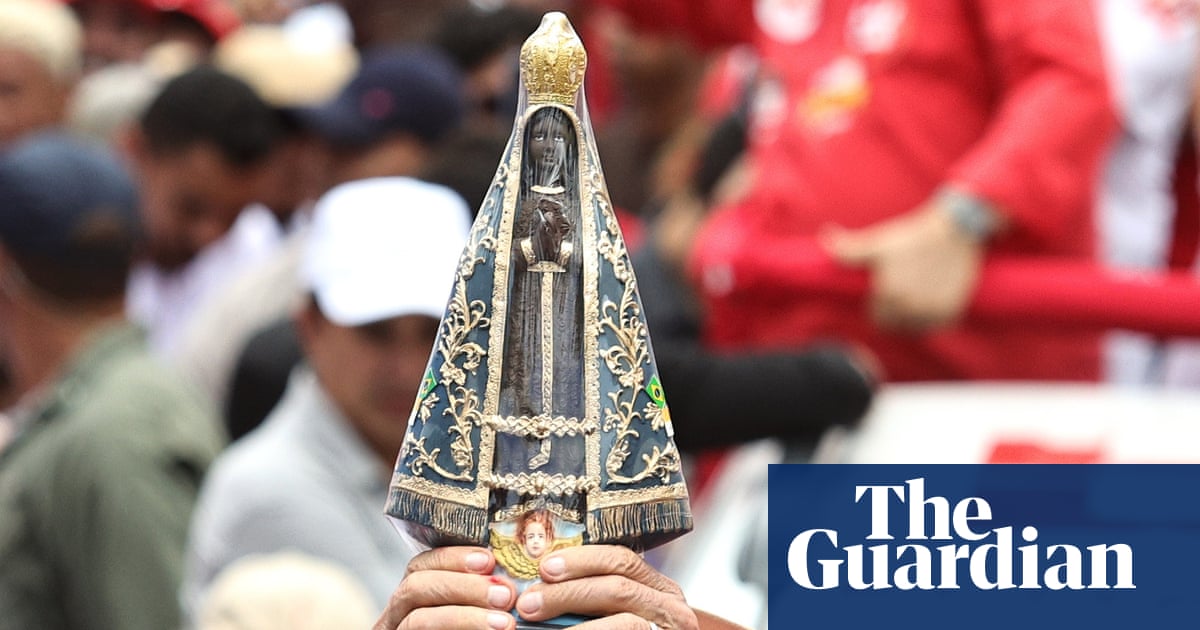
Luiz Inácio Lula da Silva holding an image of Our Lady of Aparecida. His rival Flávio Bolsonaro has called claims he plans to unseat the patron saint ‘fake news’. Photograph: Jarbas Oliveira/EPAView image in fullscreenLuiz Inácio Lula da Silva holding an image of Our Lady of Aparecida. His rival Flávio Bolsonaro has called claims he plans to unseat the patron saint ‘fake news’. Photograph: Jarbas Oliveira/EPA‘No one disrespects Our Lady’: fears for Brazil’s patron saint grip country ahead of electionSpeculation that Flávio Bolsonaro will try to strip Our Lady of Aparecida of position could become deciding factor in run-up to Sunday
A row of Biblical proportions has erupted in the run-up to Brazil’s presidential election, with the country’s patron saint, Our Lady of Aparecida, emerging as an unlikely kingmaker in the deadlocked race.
Ahead of Sunday’s vote, the two frontrunners – the leftwing president, Luiz Inácio Lula da Silva, and his far-right challenger, Flávio Bolsonaro – are level in the polls.
Read moreBut in recent days, speculation that Bolsonaro – son of the former president Jair Bolsonaro – might strip the widely cherished patroness of her position have caused a nationwide outcry, leaving some to question if it could tip the knife-edge election in favour of Lula, who is Catholic.
“It could sway things one way or the other,” said Thomas Traumann, a political analyst who has been tracking the unusual election row.
It remains unclear precisely how the commotion began, but debate over the issue exploded last week when a remark by Bolsonaro, whose movement includes many evangelical Christians, went viral online. In a recent broadcast, the former senator said one of his first acts as president would be to “decree that Brazil belongs to the Lord Jesus Christ”.
Some Catholics took that as a sign that the Protestant politician planned to unseat Our Lady of Aparecida, although only the Vatican – which declared her Brazil’s patroness in 1930 – has the authority to do so.
View image in fullscreenBrazil’s rightwing senator and presidential candidate Flavio Bolsonaro of the Liberal party during a campaign rally in São Paulo. Photograph: Nelson Almeida/AFP/Getty ImagesThose suspicions were reinforced by Bolsonaro’s reported links to JB Carvalho, an evangelical leader who has previously called for the patroness’s removal. In 2007, another Bolsonaro ally tried to introduce legislation to the same effect, although the bill was dropped.
Bolsonaro has called claims he plans to unseat Our Lady of Aparecida “fake news”. He alleged the rumours were being spread by Lula supporters, as well as members of the Episcopal Conference of Brazil, a Catholic bishops’ organisation. The conference rejected the charge.
Lula’s leftwing movement has taken advantage of the furore, keenly aware it could hurt the far-right candidate’s chances in a country where nearly 57% of the population is Catholic. With the result expected to be even tighter than the last one – when Lula beat Jair Bolsonaro by less than 2% – even a small number of votes could mean the difference between victory and defeat.
Lula has appeared on the campaign trail holding statuettes of the Virgin Mary while his wife, Janja da Silva, has worn a pendant honouring Our Lady of Aparecida. “As long as I’m president, no one will disrespect Our Lady of Aparecida. No one. People need to learn to respect all religions,” Lula told a rally in the Amazon. Lula’s vice-president and running mate, a devout Catholic called Geraldo Alckmin, published a video describing how he had received messages from Catholics “worried about the direction of the country and the terrible news that has been circulating”. Alckmin assured voters he and Lula would preserve and protect “religious traditions, so sacred to Brazilian families”.
The row speaks to the rivalry and tensions between Brazil’s once dominant Catholic church and the evangelical movement, which has grown rapidly since the 80s.
Traumann said: “It touched a raw nerve, which is the growing power of the evangelicals. Evangelicals make up about 30% of the population, but their political power is much greater than 30% – and within Bolsonarismo it is even more significant”.
Traumann believed that, irrespective of whether Bolsonaro really did intend to remove the patroness, the furore had tapped into “a genuine fear among Catholics of being pushed outside the system”. “I have no doubt that this is going to be important [in the election]. [Flávio Bolsonaro] knows it has landed badly,” he added.
Luiz Antônio Simas, a historian and author of the book So Many Marys: Our Lady in Popular Culture, said the outcry “was a symptom of the popularity that Aparecida and the Virgin Mary in general have in the formation of our culture”.
View image in fullscreenLula at a campaign rally in Belem, Brazil. Photograph: Marx Vasconcelos/Reuters“For Brazilian popular culture, Our Lady of Aparecida transcends altars … She is extremely powerful as a defining element of what we envision Brazilian popular culture to be,” Simas said, noting how Brazil’s “Black Madonna” was present in samba parades, football culture and Afro-Brazilian faiths.
While the debate flared up on the eve of the election, Simas said Our Lady of Aparecida was a long-running point of tension between Catholics and evangelicals, who oppose the Catholic veneration of saints and images. He recalled a major outcry in 1995 when a neo-Pentecostal pastor kicked a statue of Our Lady of Aparecida on TV.
Simas believed religious racism was at the heart of the outcry, given that Our Lady of Aparecida was a black representation of the Virgin Mary. “When all of this comes into contact with a turbulent political context, in a country experiencing the tensions of a highly contested pre-election scenario, all these controversies come to the surface,” Simas added.