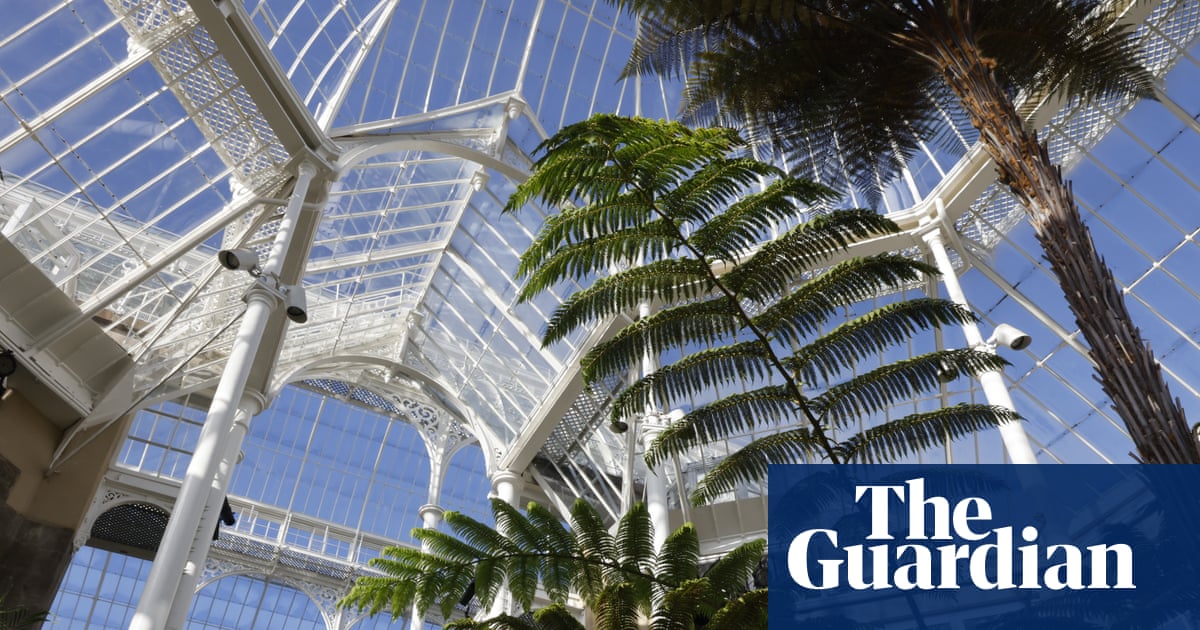
The £23.5m refurbishment has kept nearly all of the original sandstone and wrought iron shell. Photograph: Murdo MacLeod/The GuardianView image in fullscreenThe £23.5m refurbishment has kept nearly all of the original sandstone and wrought iron shell. Photograph: Murdo MacLeod/The GuardianFalling glass and ‘decapitated’ plants: the race to protect Edinburgh botanic garden’s plants After five years of work, 5,750 panels of toughened glass will help keep hundred of plants safe from Scottish winters – but more work needs to be done
In the early autumn sunlight, Royal Botanic Garden Edinburgh’s extensive plant collection appears safe in their glass enclosures. But danger lurks from above for the tropical ferns, cycads and rare alpine heathers.
Soon the September sunshine will give way to the storms and gales of the Scottish winter, which can bring hundreds of glass panels crashing to the greenhouse floor on the windiest days. Nobody is allowed inside when the wind is above 30mph.
“We’ve had plants that have essentially been decapitated by falling bits of glass,” says Sadie Barber, the glasshouse curator at RBGE. “You go into one of these tropical spaces in winter and there’s icy air coming in. It’s traumatic for those of us who put decades into caring for these plants. A storm can literally just wipe them out.”
View image in fullscreenProf Julia Knights, regius keeper and CEO of RBGE, officially opening the doors. Photograph: Murdo MacLeod/The GuardianBut this week, change is in the air for the creaking infrastructure at the 356-year-old botanic garden, the second oldest in Britain after Oxford. On Friday, the palm houses are reopening after five years of painstaking restoration work, complete with 5,750 panels of toughened glass to keep out the elements.
Before they closed for renovation works, the horticultural team had installed a net in case panels fell from the weathered structure. The new ones are not bulletproof – but they are strong enough to resist a bird strike.
View image in fullscreenDamage to one of the glasshouses after a storm. Photograph: Helen Pugh PhotographyPart-Georgian, part-Victorian, the £23.5m refurbishment has kept nearly all of the original sandstone and wrought iron shell. Inside, more than 600 temperate plants have returned to the building. The air is clean and crisp, purified by ferns that naturally remove toxins from the air. Its temperature and humidity is still controlled by the original pulleys and winches.
“We have made it one vast cathedral-like space for temperate plants,” says Prof Julia Knights, the garden’s regius Keeper and the royally appointed chief executive. She points out her favourite tree fern, which comes from Tasmania and has a Scottish liverwort growing on its woody stem. “They can grow outside in our botanic garden in Logan on the west coast of Scotland because of the oceanic climate,” she says.
View image in fullscreenExtensive work has been done to replace and strengthen panels at the greenhouse. Photograph: Helen Pugh PhotographyFounded by two physicians in 1670 to teach doctors about medicinal plants, RBGE has morphed into one of the most important collections of plant biodiversity in the world. Its research glasshouses are stuffed with rare ginger species, bananas, blueberries and dozens of begonias.
It is a global authority on rhododendrons and ferns, houses rare plant species that have gone extinct in the wild, and its scientists have helped pioneer new technology, such as DNA barcoding which is used to identify plant species. Arthur Conan Doyle studied here, infusing Sherlock Holmes novels with his botanical knowledge. Today, conservation is its primary focus.
“Our conservation collections are so important to have. The threats are extreme in the wild,” said Prof Pete Hollingsworth, RBGE’s director of science. “The driver[s] for environmental damage are so strong, so having these ex situ safe sites is really important,” he said.
View image in fullscreenNew display benches in the restored building. Photograph: RBGEBut the restored palm houses aside, many of the glasshouses used to care for the plants are decades past their originally intended lifespan and are waiting for upgrades. Leaks from Scottish rain rot the rootstock of plants, sometimes killing them. Last year, horticulturalists were not allowed inside the greenhouses for 20 days due to high winds. In 2026, they have been shut out 15 times. When they return, they have often worn hard hats and safety gear to pick out the broken glass.
“The glasshouses are the one thing we don’t want to break. It’s the plants inside that suffer,” said Barber. “I was looking at one of our records the other day of a plant we lost in the lowland tropical house. It just had ‘storm’ written next to it. It had either suffered from the cold, or even been cut by falling glass.”