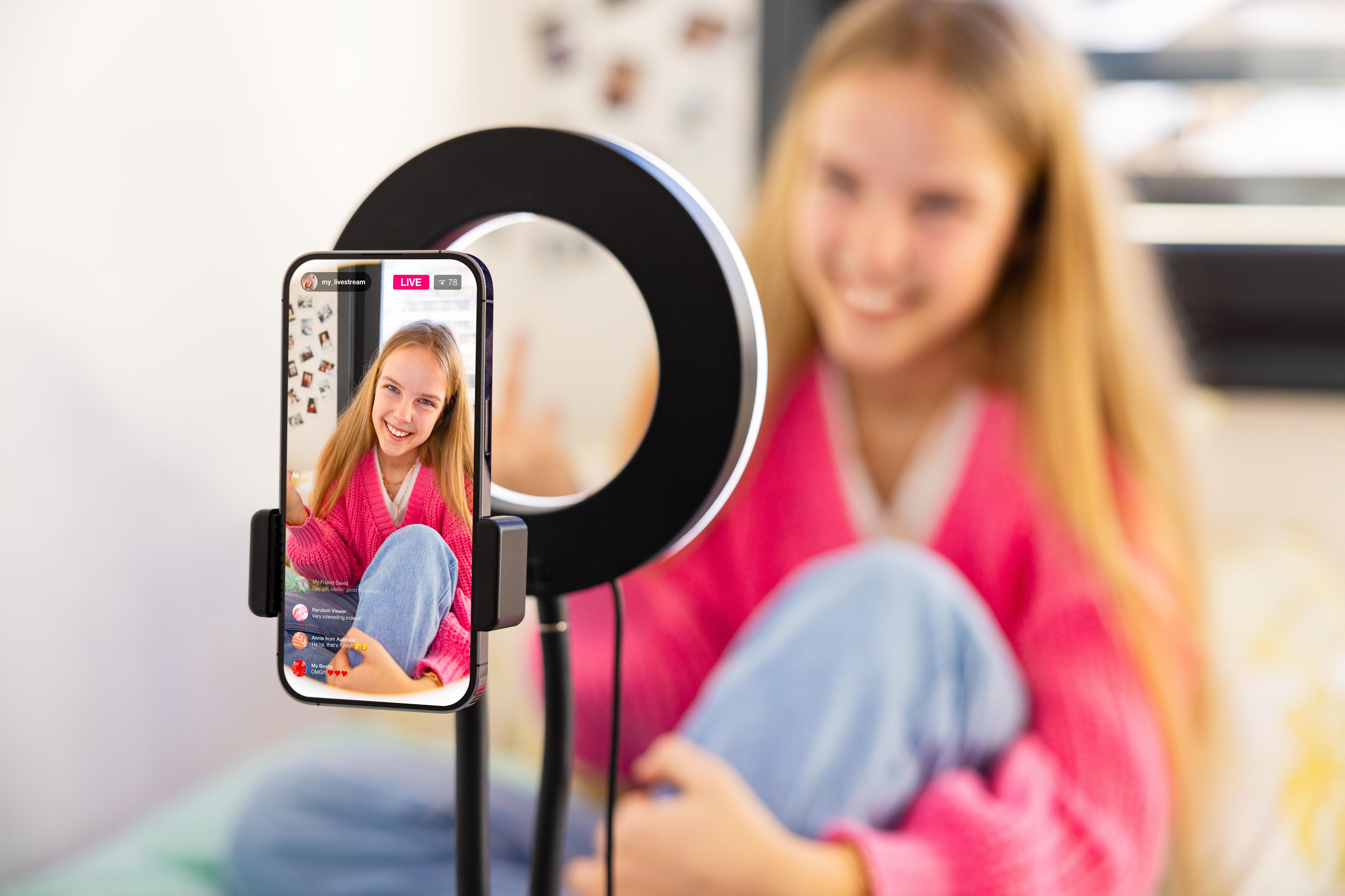
Make New York Post a Preferred Source Colleges are starting to offer degrees in social media influencing, but 33% of Americans would not support their child if they decided to major in it, says new research.
A survey of 2,000 US adults by Talker Research explored Americans’ feelings about universities teaching students how to become online celebrities.
While a third of those polled said they wouldn’t want their child to major in online content creation, 43% said they would support them if they chose to pursue the degree. A healthy 24% said they wouldn’t know how to feel at all.
Some American colleges are offering students degrees in social media influencing. Kaspars Grinvalds – stock.adobe.com About a quarter of those polled (22%) would be interested in enrolling in school to get the degree themselves.
With Arizona State University officially offering these programs, it raises questions about whether social media influencing should be viewed as a legitimate career path.
According to the data, posting online may no longer be just a hobby, but something you can put on your resume.
Thirty-two percent of Americans believe social media influencing qualifies as a legitimate career, but 52% don’t see it that way.
When splitting the data by age group, it was younger Americans who were more likely to vouch for the legitimacy of social media influencing.
Half of Gen Z respondents (49%) and 42% of millennials agreed that social media should be considered a real job. Compare that to just 32% of Gen X and only 19% of baby boomers who feel the same way.
To Amy Mosset, MPCC, RQS, Founder of Interactive Counselling, this debate is simply the latest version of a familiar generational divide:
“Nearly every generation has had a job its parents didn’t count as real. What’s different now is that young people have watched peers earn a living online for most of their lives, so to them it’s just work that happens to be visible.”
The survey also gave respondents a hypothetical: Pick between a steady 9-to-5 job or one million followers on social media.
Half of those polled (51%) took the 9-to-5 desk job, but a plucky 25% wanted the million followers.
Again, split by age, the results showed that younger Americans place more value on the power of being online.
Thirty-eight percent of Gen Z respondents would take the million followers over the steady 40-hour job, compared to just 20% of boomers.
“I’d read that as a statement about how people feel about the 9-to-5 more than about followers, continues Mosset. “Wanting freedom and recognition is healthy. Where I’d push back is on expecting an audience to supply either one reliably. Followers are attention, and attention is fickle. Tying your mood to it is a hard way to live, so anyone going that route needs something solid in their life that has nothing to do with the numbers.”