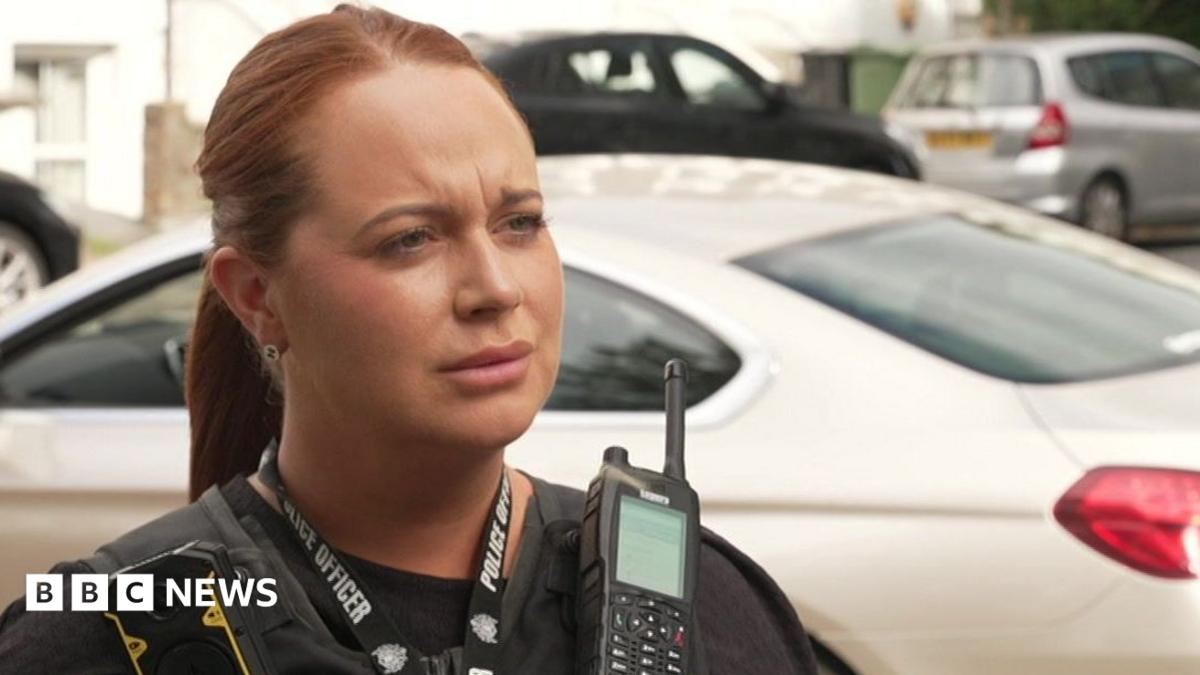
Image caption, PC Zoe Ticehurst tries to engage with children who are at risk of exploitation
London home affairs correspondentPublished2 hours ago"There are parents who think next time we come to their door, it will be to tell them their child is dead."
I'm told this by PC Zoe Ticehurst and her colleague, Det Con Faisal El Issaoui.
They are showing me around the neighbourhoods of Lambeth and Southwark in south London, where some children are highly vulnerable to the gangs who operate there.
El Issaoui explained: "It's very hard for a lot of young people who are brought up on these estates. That's the only thing they can see.
"Unfortunately, when you get to a certain age, there's a choice that has to be made."
The officers, who serve on the Metropolitan Police's proactive offender targeting and management team, said summer, when schools are closed and the long, warmer days bring children on to the streets, was a prime recruiting time for gangs.
El Issaoui said gang members easily spotted more vulnerable children, who were often from more deprived backgrounds or excluded from school.
"They might get offered money in exchange for holding on to something, or to carry something from one place to another, as a means of sort of making some quick money. That's how it starts."
Ticehurst added: "They come home with new stuff and the parents haven't given them money, or they go missing for days. And unfortunately they're caught up in stuff they shouldn't be.
"I've been to young people's houses and the parents were so afraid, because they're going into that last year of school and they believe they've got to make a choice: Go into the gang, or they don't."
Image caption, The officers told the BBC they needed help from the local community to tackle gun and gang violence
This summer, youth violence became a particular concern.
Although homicide in London fell to its lowest level in more than a decade last year, 11 of those killings since April - about a fifth - have been in just two boroughs: Lambeth and Southwark.
There was also a series of non-fatal shootings and stabbings.
Recorded gun crime rose by 23% in Southwark in the year ending August 2026 compared with the previous year, and by 22% in Lambeth.
The Met says there have been 14 lethal barrel discharges, where a gun is actually fired, across both boroughs, compared with seven from the previous financial year.
Lambeth has also seen a 9% rise in the number of knife injuries reported to police between April and August this year compared with the same period in 2025.
Image caption, Flowers and candles have been left at the spot where bus driver Auguste-Marie Bile-aka Amoa was shot dead in August
As he drove around Lambeth, El Issaoui pointed out various roadside memorials to young people who have lost their lives to violence.
Outside a pub in Clapham, a woman quietly laid flowers for 25-year-old Auguste-Marie Bile-aka Amoa, a bus driver, who was shot dead in in August.
Police investigating his killing said they needed the community to help them find answers.
A 22-year-old-man arrested on suspicion of murder after he went to hospital with a gunshot wound has since been released with no further action.
"It was early evening, you know," said Ticehurst. "There were people in the pub behind me, and there were people on the high street.
"A lot of people saw what happened here and I think it was a big shock."
Image source, Amoa familyImage caption, Auguste-Marie Bile-aka Amoa was shot dead on Willington Road, Clapham, on 10 August
Police cannot be certain what has driven the increase in violence, but they have launched several targeted operations over the summer.
Plain clothes officers and firearms patrol units searched for those suspected of carrying weapons and dealing drugs.
Officers said they had made more than 700 arrests and seized more than 40 weapons, as well as Class A drugs.
El Issaoui reeled off the names of multiple gangs which he said were dotted across the borough.
"There's a gang called the ABM, which stands for All About Money, so they're the local sort of gang here.
"They're currently rivals to a gang that's just at the end of this road, which is the Wandsworth Road, O-Tray gang.
"It's just literally two minutes away from each other."
He said the number of gangs and their close proximity to one another meant tensions regularly and violently erupt on the streets.
"It's tit-for-tat stuff, and unfortunately it does affect a lot of innocent people who aren't linked to gang crime."
Although many of the gangs have been around for decades, El Issaoui says they have been "re-branded - with the new generation overtaking the old".
He told me social media was fuelling the violence.
"We see one gang going into a rival's territory and live streaming it. Just to say, 'we're here, come get us' sort of thing."
But he says there is also another disturbing trend - a type of league table where violence is treated like a game.
"Any affront into another area will be seen as a point score for that gang.
"It's even more points if an actual gang member was targeted, but as far as these groups are concerned, normal passersby are fair game.
"It's a really sort of dangerous sort of element for local communities, where innocent people get literally caught in a crossfire."
Image source, Metropolitan policeImage caption, Police have released images of some of the weapons and drugs seized during several operations over the summer
The officers, who wear plain clothes instead of uniform, try to engage with families and divert young people toward other agencies who may be able to encourage them into education or apprenticeships, but they face significant challenges.
El Issaoui said some parents like the police, but others do not.
"I think a lot of parents are in denial about what their young children are up to," added Ticehurst.
"They kind of shut it down, even though we're telling them, 'we know this is happening'."
Others are desperate to get help but feel powerless against the lure of county lines drugs gangs.
In July, an inquest into the death of 14-year-old Corey Junior Davis, who was killed in a drive-by shooting in an east London playground in 2017, found there had been "collective failings" across multiple public agencies.
His mother, Keisha McLeod, had repeatedly asked authorities for help in protecting her son, who was being exploited by a gang.
Image source, Davis familyImage caption, Corey Junior Davis, known as CJ, was killed in a drive-by shooting in Forest Gate in 2017
In a separate case, a safeguarding review into the 2024 death of 15-year-old Daejaun Campbell, who was stabbed in Woolwich, highlighted failings in the way agencies worked together, despite repeated warnings from his mother as he was groomed into drug dealing.
The Met Police's own handling of child exploitation was heavily criticised in a 2023 report by HM Inspectorate of Constabulary and Fire & Rescue Services.
A follow-up report by the police watchdog in 2025 found the force had made a number of improvements, although it also highlighted cases where the Met did not try to find missing children.
Det Supt Gareth Gilbert told me children as young as 10 were being lured into gangs, making it even more vital that officers intervene early.
"There's only a small window of time that we can do that before they are so entrenched in the gang lifestyle.
"It's even harder then to be able to take them away from that life."
Image caption, Det Ch Supt Emma Bond said low trust in policing was among the challenges
"We can't do this alone," said Det Ch Supt Emma Bond, commander for the unit covering Lambeth and Southwark.
She said specialist operations helped reduce violence, but acknowledged the pressure on resources.
The number of officers in the force has fallen by more than 3,000 over three years, and cuts were made to a number of front line services - including to the youth engagement and safer schools officers, which the force said would be brought into neighbourhood policing.
Bond said: "The commissioner talks about the fact he's got to make tough choices and he really has, with the budget that we've got, and then we've still got rising crime levels, we've got high demands. So it's really difficult."
She said officers needed more information from communities to prevent crime happening in the first place.
It is a challenge because of the fear of gang retaliation - and a long-held distrust of the police, which Bond said the force was "working really hard to improve".
She added: "I would urge people to come and talk to us, because we need to keep people safe."
Listen to the best of BBC Radio London on Sounds and follow BBC London on Facebook, external, X, external and Instagram, external. Send your story ideas to hello.bbclondon@bbc.co.uk, external
Met put vulnerable children at risk, says watchdog