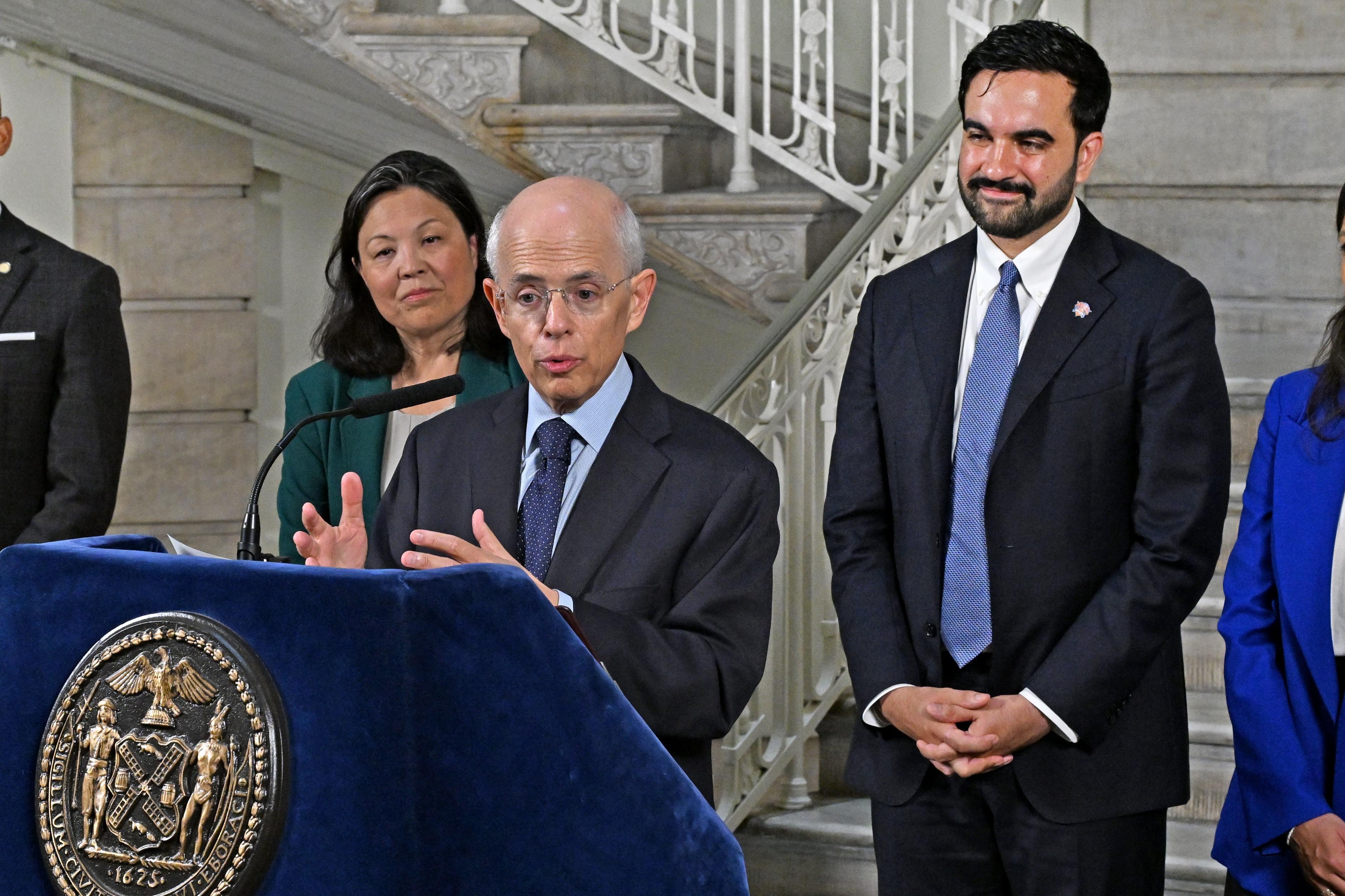
Make New York Post a Preferred Source Mayor Mamdani announced Anthony Shorris will be the new CEO of the Economic Development Corporation, and Lina Khan will be chair of the board of the EDC. Gregory P. Mango for NY Post New York City’s Economic Development Corporation has been a prime mover in promoting citywide prosperity and growth for 35 years.
But under the thumb of Mayor Zohran Mamdani, we might need to call it the Economic Stagnation Corporation instead.
That’s the takeaway from a speech by Anthony Shorris, Mamdani’s recently appointed EDC president and CEO.
Shorris’ under-the-radar keynote, delivered at City & State’s Sept. 17 “Economic and Workforce Development Summit,” means we should be afraid, very afraid, of the role he envisions for the agency.
The former deputy mayor under Bill de Blasio joined an administration whose hostility toward business enterprise is palpable.
As The Post reported this week, Mamdani’s “influencer” minions are plotting a smear campaign against the city’s top business leaders — apparently expanding on the mayor’s infamous tirade against Citadel founder Ken Griffin for owning a $238 million condo.
Never mind that Griffin’s companies employ thousands of New Yorkers, who paid over $2.3 billion in city and state taxes over the last five years.
In his speech, Shorris didn’t acknowledge the capitalists who make the city’s big spending possible.
But he charmingly referred to EDC board chairman Lina Khan — the anti-business crusader who headed Joe Biden’s overreaching Federal Trade Commission — as “my partner in crime.”
Yet in the rest of his remarks, the man entrusted with the indispensable, herculean task of promoting citywide business growth sure sounded like he’s swallowed Mandani’s socialistic Kool-Aid.
A crucial EDC mission entails creating the job-generating conditions that enable poorer citizens to enter the middle class.
Its role is not to shower citizens with government handouts that encourage them to remain poor.
Yet Shorris, parroting the rhetoric of Mamdani and his true believers, repeatedly referenced “inclusion” and “economic justice” as EDC goals.
Government, he said, should be “providing public goods that level the playing field . . . to restore a little bit the balance between working people and the wealthiest and the most powerful.”
He even cited the Marxist dream of a “mass engagement effort” to “make people in partnership with government concerns.”
Enthusing over Mamdani’s “culture of innovation and design,” Shorris cited the five government grocery stores that EDC is overseeing — and promised, “There is more to come.”
The discount food shops, which will cost millions of dollars in public funds and take years to launch, are folly enough.
But what else does Shorris have in mind — price controls on privately owned grocers?
“For too long, economic growth has fueled inequality,” Shorris declared.
“It doesn’t have to be that way, and our focus at EDC will be to make sure it does not.”
It’s hard to see how job-creation, real-estate development and corporate profitability have somehow hurt the Big Apple’s 8.5 million citizens.
If he truly believes it, Shorris needs to share his wisdom.
Exactly how, for example, did EDC’s push to restore the South Street Seaport’s landmarked Tin Building fuel inequality?
Or the $750 million investment EDC spearheaded to create 3,400 new homes in Coney Island, or the $112 million it contributed to design and build the High Line park?
Those are just a few of the EDC successes that have expanded New Yorkers’ opportunities and horizons.
EDC helped create modern industrial spaces at the Brooklyn Army Terminal, revitalize the Hunts Point Produce Market and food-distribution facilities in the South Bronx, and improve the business climate in neighborhoods like downtown Jamaica, Queens, and 125th Street in Harlem.
But Shorris’ remarks suggested his heart is in chump-change steps like “$7 million of investment in CUNY’s green workforce training infrastructure.”
Worst of all, he recoiled at the notion of “unbridled growth . . . at the expense of communities or opportunities or equity.”
Real-estate projects that create new homes or spread commercial opportunities have been anything but unbridled in recent years, despite the familiar anti-“gentrification” rhetoric community demagogues continue to recycle.
Most every privately backed development must navigate a thicket of guardrails, from zoning regulations to state oversight.
The single largest housing-development proposal now on the table — the Sunnyside rail yard in Queens — could create 12,000 affordable new homes on a deck above the tracks.
Maybe Shorris should have a talk with his boss, whose understanding of the site’s potential actually compelled him to seek some common ground with President Donald Trump.
Of course, acknowledging that would undercut Shorris’ whole argument that only “mass engagement,” whatever that actually means, can save us from inequality.