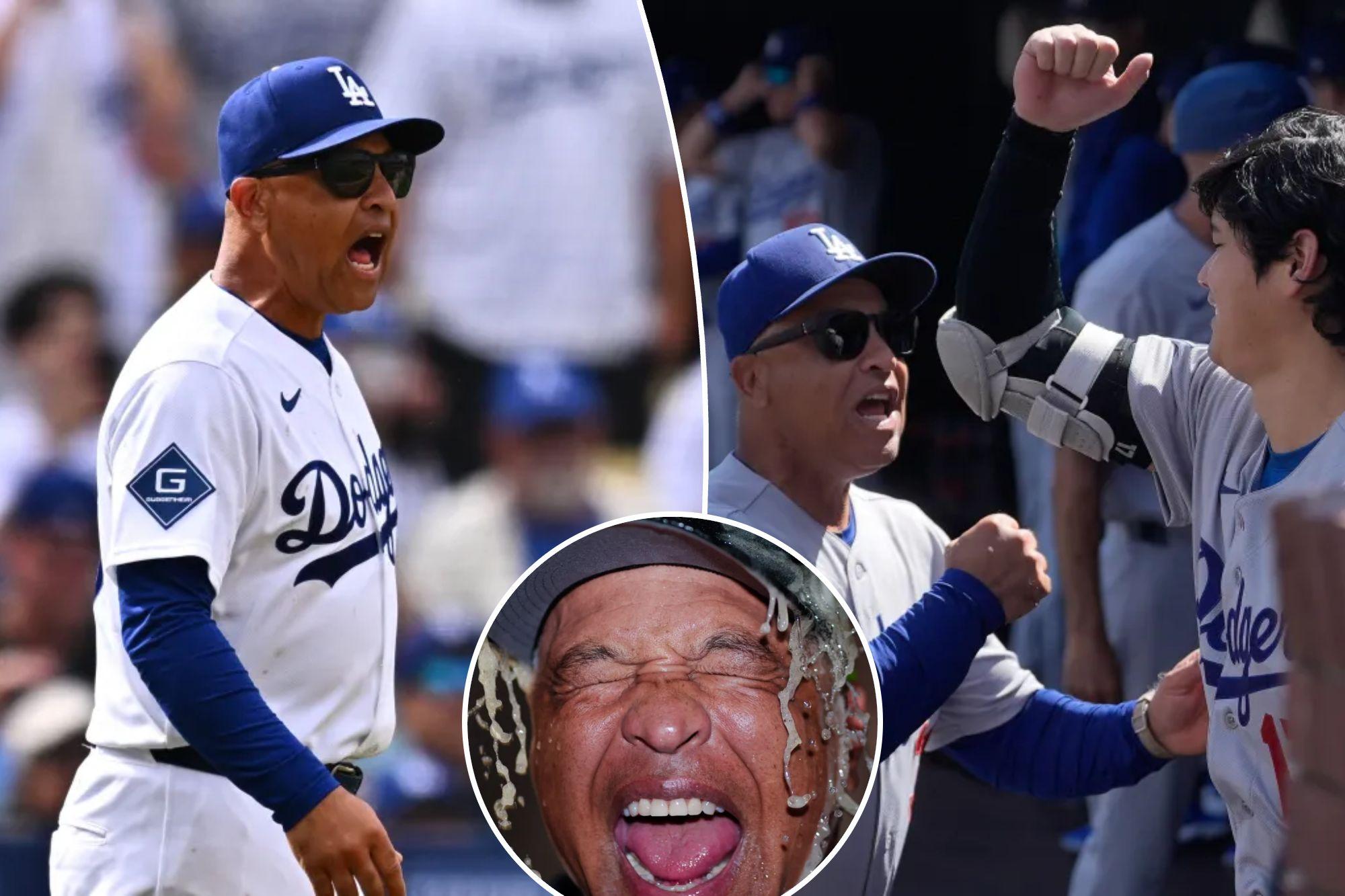
Make California Post a Preferred Source About a month before his team reported to spring training this year, Dodgers manager Dave Roberts sat on the balcony of an upscale restaurant near his offseason home in San Diego, recounting his journey from franchise scapegoat to championship leader.
The more Roberts spoke about his professional evolution, the more it became clear that he wasn’t just explaining who he was a manager at that moment.
“At 53,” Roberts said, “I feel I’m just scratching the surface.”
The Dodgers have a loaded starting rotation. They have an experienced but inconsistent lineup. They have a hodgepodge of a bullpen.
And they have another X-factor in Roberts, who ranks third all-time in playoff wins as a manager with 59. No other manager in this postseason field has won more than 26.
With the Dodgers reaching the playoffs in each of their 11 seasons under him, Roberts has already managed 117 postseason games.
The experience has resulted in a change in how he sees October games.
As the games unfold, he can better predict what will happen next. When making decisions, he doesn’t feel rushed.
That could be especially valuable in this postseason.
The Dodgers have an all-world rotation that includes Yoshinobu Yamamoto, Tarik Skubal, Blake Snell and Tyler Glasnow. They have two relievers they trust at the back of their bullpen in Tanner Scott and Roki Sasaki.
The question Roberts will have to face on most nights will be how to manage the innings that aren’t pitched by the starter, Scott or Sasaki.
When the Dodgers had a weak bullpen last year, Roberts’ approach was relatively straightforward: Ride the starters as long as possible, turn to them whenever possible.
Dodgers starters pitched into the seventh inning or beyond seven times last postseason. Yamamoto pitched two complete games. Snell made an eight-inning start. Three of the team’s four starters were used as relievers at some point, and the other, Shohei Ohtani, started Game 7 of the World Series on three-days’ rest. Yamamoto pitched the final 2 ⅔ innings of that game – a day after pitching six innings in a Game 6 win.
A repeat of that is entirely possible. But what the rotation did last year was historic and the counting on the group to do that again might not be realistic.
The advantage the Dodgers have this year is that their bullpen has more upside than it did last October, which should provide Roberts with a greater number of middle relief options. But every option carries significant risk.
Displaced $69-million closer Edwin Diaz had a nightmare of a regular season. Edgardo Henriquez is the hardest thrower on the team – and probably the most improved as well – but he missed the end of the regular season with a back injury. Fireman Alex Vesia posted his highest walk rate in five years. Evan Phillips has looked like a ninth-inning possibility on some nights but has been home-run prone. Converted starter Justin Wrobleski was an All-Star but had a rough second half of the season.
Roberts will be counted on to navigate the middle innings of this group, which could also include the left-handed Scott if a particularly dangerous group of left-handed hitters is due up at a critical juncture.
Whatever happens, the situation shouldn’t be nearly as complicated as it was during the Dodgers’ World Series run in 2024.
The Dodgers went into that postseason with only three viable starting pitchers – Yoshinobu Yamamoto, who was in his first year in the majors and limited to 90 regular-season innings because of shoulder problems; Jack Flaherty, a trade-deadline acquisition who posted a 4.99 earned-run average the previous year; and Walker Buehler, who registered a 5.38 ERA in his first season back from Tommy John surgery.
The limited number of starting pitchers forced the Dodgers into a bullpen game at least once in every series. He was forced to punt certain games to preserve the little pitching he had for the future.
As chaotic as it looked from the outside, Roberts said he was clear-headed.
“I couldn’t have said that in ‘16, ‘17, ‘18,” he said.
Roberts mentioned how athletes decline after playing a certain number of years.
“But with coaching, your best years are with experience and as you get older,” he said. “That’s the irony. And I do feel that I’m much more wise. My decision-making, I feel, has gotten even better. My feel for the game.”
Now on the brink of a three-peat, the Dodgers might be more reliant on that feel than they ever have.