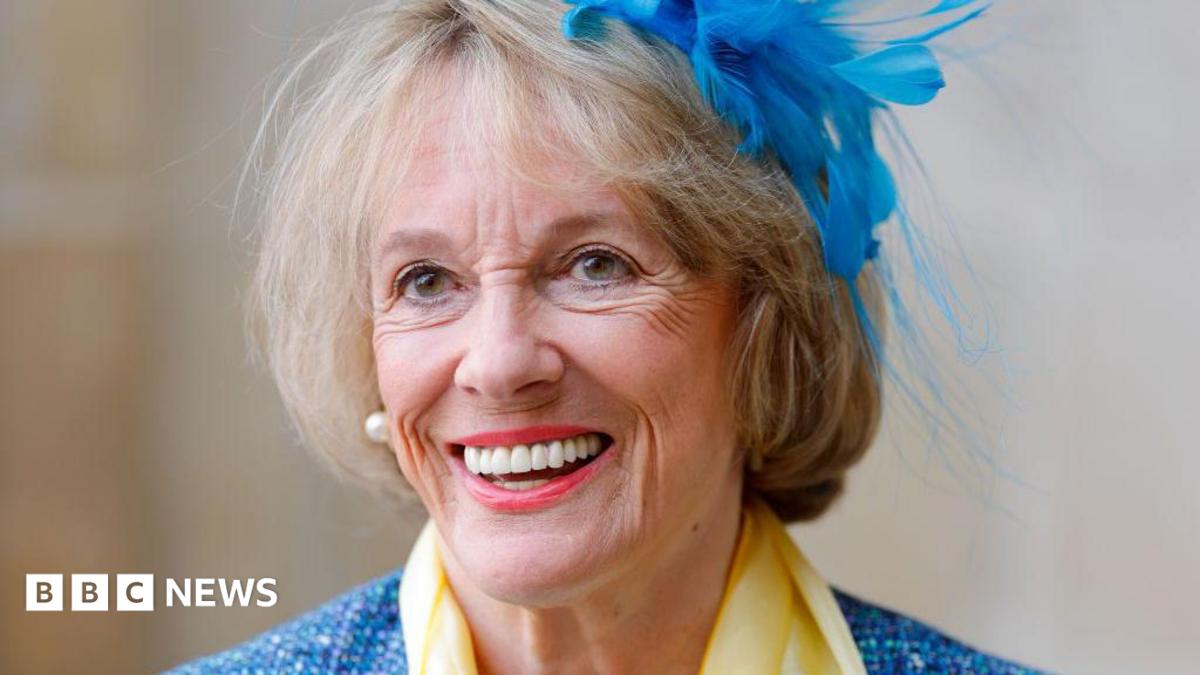
Image source, Getty ImagesPublished8 minutes agoDame Esther Rantzen, who has died at the age of 86, was best known for presenting the BBC TV programme That's Life!
Over two decades, what started as a consumer programme with quirky asides became renowned for its high-profile campaigns, notably against child abuse.
It resulted in Dame Esther setting up Childline, a national telephone helpline for children suffering abuse or neglect.
She later became a renowned campaigner for older people and, in the last years of her life, for the legalisation of medically-assisted death.
Esther Louise Rantzen was born in Berkhamsted, Hertfordshire on 22 June 1940. Her paternal ancestors were Polish Jews.
Her father, Henry, who worked as a broadcast engineer for the BBC, had moved the family out of London to escape German bombing.
The family returned to London when the war ended. She later recalled she hated the grey streets of the capital after the semi-rural idyll in which she had spent her early childhood.
After a spell at a private school, run by what she recalled was a sadistic headmistress, she went to the North London Collegiate School in Edgware, and then to Somerville College, Oxford, where she read English.
Image caption, Rantzen [centre] had an idyllic early childhood
She became an enthusiastic member of the Oxford University Dramatic Society and of the Experimental Theatre Group.
Rantzen then secured a job as a trainee studio manager with BBC Radio, before moving to television as a researcher on the satirical show BBC3, which had been created by Ned Sherrin.
She met documentary maker Desmond Wilcox when she approached him in a BBC bar and asked him to give a talk to a local youth club.
He asked her to dinner and offered her a job on Man Alive, the BBC's current affairs programme. The pair later began a relationship.
The relationship caused huge tensions in her department, not least because Wilcox's wife Patsy, one of Rantzen's best friends, also worked at the BBC.
By 1968, she was working on Braden's Week, a consumer programme fronted by Canadian presenter Bernard Braden.
A decision to allow the researchers a short spot on air gave Rantzen her first on-screen TV experience, where she made a favourable impression on the producers.
In 1972, Braden was sacked by the BBC after he appeared in a commercial for Stork margarine and his show was dropped.
A year later, the programme was resurrected, given a new title, That's Life! and Rantzen was selected as the main presenter.
Image caption, Dame Esther made her first TV appearance on Braden's Week
Braden was sanguine about Rantzen's promotion but his wife, TV presenter Barbara Kelly, was publicly contemptuous of the decision and accused Wilcox of being instrumental in her appointment.
Launched in May 1973, That's Life! became an almost instant hit.
Recorded just before transmission on Saturday nights, it was initially a consumer protection programme investigating viewers' complaints about shoddy service and faulty goods.
Over the years it grew to include more quirky items.
It initiated the Jobsworth award for over-zealous bureaucrats and council officials, and Heap of the Week, in which failing domestic appliances would be destroyed on screen in a variety of ingenious ways.
Over the years, Rantzen was joined by a series of co-hosts, including Paul Heiney, Chris Searle and Bob Wellings, while the comedian Cyril Fletcher read his Odd Odes.
The show quickly became something of an institution but her relationship with Wilcox was causing problems behind the scenes.
Patsy Wilcox had reluctantly agreed to a divorce after Rantzen became pregnant, and Rantzen and Wilcox went on to marry in 1977.
But there were accusations from some BBC staff that Wilcox, who was her boss as well as her husband, was furthering her career, pointing out that BBC rules forbade married couples working together.
Wilcox resigned in 1980 and set up his own successful production company.
Rantzen also found time to devise a new talent series, The Big Time, which launched the career of singer Sheena Easton.
She became involved with the team behind the new ITV breakfast programme, TV-am, but dropped out before it went to air in 1983 so that she could remain at the BBC.
By the 1980s, That's Life! had expanded its remit away from basic consumer issues to take on the role of campaigner.
The appearance of Ben Hardwick, a child desperately in need of a liver transplant, launched a drive to raise the awareness of the need for organ donors. As a result, Ben received a new liver at the age of two, but died a year later.
Other campaigns helped introduce the replacement of hard surfaces in children's playgrounds with softer material and a change in the law to enforce the wearing of children's seat belts in the rear of cars.
Not everyone was happy with the new format and there were complaints that a serious, and sometimes emotionally draining sequence, was followed by a quirky item on, for example, rude-looking vegetables.
The programme continued to maintain its high viewing figures after a move to Sunday nights, but the television landscape was changing.
The BBC's show Watchdog and ITV's The Cook Report were bringing a much harder edge to consumer journalism.
Image source, PAImage caption, The death of Desmond Wilcox prompted Rantzen to launch a campaign to support older, lonely people
The final That's Life! was broadcast on 19 June 1994 and featured a look back at both the highlights of the programme and Rantzen's own campaigning.
Possibly the most important and lasting result of any That's Life! campaign was the setting up of Childline in 1986. It followed a number of incidents, featured on the programme, including one in which a toddler had starved to death, locked in a bedroom.
Rantzen persuaded the BBC after the programme was transmitted that a helpline should be set up so that children suffering abuse or neglect could call in confidence. In the 48 hours it was open, it was inundated with calls.
This led to Rantzen campaigning for a 24/7 service to be set up. Childcare professionals claimed it would be impossible but she managed both to raise the money and persuade BT to provide premises and a free phone line.
Rantzen also devised and presented Hearts of Gold, a programme that celebrated previously unknown people who had been responsible for good deeds.
When That's Life! came off air, Rantzen continued to present her own afternoon talk show, entitled Esther, on BBC Two. It ran for 600 episodes and received two Bafta nominations.
Desmond Wilcox died in 2000 leaving Rantzen bereft. She wrote a series of articles about the problem of loneliness among older people, which she described as "a creeping enemy which erodes confidence."
She eventually set up The Silver Line, a 24/7 phone support system which offered advice, information and support to those who felt alone and unwanted.
Image source, Dave Benett Collection via Getty ImagesImage caption, Dame Esther set up Childline after a feature on That's Life! about a toddler who had starved to death, locked in a bedroom
Rantzen also went on to make an appearance on the ITV show I'm a Celebrity, Get Me Out of Here in 2008.
She wrote a number of regular columns for newspapers and magazines and also involved herself with more than 50 charities.
Following the MPs' expenses scandal in 2009, Rantzen announced she would stand for parliament in Luton South.
She pitched herself against the sitting Labour MP, Margaret Moran, who had claimed expenses in excess of £23,000 for her second home in Southampton.
Moran stood down two days later but Rantzen fought the seat in the 2010 General Election, coming fourth with just over 4% of the vote.
Rantzen was made an OBE in 1991 and CBE in 2006. In the 2015 New Year Honours list, she was appointed a Dame Commander in recognition of the two helpline services she set up.
The following year she warned of the social media pressure on children in the digital world, urging families to "be aware" of the issue.
Speaking on Desert Island Discs in 2019, Dame Esther told presenter Lauren Laverne that her own broadcasting career would not be as successful if she had joined the industry now as a young woman, because she would not be "pretty enough".
In an interview with The Mirror in June 2023, she spoke about her diagnosis with stage-four lung cancer.
It "made me realise how very lucky I've been in my life," she said, "working with Childline and the Silver Line, and meeting so many fascinating and inspiring people".
"I'm not good at regrets. What I treasure most are the fantastic friendships I have made thanks to That's Life! during the last 50 years, the people I met, and the team who worked so hard, and laughed so hard, together for so long."
Six months later, she told The Times she did not expect to live much longer.
"Last January," she explained, "I assumed that I would probably not be around for my birthday in June, and that I'd definitely miss this Christmas."
"But when I met my oncologist I realised how ignorant I was and what gargantuan strides medicine has made recently."
"Has my diagnosis taught me any lessons valuable enough to pass on? The cliché is live each day as if it's your last and treasure every moment."
Image source, PA MediaImage caption, Dame Esther's advice: "Live each day as if it's your last and treasure every moment"
In December 2023, Dame Esther said that she was taking a "miracle" treatment for her lung cancer, adding that she might "buzz off to Zurich" - where assisted dying is legal - if it did not work.
A year later, she witnessed the House of Commons vote in favour of the first stage of a Bill that might make a medically-assisted death legal in England and Wales. A similar bill was introduced to the Scottish Parliament.
Although Dame Esther knew that she would not live long enough to take advantage of any new law, she said she wanted to protect other families from "the same agonising experience".
"In the olden days, doctors would ease you out of life and the difference was it wasn't necessarily with your consent," she said.
In March 2025, her daughter confirmed that the drug that had kept Dame Esther alive since her cancer diagnosis was no longer working. They had always known that its effects would be temporary.
Last December, she told a newspaper that she was planning "an 'official' Christmas with my children and five grandchildren, slightly ahead of the real Christmas so that there will be more chance that I am actually alive to enjoy it with them!"
In September 2026, the House of Commons voted against the Assisted Dying Bill, a decision Dame Esther described as "a tragic day".
She added that she was now too frail to travel to Switzerland to end her life.
"Everything I didn't want to happen I'm having to go through now," she said, "which means that the people I love and care about either cannot visit me, or when they do, see me suffering pain or indignity which will inevitably get between them and our shared happy memories, and may even overwhelm the way they think of me."
The broadcaster and campaigner was once asked about what drove her to get involved in a multitude of causes.
"I need to be needed," she said. "It's what makes you get up in the morning, and makes you feel when you go to bed that the day has been well spent.
"There's a real pleasure in feeling somebody needs your help and that you actually have made a difference."