Video Expert: NATO Must Take Russia’s Kaliningrad Threat ‘Very Seriously’ Professor Azeem Ibrahim says Russia’s heavily militarized Baltic enclave has become a testing ground for hybrid warfare targeting European infrastructure.
Russia’s warning that it could resort to nuclear weapons if NATO attempts to isolate Kaliningrad is raising new concerns that the heavily militarized Russian exclave could become a flashpoint between Moscow and the alliance, as experts warn the territory is already being used to pressure Europe through hybrid warfare.
Moscow warned NATO in a diplomatic document that it was prepared to use "the entire arsenal of forces and capabilities at its disposal, including nuclear weapons" if alliance members attempted to isolate Kaliningrad from the rest of Russia, Reuters reported Wednesday.
Kaliningrad, a Russian territory geographically separated from the Russian mainland, sits on the Baltic Sea between NATO members Poland and Lithuania and hosts significant Russian military assets, including elements of Moscow’s Baltic Fleet.
RUSSIA THREATENS STRIKES ON UK MILITARY TARGETS, ‘CATASTROPHIC CONSEQUENCES’ OVER UKRAINE
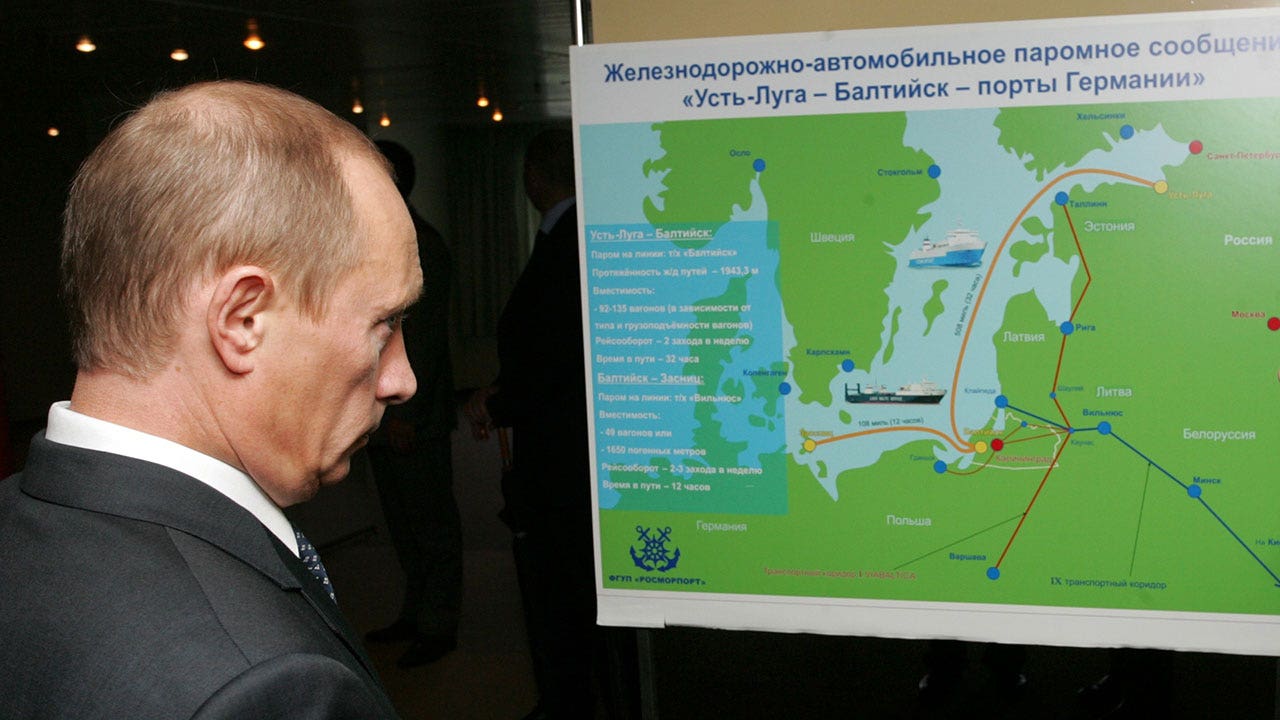
Russian President Vladimir Putin ((L) looks on a map with new ferry route that will allow trains to travel between the Kaliningrad exclave and the rest of Russia without traversing other countries, as they must when traveling by land, Russia RUSSIA - Sept. 10, 2006 (Konstantin ZAVRAZHIN/Gamma-Rapho via Getty Images)
The Russian document also raised the possibility of strikes against "decision-making centers" in NATO member states from the outset of a conflict.
NATO rejected Moscow’s allegations in a response reviewed by Fox News Digital, saying the alliance is defensive and that none of its exercises or activities threaten Russian territory. The alliance also urged Russia to stop its "irresponsible nuclear rhetoric."
Carrie Filipetti, executive director of the Vandenberg Coalition, a nonpartisan network of foreign policy leaders, told Fox News Digital that Moscow has repeatedly used nuclear threats as a means of trying to deter Western support for Ukraine.
"Russia has threatened to use nuclear weapons in the past, including veiled references to tactical nuclear attacks at the beginning of Putin's invasion of Ukraine, lowering their formal threshold for launching a nuclear attack in 2024, placing Russia's nuclear forces on high alert, and restarting nuclear testing," Filipetti said. "It is very common for Putin to use these threats, because he sees it as a way to deter Europe and the United States from continuing to support Ukraine."
SHE GREW UP UNDER SOVIET RULE. NOW EU'S TOP DIPLOMAT WARNS EUROPE AGAINST GIVING RUSSIA WHAT IT WANTS
BALTIC SEA (June 5, 2025) The Blue Ridge-class command and control ship USS Mount Whitney (LCC 20) participates in exercise Baltic Operations 2025 (BALTOPS 25) as ships sail in formation through the Baltic Sea, June 5, 2025. BALTOPS 25, the premiere maritime-focused exercise in the Baltic Region, provides a unique training opportunity to strengthen combined response capabilities critical to preserving freedom of navigation and security in the Baltic Sea. (U.S. Navy Courtesy Photo)
"The threat about a nuclear attack if Kaliningrad is threatened or isolated comes on the heels of a few developments," she added, pointing to NATO jets being scrambled over Russian aircraft, U.S. and NATO air drills near Kaliningrad last month and heightened tensions over the war in Ukraine.
Filipetti, who also served as a deputy assistant secretary at the State Department and as a senior policy advisor for the United States Mission to the United Nations (USUN), argued that the timing also reflects mounting pressure on Moscow as the war continues.
"Putin seems to understand that the tide is turning against him, and he's resorting to aggressive rhetoric to try to stop European support for Ukraine as he has tried to do in the past," she said.
Dr. Azeem Ibrahim, a research professor at the Strategic Studies Institute at the U.S. Army War College and chief strategy officer at the New Lines Institute, told Fox News Digital that NATO should take the warning seriously, particularly because of the broader role Kaliningrad is already playing in Moscow’s confrontation with Europe.
BATTLE-TESTED ZELENSKYY SOUNDS CHILLING ALARM ON WHERE PUTIN’S WAR COULD HEAD NEXT
NATO's largest annual maritime drill, Exercise Dynamic Mariner / Flotex 25, continues in the Gulf of Cadiz off southern Spain on March 28, 2025. NATO's Exercise Dynamic Mariner / Flotex 25, running from March 24 to April 4 in the western Mediterranean and Atlantic, involves six nations and 1,500 personnel. The drill strengthens cooperation, readiness, and maritime security while preparing the Spanish Navy for its NATO role in July. Turkiye will assume command of the Allied Reaction Force's Amphibious Task Force and Landing Force for the first time in July. (Photo by Burak Akbulut/Anadolu via Getty Images)
Ibrahim argued that while NATO has traditionally prepared for conventional military conflict involving "tanks and troops and divisions," Russia is increasingly using methods designed to disrupt the infrastructure and systems on which civilian societies depend.
"Russia is actually adopting a very different approach," he said, describing a strategy of hybrid warfare targeting "infrastructure" and "societies in general — what keeps societies functioning."
Ibrahim described Kaliningrad as the "front line" of that effort.
"It’s essentially become a Russian fortress," he said. "This is essentially a front-line operation of the Russians in terms of signals intelligence, signals interference and essentially mechanisms by which to carry out this hybrid warfare."
Such interference, Ibrahim said, could play a role in the broader confrontation by disrupting civilian communications and infrastructure before or alongside a conventional military attack.
"All of that would be preceded by interference operations like this to ensure that societies are not functioning, are not able to respond to emergency services, the news information services, etc.," Ibrahim said. "So governments lose control over what actually makes societies function."
RUSSIA'S SHADOW WAR IS PUTTING EUROPE ON EDGE AS GERMANY CONFRONTS A GROWING THREAT
Soldiers from Poland’s 18th Division demonstrate battlefield medical training near the Belarus border after a serviceman from the division was killed in an attack by an illegal migrant. May 16th, 2026. (Efrat Lachter/Fox News Digital)
The challenge for NATO, he said, is that such operations can be more difficult to attribute than a conventional assault.
"Many times, you cannot trace exactly where a lot of this interference is actually coming from — attacks on power stations or internet and telecommunications, et cetera," Ibrahim said. "There’s always some sort of plausible deniability if it’s done by an actor who's very capable."
The ambiguity, Ibrhaim argued, presents a challenge for an alliance built atround collective defense armed attack.
"NATO really does have to kind of reconfigure its posture to understand that these kinds of attacks are equivalent to essentially any sort of kinetic attack," he said.
Asked what NATO and neighboring Poland and Lithuania should do following Russia’s warning, Ibrahim called for the alliance to establish clearer consequences for hybrid attacks.
"We now need to start going on the offensive in terms of hybrid warfare and understanding the threat and pushing back and sending a very clear signal to Moscow that such threats will not stand," he said, arguing that a sufficiently serious hybrid attack should be considered capable of triggering NATO’s Article 5 collective-defense clause.
Lithuania, which directly borders Kaliningrad, rejected Moscow’s warning and accused Russia of trying to undermine NATO unity and Western support for Ukraine.
"Russia’s insinuations and threats have no basis. NATO is a defensive Alliance and poses no threat to Russia or any other country," Lithuania’s Foreign Ministry told Fox News Digital. "Russia’s threatening is intended to fracture transatlantic unity and impede our support to Ukraine. Russia will not achieve its goals."
The ministry added: "We strongly condemn any threats to use force and irresponsible nuclear rhetoric. Russia must stop its aggression against Ukraine… Lithuania is strengthening its national defense system and capabilities, including air defense," the ministry said. "We train with our allies and work alongside NATO forces deployed in Lithuania. We are prepared to defend every inch of NATO territory and respond to any threats."
The ministry said Lithuania would also continue providing "comprehensive support to Ukraine and its fight against the aggressor Russia.
Retired Air Force Lt Gen Richard Newton told Fox News Digital that, "In the weeks leading up to February 2022, many officials and commentators (myself included) weren't sure Putin would actually invade Ukraine, even though there were a number of warnings and indicators he would do so. And then on that Feb 24th, Putin launched the largest land invasion against Ukraine since World War II."
US ALLIES NEED TO SHOOT DOWN RUSSIAN AIRCRAFT TESTING NATO BOUNDARIES, CZECH PRESIDENT WARNS
A razor-wire boundary fence is seen along the Polish-Lithuanian border with the Russian exclave of Kaliningrad near the village of Grzybina, Podlaskie Voivodeship, near the Suwalki Gap on September 26, 2026. The Suwalki Gap is a 104-kilometre stretch of the Polish-Lithuanian border that forms the only land corridor connecting the Baltic states with the rest of NATO, while separating Belarus from Russia's Kaliningrad exclave. (Photo by Sergei GAPON / AFP via Getty Images)
"NATO should take Russia's warning seriously that it could resort to employing nuclear weapons against the alliance should Kaliningrad be cut off from Russia. We are in the midst of Russia employing "gray zone" coercive actions against NATO nations, so this pronouncement should not surprise the West," he added.
Filipetti cautioned that regardless of whether Moscow intends to follow through, nuclear threats themselves carry risks.
"NATO is a defensive organization that is in no way threatening Russia's position on Kaliningrad," she said. "That said, any time there is a public threat of nuclear attack it must be taken seriously, especially with someone like Putin."
"Nuclear bombs are a potentially world-altering technology," Filipetti added. "It is not only their use, but the threat of their use, that could cause significant miscalculations and escalations."
Russia has denied Western accusations that it is conducting hybrid warfare against European states and has said it has no intention of attacking NATO countries. Moscow says NATO military activity around Kaliningrad is instead contributing to an increasingly dangerous confrontation.
Kremlin spokesman Dmitry Peskov characterized recent Russian warnings as diplomatic reminders to "hotheads in Europe," Reuters reported Wednesday.
CLICK HERE TO DOWNLOAD THE FOX NEWS APP
An office building burns following a Russian drone attack in central Odesa, Ukraine, on Friday, Sept. 18, 2026. (Michael Shtekel/AP)
Fox News Digital reached out to the Polish and Russian embassies for comment but did not receive responses in time for publication.
Efrat (Effie) Lachter is a reporter for Fox News Digital with more than 15 years of experience covering conflict, global affairs, human rights and political accountability. She has directed and produced more than 200 documentary segments across more than 40 countries, documenting conflicts, humanitarian crises, corruption, human trafficking, gender-based violence and the human stories behind major world events.
Lachter’s reporting has taken her into conflict zones and crisis areas across the Middle East, Europe, Asia and Africa. Her work has included uncovering human trafficking networks, revealing an ISIS underground torture prison in Syria, documenting the war in Ukraine and interviewing senior political figures and world leaders. She was also among the Western journalists who entered Russia after the war began to bring testimonies from Putin’s opposition. Lachter is the recipient of the 2022 Peres Center for Peace Award and was a 2023–2024 Knight-Wallace Journalism Fellow at the University of Michigan. She also won two Rockower Awards for Excellence in Reporting. She holds a bachelor's degree in communication and a master's degree in political science.