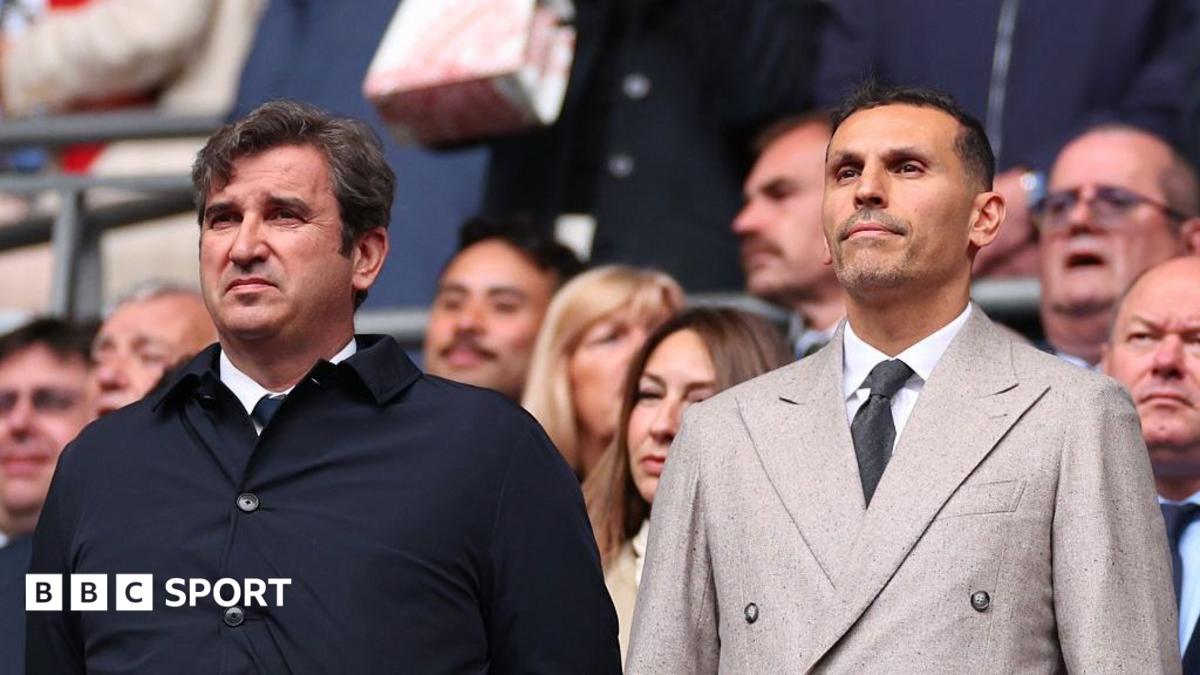
Image source, Getty ImagesImage caption, Manchester City CEO Ferran Soriano (left) and chairman Khaldoon Al Mubarak have continued to insist that the club is innocent despite the guilty verdicts
The verdict that football fans around the world had been awaiting for years is in - Manchester City are guilty.
The club still insists it is innocent of the financial rule-breaking charges first brought against it by the Premier League in 2023, and can appeal, so the legal wrangling is far from over.
And the verdict has unleashed some huge questions for both the near and long-term future.
BBC Sport has taken a look at the key issues in the case and what we know about each of them so far.
The deadline for Man City to make their appeal is Friday. In previous instances - including the guilty verdicts and punishments handed out when Everton and Nottingham Forest breached spending rules - the appeal was heard and a decision made before the sanctions against the clubs was announced.
So precedent indicates that City's appeal will be considered and decided upon before punishments are declared.
But how long that process - which will be heard by a new three-person commission - will take is unclear.
Man City cannot make a further appeal to the Court of Arbitration for Sport, but could potentially claim the process was not impartial at the High Court.
The Premier League's statement, formally announcing the guilty verdicts read on Monday, said it wants the process to be "concluded as soon as possible".
The phrasing may not offer any exact insight but the tone - of both the statement, and the strong language used in the independent commission's findings about the length of time the case has taken - is notable.
"It has taken us much longer than we would have wished, and much longer than we had anticipated would be the case when the hearing concluded, to produce our decision," the commission wrote. "That is regrettable."
It is clear that those in charge want the matter wrapped as quickly as can be done.
Image source, Getty ImagesImage caption, Erling Haaland's goals have powered Manchester City to the top of the Premier League, but whether they are truly in a title challenge is unclear until sanctions are known
And it is arguably to the benefit of both Manchester City and all of the other clubs in the Premier League and English Football League to know where they stand sooner rather than later.
City are top of the Premier League, having taken a maximum 15 points from their opening five matches, but whether they are genuinely in a title race will be unclear as long as players, fans, and club owners are in the dark about what their punishment will be.
Were the appeal and sanctions process to drag on beyond the end of the season, it would be possible that legal challenges could be brought by teams who finished below City in the table, or are relegated, or were knocked out by them in the domestic cups, which would be far less viable if the club's 'real' position is known before that point.
The first is that one of the sanctions Manchester City are given is so significant a points deduction that they finish this season (or another future campaign, if the process takes longer) in the Premier League's bottom three and are automatically relegated to the Championship.
The second scenario is that they are expelled by the Premier League, which would require 15 of their rival clubs to vote in favour of a motion decreeing so.
Were that to happen, the club's future would be much less clear and would require them to apply to the Football Association for re-entry.
Because the EFL and National League are separate entities from the Premier League, neither would necessarily be obliged to accept an entry request from Manchester City.
And, even if a request were accepted by the EFL, its 72 clubs would have to vote whether or not to accept them.
That is where the possibility of City beginning a reascent in League Two - or potentially even lower - arises from.
There is a huge sporting and financial difference between dropping down to the Championship, with the high possibility of being promoted back to the Premier League after a single season, and starting again far lower down the pyramid.
When Juventus were relegated from Serie A to Serie B in Italy, after being found guilty of match-fixing charges in 2006, they were able to retain some of the world's best players, including Gianluigi Buffon, Pavel Nedved and David Trezeguet.
Image source, Getty ImagesImage caption, Players like Fabio Cannavaro, Patrick Vieira and Gianluca Zambrotta left Juventus after their enforced relegation, but Gianluigi Buffon stayed and captained the club to the title
They were willing to put up with a single season in a lower tier and, when the club returned to Serie A after winning the Serie B title, they immediately finished third and qualified for the Champions League.
If City faced only a single season outside the Premier League, players on long, lucrative contracts would likely be far more inclined to stay, and the economic damage of losing access to the top flight's TV rights income would be hugely reduced.
Could the charges become a legal or criminal investigation?The Fraud Act 2006 states that dishonestly making a false representation with the intention of making a gain or avoiding a loss can lead to individuals being imprisoned for 10 years and facing an unlimited fine, if charges are brought and proven.
"Surely the Man City findings are now a police matter," said Lord Cruddas, a banker and businessman.
"If accounts have been falsified and auditors have been misled then it is potentially a criminal matter. The auditors will call in the police, directors are personally liable for any fraud of a UK company even if it is foreign-owned."
For the case to move from football wrongdoing to something more, there would first need to be an investigation by the relevant authorities.
The bodies who can investigate potential financial crimes in the UK include regional police forces, the National Crime Agency, HMRC and the Serious Fraud Office.
BBC Sport has contacted each of those bodies and been given no indication that any kind of investigation has begun, but some do not routinely confirm investigations owing to confidentiality.
But former Manchester City chairman David Bernstein - who left the club five years before its current owners took control - raised the possibility during an interview on BBC Radio 5 Live.
"This is very serious and I wonder whether some of these issues might need to be referred to authorities outside of the league," Bernstein said.
"My immediate thoughts are - can the board of directors continue and should the people involved be suspended immediately?"
Football finance expert Kieran Maguire feels wider investigation may be unlikely.
"HMRC might consider it but there is not a lot for them to go on," he said. "There is certainly no corporation tax to recover. Football clubs lose money and City would have lost more money had it not been for the activities it undertook."
Fans and pundits have been making the point since news of Manchester City's guilt first broke - if they deliberately flounced the rules over the course of nine years, how can their owners possibly be trusted to run the club moving forward?
There is potentially a role to be played by the Independent Football Regulator (IFR), which was established in 2025 with the goals of protecting the heritage of English football, ensuring the financial soundness of clubs and promoting resilience in the ownership and spending of clubs.
The IFR awards licences to all 116 clubs in English football's top five tiers, which permits them to operate.
Club owners, directors and senior executives are subject to an enhanced suitability framework - a beefed-up version of the old-school 'fit-and-proper person's test'.
The Football Governance Act 2025 allows the IFR to suspend or revoke licences awarded to clubs as a last resort in cases of wrongdoing.
And there is another possible scenario too - government intervention.
In 2022 Roman Abramovich was forced to sell Chelsea by the UK government, following the launch of Russia's full-scale invasion of Ukraine. Abramovich's background as an oligarch meant the government froze his assets and threatened to conduct a full seizure.
The Manchester City owners are not subject to any action by the UK government, and all that has been formally declared is that the club broke football financial rules.
But the precedent exists that the government can be part of a process in which a football club owner is ousted.
Relations between the UK and UAE - whose royal family controls City's ownership group - were previously strong but have weakened to a degree in recent years.
Any form of ousting would prove a severe test of diplomacy.
£1.2bn on transfers with £830m inflated in sponsorships - Man City's 'asterisk era'
The intricate web Man City spun to con the Premier League
Richards 'devastated' by Man City guilty verdicts