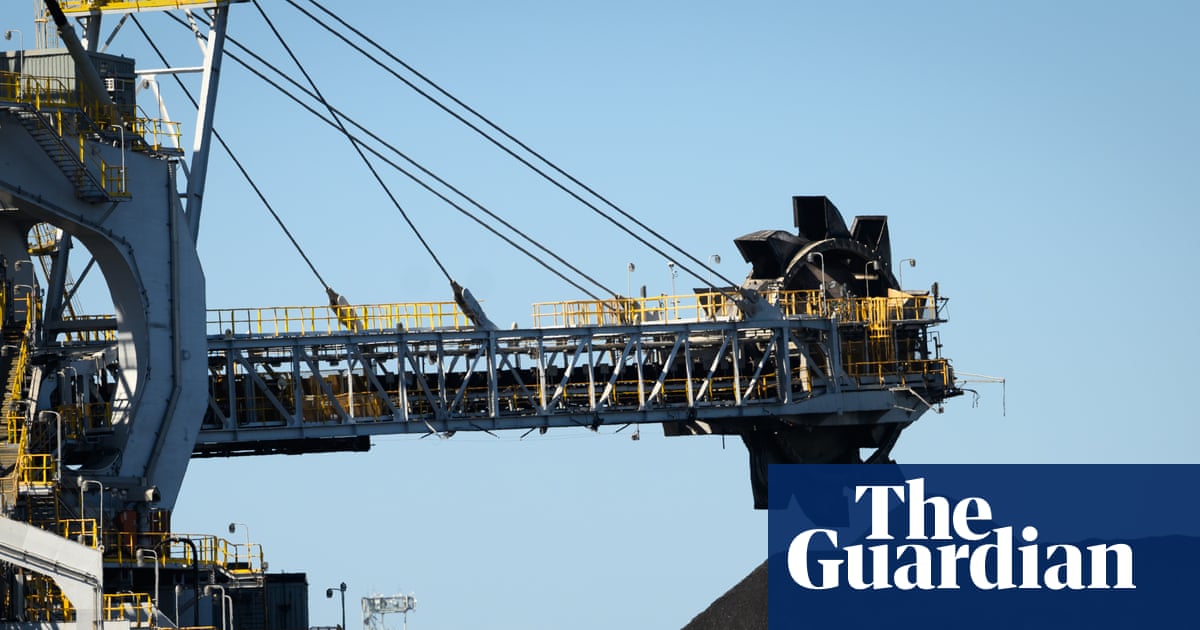
Urgewald tracked loans and underwriting from 744 commercial banks around the world to companies operating across the ‘coal value chain’. Photograph: Dan Himbrechts/AAPView image in fullscreenUrgewald tracked loans and underwriting from 744 commercial banks around the world to companies operating across the ‘coal value chain’. Photograph: Dan Himbrechts/AAPUK banks are Europe’s biggest coal financiers, report findsStudy says UK-based banks provided $8.3bn in coal financing in four years, with Barclays and HSBC leading rise
UK banks are Europe’s biggest financial backers of the global coal industry, providing billions of pounds in funding for the climate-wrecking fossil fuel in the past four years, according to a report.
The study found UK-based banks had provided $8.3bn (£6.2bn) in coal financing since Cop26 in Glasgow in 2021, when global leaders pledged to “phase down” coal use. This compared with $4.9bn from German banks and $3.4bn from French banks over the same period.
The sums provided by UK banks were largely driven by Barclays and HSBC, which both increased their coal financing between 2022 and 2025 despite high-profile climate and net zero commitments, according to the research.
It found Barclays’ coal financing increased by 34%, from approximately $1.2bn in 2022 to $1.6bn in 2025, while HSBC’s more than doubled from $200m to $414m.
The research was carried out by Urgewald, a Germany-based environmental and human rights organisation. It tracked loans and underwriting from 744 commercial banks around the world to companies operating across the “coal value chain” – those organisations involved in every aspect of the industry, from mines and power generation to logistics, exploration and trading organisations.
Heffa Schücking, the director of Urgewald, said: “Barclays and HSBC should explain why their financing is moving in the opposite direction to the rest of Europe.”
A spokesperson for HSBC said the bank had committed to phasing out financing “for thermal coal-fired power and thermal coal mining” by 2030 in EU and OECD markets and by 2040 in other markets.
They added: “These commitments support our ambition to align the financed emissions in our portfolio with net zero by 2050. As reported in our 2025 annual report and accounts, financed emissions from thermal coal mining fell by 94% between 2020 and 2024, while reported thermal coal financing exposures, calculated on the basis set out in our disclosures, fell from approximately $1bn to approximately $0.5bn over the same period.”
A spokesperson for Barclays said many of the companies named in the report were “diversified energy or mining companies”. They said Barclays did not provide financing to companies that generated “more than 30% of revenues from thermal coal mining or power generation”.
“Barclays is financing an energy sector in transition, providing finance to meet current energy needs and also financing the scaling of clean energy,” the spokesperson said. “Over the past three years we have facilitated more than $300bn of sustainable and transition finance, including billions to cleaner energy projects, and invested millions into climate tech.”
Urgewald defended its definition of companies in the “coal value chain”, saying it was widely accepted by many financial institutions.
Its report found that although some UK banks had reduced their coal financing, the overall financial flows from Britain-based banks to the “coal value chain” grew by 17% over the period. This compares with a 46% reduction overall from EU banks.
Globally, Urgewald found that between 2022 and 2025 bank financing for coal remained broadly flat, averaging about $117bn a year, despite the commitment made at Cop26 in Glasgow.
However, researchers said the headline figure concealed a growing divide within the banking industry, with Chinese and US banks increasing their funding.
The study found Chinese banks accounted for 62% of global coal financing, providing $289bn, an 8% rise over the four-year period. US banks provided $67bn, a rise of 23%, while Indonesian banks increased their coal financing by 64%, from $1.4bn in 2022 to $2.3bn.
By contrast, banks in the EU, Taiwan, Malaysia and Thailand significantly reduced their coal financing.
Schücking, welcomed the decrease, saying it showed that a clear coal policy could “disrupt the flow of money to the industry”.
But she cautioned that this progress was “being swallowed up” by rising coal finance elsewhere. “Banks still funding coal cannot hide behind distant climate promises. They need policies that rule out new coal and bring their financing down now,” she said.