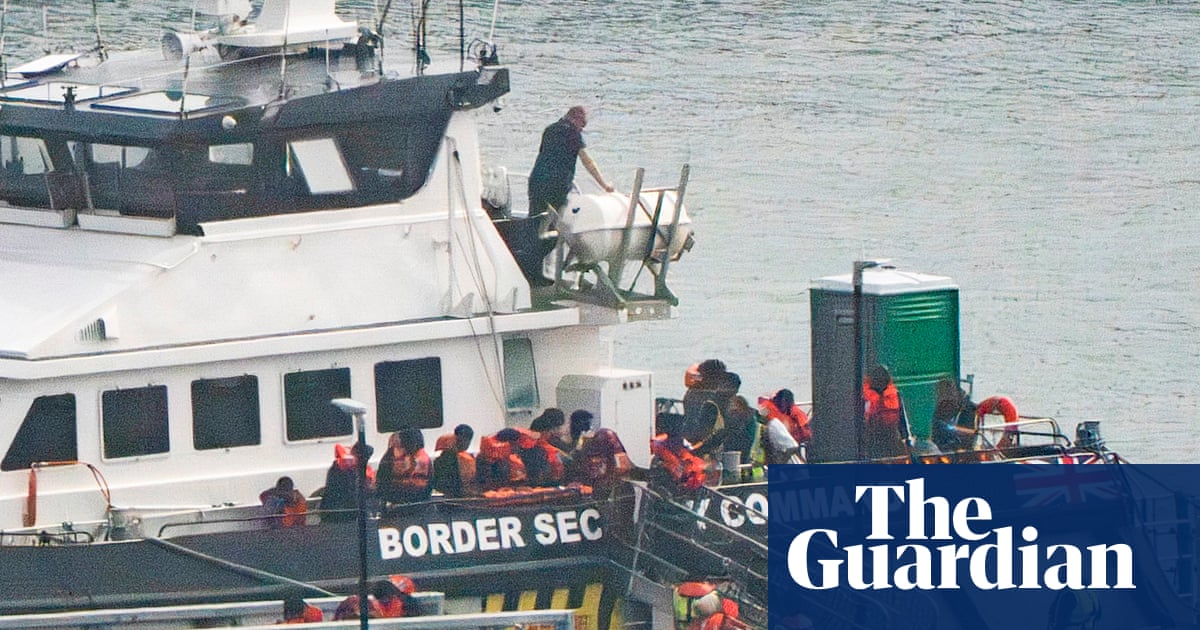
A group of people arrive at the Border Security Command compound in Dover, Kent. Photograph: Gareth Fuller/PAView image in fullscreenA group of people arrive at the Border Security Command compound in Dover, Kent. Photograph: Gareth Fuller/PAUK-France ‘one in one out’ deal to expire on Thursday, say sourcesDeal aimed at deterring small boat arrivals set to end as talks stall over French demand for EU-wide scheme
The UK government’s “one in one out” deal with France, which was supposed to help deter small boat arrivals, is expected to expire on Thursday, government sources have said.
It is understood that negotiations have stalled over French demands for a Europe-wide deal instead, and a reluctance to scale up the numbers of people exchanged between the two countries.
Flights that remove people who have been already detained under the scheme will continue, but they are expected to end within weeks.
A UK government source confirmed that the expectation was that the deal would be formally drawn to a close on Thursday.
“We would like to see the deal continue. But its not the end of the world if it doesn’t because it never got to the scale where it would have been a proper deterrent to people coming to the UK in small boats,” the source said.
Negotiations in Paris over how best to tie up the deal are continuing between Home Office staff and their French counterparts.
More than 1.400 people who have arrived in the UK via small boats have been sent back to France under the deal while a reciprocal number of asylum seekers with links to the UK have been flown to the UK from France.
The deal was set to expire in April but was extended to 1 October to help counter the anticipated increase in attempted crossings during the summer.
The scheme was announced by Keir Starmer and the French president, Emmanuel Macron, in July 2025, with the first flights taking off in September of that year.
France has insisted it was a time-limited pilot. But ministers wanted to increase the numbers removed as a deterrent to crossings.
In June, Laurent Nuñez, France’s interior minister, lauded the scheme as a potential deterrent but still said France was not prepared to go it alone with Britain.
“According to information from the UN high commissioner for refugees, word of the scheme is beginning to spread, which is prompting a number of migrants to abandon their plans to make the crossing,” Mr Nuñez told a parliamentary commission.
“The value of this scheme is therefore clear. Nevertheless, we consider that France should not bear the burden alone, and that it would be better to incorporate it into an agreement between the EU and the UK.
“I have therefore already made it clear to my counterpart that this pilot agreement, which we signed in August 2025, was not intended to be extended beyond 1 October 2026.”
An EU-wide returns deal known as the Dublin agreement existed before the UK left the EU. Attempts to continue the returns deal post-Brexit have been rejected by EU leaders.
Shabana Mahmood, the home secretary, disclosed to MPs earlier this month that the deal cost about £56,000 for every person sent back to France.
She also dismissed suggestions that an EU-wide system would be a “silver bullet” for the Channel crisis.
“It is a real mistake to think that that pact is the future. And if we were in that, this problem would go away because I promise you, it would not,” she said.
She said the government’s scheme had struggled to scale up to larger numbers of returns, adding that it had been “operationally difficult” to increase removals because of constraints such as detention space.
“It’s not been without its challenges. Obviously, the numbers are still relatively small,” she said.
Between January and 27 September, a total of 19,135 people crossed the English Channel by small boat from France. This was down by 42% on the same period the previous year.