play Live Sign upShow navigation menuplay Live Click here to searchsearchSign upNews|ElectionsMorocco’s pro-Palestine protests challenge Rabat’s deepening Israel tiesProtests across Morocco highlight gap between public opposition to normalisation and Rabat’s closer ties with Israel.
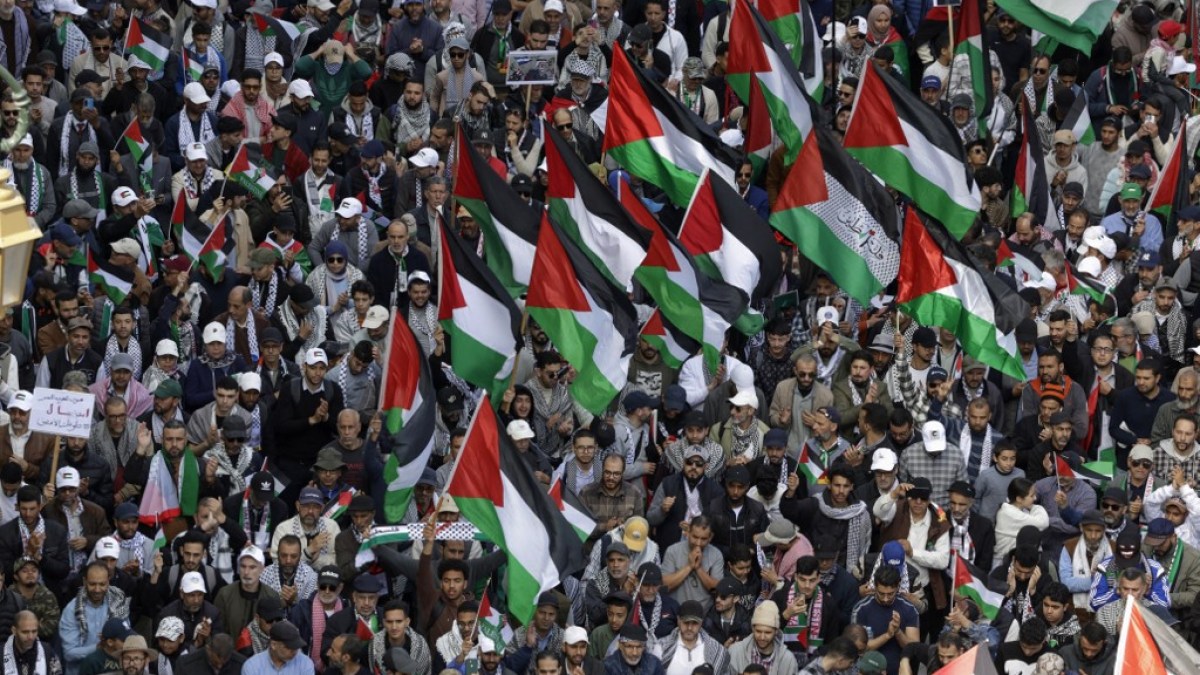
xwhatsapp-strokecopylinkgoogleAdd Al Jazeera on GoogleinfoPeople wave Palestinian flags during a pro-Palestinian march in Rabat, Morocco, amid opposition to Israel’s Israel's genocidal war on Gaza [Abdel Majid Bziout/AFP]By Al Jazeera staffPublished On 30 Sep 202630 Sep 2026Pro-Palestine protests have spread across several Moroccan cities, with demonstrators demanding an end to diplomatic normalisation with Israel as Rabat deepens ties with Tel Aviv.
The latest mobilisation took place on September 27, at the end of three days of action called by the Moroccan Front for Supporting Palestine and Against Normalisation.
They followed a September 16 announcement that Morocco and Israel would elevate their diplomatic missions to full embassies and appoint ambassadors.
On September 25, the Moroccan Committee for Supporting the Nation’s Causes said it had organised 76 events in 45 cities under the slogan “Friday for Al-Aqsa and against normalisation”.
Moroccan media reported gatherings in cities including Rabat, Casablanca, Marrakesh, Tangier, Fez, Agadir, Oujda, Tetouan, Kenitra and Sale. The 76-event figure was the committee’s own count, with no independent national tally of participants.
In Rabat, protesters gathered outside Parliament, while a demonstration in Marrakesh developed into a march through several main streets, according to Lakome. Moroccan media also reported restrictions and arrests in some cities.
The mobilisation faced restrictions in some cities.
In Tangier, local authorities issued a decision banning a planned demonstration on September 27. Achkayen later reported that security forces dispersed hundreds of participants and that more than 12 people were detained, citing its own sources.
Lakome reported that authorities also prevented demonstrations in M’diq, while security forces surrounded a gathering in Agadir to prevent it from becoming a march.
The Moroccan Committee for Supporting the Nation’s Causes subsequently condemned what it described as bans, restrictions and arrests.
The response underscored another dimension of the dispute: Opposition to the relationship with Israel has remained visible on the streets, even as the government has continued to develop official ties.
Morocco restored diplomatic relations with Israel in December 2020 as part of the US-brokered Abraham Accords framework, alongside Washington’s recognition of Moroccan sovereignty over Western Sahara.
On September 16, Moroccan Foreign Minister Nasser Bourita and Israeli Foreign Minister Gideon Saar met in New York at a trilateral summit hosted by US Ambassador to the United Nations Mike Waltz.
The three countries confirmed plans to elevate the Moroccan and Israeli diplomatic missions to full embassies and exchange ambassadors.
Morocco and Israel also agreed to conclude agreements on investment protection and avoiding double taxation, expand direct flights and organise high-level reciprocal visits.
The move therefore goes beyond maintaining diplomatic relations established in 2020. It sets out a broader programme of institutional, economic and transport links between the two countries.
For opponents of the relationship, the embassy agreement represents another step in a policy they have rejected since 2020.
Morocco has maintained diplomatic relations with Israel while continuing to publicly support the Palestinian cause and the establishment of a Palestinian state.
For opponents of normalisation, however, the two positions are incompatible, particularly amid Israel’s genocidal war on Gaza.
“What has changed is the political context: Normalisation is being consolidated at a time when the war in Gaza has generated unprecedented public anger and intense images of Palestinian suffering,” Kathya K Berrada, senior programmes manager at the Arab Center for Research, told Al Jazeera.
“What we are seeing in Morocco is a growing disconnect between official diplomacy and public sentiment,” Moroccan activist Mouna Rahiani said, citing the latest Arab Opinion Index, which found that 89 percent of Moroccans surveyed opposed their country recognising Israel, while six percent supported it.
“While the state is moving towards deeper and more formal relations with Israel, Moroccans are still taking to the streets to say that Palestine cannot be treated as separate from our political and moral responsibilities,” she said.
The September agreement has brought an existing tension into sharper focus: public mobilisation against normalisation continues while the state pursues closer institutional ties with Israel.
Berrada said there was an important distinction between official policy and popular opinion, arguing that there is not enough reliable public data to establish how many Moroccans support or oppose normalisation.
The timing also matters for Morocco’s Western Sahara policy. The United Nations Security Council is due to consider the mandate of the UN Mission for the Referendum in Western Sahara (MINURSO) in October. Its current mandate runs until October 31, 2026.
The September 16 trilateral statement came against the backdrop of US recognition of Moroccan sovereignty over Western Sahara and Israel’s support for Morocco’s position on the territory.
For Rabat, the relationship with Israel sits within a wider foreign-policy framework in which ties with Washington and international support for its position on Western Sahara remain important.
For opponents of normalisation, however, that strategic calculation does not resolve their objection to closer ties with Israel, particularly while the Palestinian issue remains highly salient.
Ahmed, a Moroccan sociologist who asked to be identified by one name, said the September 16 move was “a continuation of the trilateral agreement of December 10, 2020”, but that Morocco should make the relationship “comprehensive, not selective or partial”.
The protests came days after Morocco held parliamentary elections on September 23.
The final results gave the Authenticity and Modernity Party 97 of the 395 seats, followed by the National Rally of Independents with 66, the Istiqlal Party with 65 and the Party of Justice and Development (PJD) with 54.
The PJD had won 13 seats in 2021. Turnout was 38.08 percent, compared with 50.86 percent in 2021 and 42.27 percent in 2016, according to Morocco’s Ministry of Interior.
It was the PJD in power when Morocco restored relations with Israel in 2020. Then-Prime Minister Saadeddine el-Othmani signed the Morocco-US-Israel joint declaration that December.
The PJD has maintained that opposition to normalisation was a longstanding party position. The party subsequently reaffirmed its rejection of normalisation and relations with Israel, while el-Othmani defended the 2020 decision as a state-level decision.
On September 17, following the announcement of the planned diplomatic upgrade, the PJD’s general secretariat reiterated its opposition to normalisation and to relations and agreements with Israel.
After the election, the PJD’s national council unanimously decided to remain in parliamentary opposition and not participate in the next government.
The PJD’s position has illustrated the limits of using party politics to measure the effect of opposition to normalisation. The party opposed the policy while in government, yet its prime minister signed the 2020 declaration.
Its larger parliamentary presence in 2026 gives the issue a stronger political platform, but does not by itself alter Morocco’s foreign policy.
It has not been established that the Palestine issue or opposition to normalisation was a decisive factor in voting, and neither do the PJD’s gains demonstrate that its position on Israel directly drove its increased representation.
The September demonstrations show that organisations opposed to normalisation retain the ability to mobilise across a wide geographic area. But their effect on government policy is less clear.
“There is an important distinction between state policy and popular opinion. Normalisation is an official state decision, but there is limited reliable public data allowing us to measure the level of popular support for it,” Berrada said.
“It would therefore be difficult to claim that either a majority or a minority of Moroccans endorse the policy.”
That distinction is important when assessing the significance of the protests. Demonstrations can show the strength and persistence of organised opposition, but they do not by themselves establish the views of the wider population or show that government policy will change.
The PJD now has a larger parliamentary presence than it did after the 2021 election, but it remains in opposition. It will be able to voice its opposition to normalisation in Parliament, but will not have a place in government.
At the same time, the September 16 agreement remains part of a broader Moroccan foreign-policy framework involving the United States, Israel and Western Sahara. The Security Council’s consideration of MINURSO in October will provide another diplomatic setting in which Morocco’s position on the territory is under discussion.
For now, the protests demonstrate that opposition to normalisation remains capable of sustained mobilisation, while the government continues to deepen the relationship. Whether that public opposition translates into sustained political pressure remains less clear.