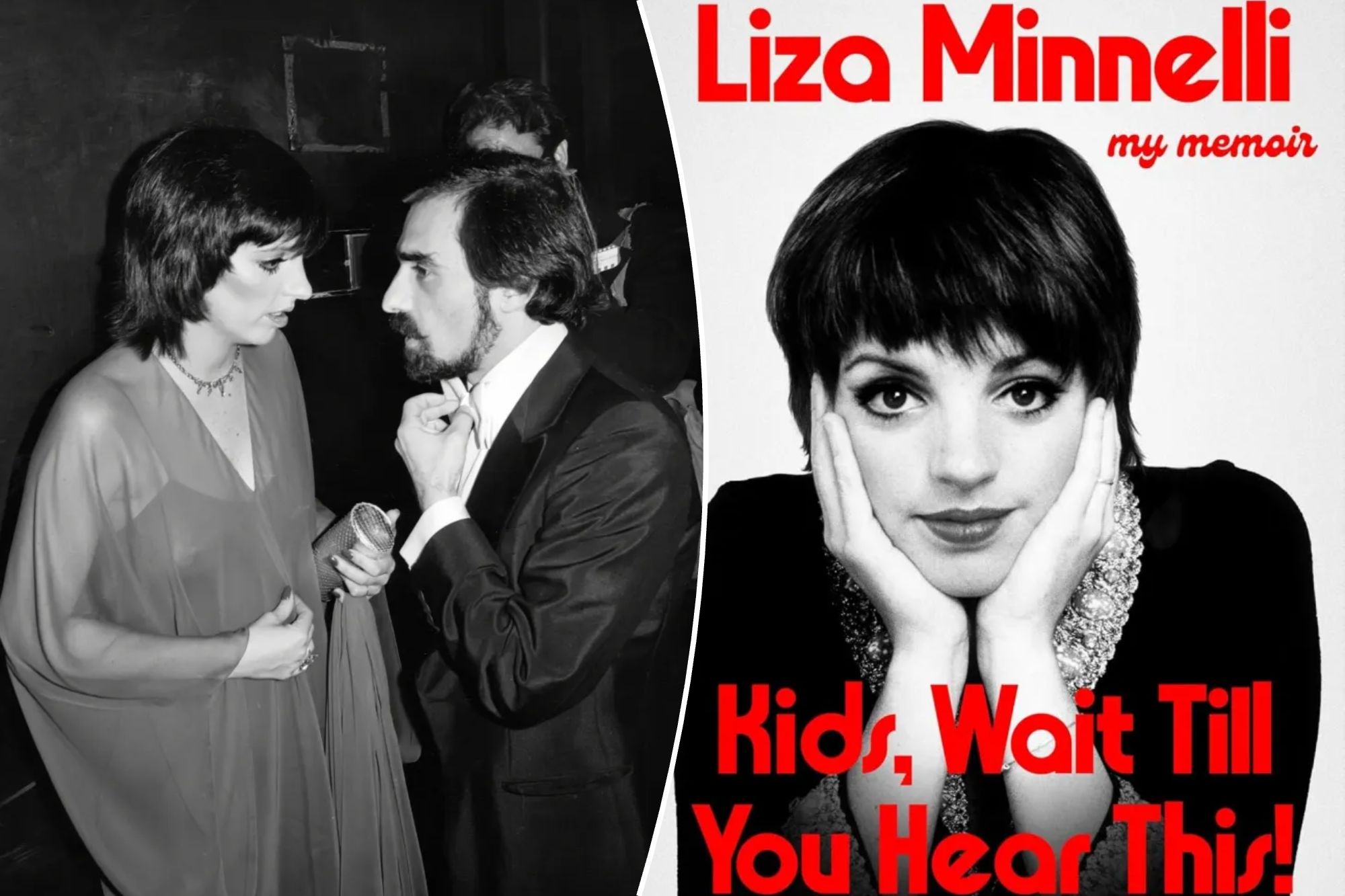
Liza Minnelli and “Godfather” director Martin Scorsese had a tumultuous secret affair with “more layers than a lasagne”— as they sank into a deep pit of drug addiction together.
In her new memoir, “Kids, Wait Till You Hear This!” Minnelli, 79, details how she fell for Scorsese on the set of their 1977 movie musical, “New York, New York,” while they were married to other people.
Both had “volcanic tempers” and things were so intense that Minnelli and her then-husband, Jack Haley, once ran into Scorsese in Greenwich Village — and the director berated her because he’d heard she was also having an affair with Mikhail Baryshnikov.
Minnelli does admit to sleeping with the Russian ballet dancer.
“How can you do this to me. How can you do this to me!” Scorsese, now 83, yelled at her.
She blames the affair on “amour fou. The French term for a passionate relationship that becomes a self destructive obsession … The relationship becomes a powerful hypnotic drug in every way.”
“As we filmed, Marty became a heavier and heavier user of cocaine. It seemed that it was no longer recreational for either of us. It was day and night. On the set, in between takes, and when we went out in the evening,” Minnelli writes.
“We were constant companions and I was right there beside him. Line by line, Marty claimed the drug helped his creative juices. Sure it did. Or is that just one more fabulous lie you tell yourself when you’re in the grip of substance use?”
The Post has reached out to Scorsese’s representative for comment.
During the affair, the “Cabaret” icon was wed to second husband Jack Haley Jr. — whose father played the Tin Man in “The Wizard of Oz” alongside Minnelli’s mother, Judy Garland, as Dorothy. Scorsese was married to second wife Julia Cameron, the mother of his daughter Domenica, at the time.
“We were on a runaway train,” Minnelli writes of the affair. “Nothing good could come of it.”
She recalls how one incident popped up in Andy Warhol’s published diaries, when she and Scorsese turned up late one night at the Manhtan home of fashion designer Halston.
“‘Give me all the drugs you’ve got,'” I said, and he handed over some cocaine, marijuana, Valium and quaaludes,” she writes. “Then Marty, who had been waiting around the corner, came up to Halston and kissed him on the cheek. We thanked him and said goodbye.”
Meanwhile, their movie rocketed past its $7 million budget, to $12 million, and took 22 weeks to complete instead of the planned 14.
When released, “it did not live up to box office expectations,” Minnelli admits.
Her illicit affair with Scorsese continued after the film premiered, when she demanded that he direct her new Broadway musical, “The Act,” even though he had never before helmed a big stage show.
But Scorsese sent up a “red flag” when he walked into the theater and insisted on a dressing room, something a director never has.
Minnelli ended up having to fire her lover, even though “it damn near killed me and broke my heart.”
Scorsese, meanwhile, was “exhausted … and a steady diet of hostility and substances certainly wasn’t helping matters. As it turns out, his life was in jeopardy, and he is now able to admit that he ended up in the hospital cheating death.”
Pal Robert De Niro gave Scorsese a dose of “very tough love” in the hospital, Minnelli writes, telling him he had to get himself together for his young daughter. The actor also convinced him to direct “Raging Bull,” a movie that would change both their lives, earning Scorsese Best Director and Best Picture nominations at the Oscars in 1981.
And yet, the affair continued, even though Minnelli was still married and missing performances due to the “steady impact of drugs and alcohol.”
And “not all of the bad feelings have healed,” Minnelli admits. “Years later, I saw Marty at the Oscars ceremony in 2014 and walked up to say hello. Unfortunately he turned away from me. Very sad.”
The four-times-married Minnelli — who calls herself the original “nepo baby,” as she was born to Garland and “An American in Paris” director Vincente Minnelli — also details how addiction was in her blood. Garland struggled for years before her death from an accidental barbiturate overdose at age 47, in 1969.
Lifelong friend Elizabeth Taylor told Minnelli that Minnelli would die if she did not go to rehab, leading to her checking into the Betty Ford Clinic in 1984.
After undergoing a hip replacement, she abused Oxycontin and, in 2000, staffers found her collapsed at home.
“It looked like I had suffered a major stroke,” she said. “Fire department officials said I was paralyzed on one side of my body. My speech was slurred, my facial muscles sagging. Dr Maurice Hanson, a respected neurologist, later told the press that I had a severe case of encephalitis — a sudden inflammation of the brain that can be fatal.”
She admits to lying to the press, saying it was from a mosquito bite.
In reality, friends found 60 Oxy pills stashed under her mattress and around the house. “I can’t remember how many prescription bottles were in my bathroom and bedroom,” Minnelli notes.
Minnelli writes of being so messed up on drugs and alcohol in 2003 that she passed out on a Lexington Avenue sidewalk — with New Yorkers “who didn’t give a damn who I was” stepping over her.
But now, Minnelli says, she has been sober for 11 years — her last stint in rehab was at a Malibu recovery center in 2015.
“It’s the great personal victory of my life. But let me warn you — I’m not talking about a slam dunk triumph over addiction. An addict is always in recovery or dying.”