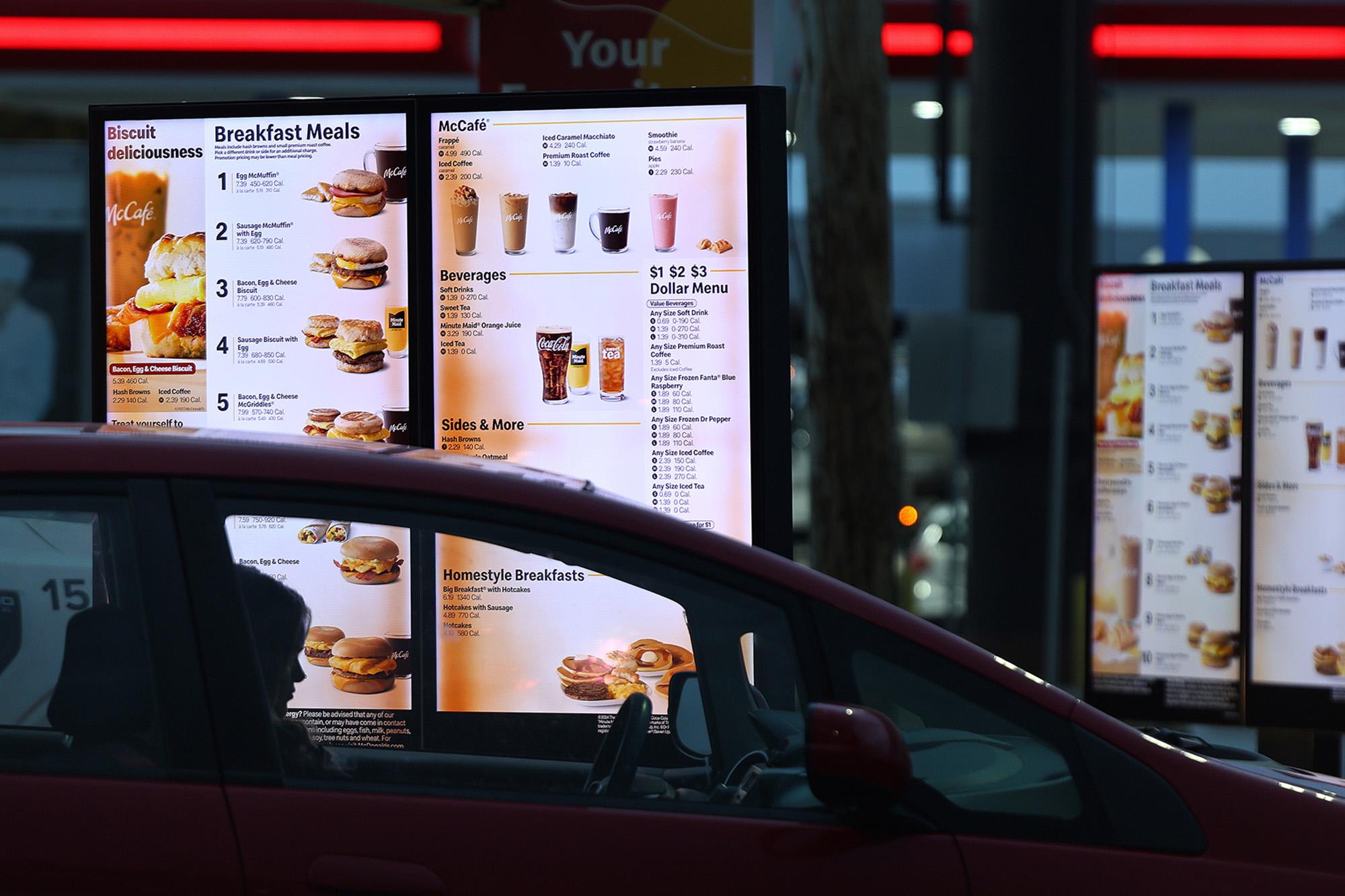
Make New York Post a Preferred Source McDonald’s has ramped up its use of AI to guide menu prices at restaurants across the country as it tries to boost profits – risking backlash from regulators and customers already fed up with surveillance pricing tactics.
The world’s largest fast-food chain has increasingly been pushing franchisees to use an AI-powered algorithm that analyzes data across McDonald’s 14,000 restaurants to estimate “customer willingness to pay in your area,” according to a Reuters report.
At a McDonald’s store in Fresno, Calif., for example, a Big Mac costs $5.69, according to the company’s mobile app. But at a location just two miles away, customers need to fork over $6.89 for the same burger.
It’s unclear how much of that price difference is the result of the algorithm’s suggestions and the franchisee’s own discretion, since owners always have the final say in setting prices.
Franchisees told Reuters that the algorithm has widened the gap between prices on identical items at various restaurants within the same neighborhoods.
The AI platform also includes public pricing information from nearby rival chains like Wendy’s and Burger King, according to the report. The two fast-food chains have said they do not use AI in pricing decisions.
A spokesperson for McDonald’s argued the Reuters report was misleading since the AI algorithm does not set prices in real time, but only suggests prices to franchisees, who make their own decisions.
“These speculative and uninformed claims attempt to recast a standard business practice as something controversial. AI does not set the price of a Big Mac or any other menu item,” the spokesperson told The Post.
“The use of pricing recommendation tools and analytics is widespread across industries,” he added. “The pricing portal is a tool, not a mandate, designed to provide restaurant-specific recommendations to help franchisees deliver value for customers and make informed business decisions.”
But five store owners told Reuters the company pressured them to use the pricing tools. A franchisee document showed McDonald’s had started tracking in detail how much restaurants deviated from the suggested prices.
George Michell, a Connecticut franchisee, sued McDonald’s after his restaurant was flamed online for charging $18 for a Big Mac meal, alleging the AI tools suggested that price. He also accused the company of trying to oust him for discriminatory reasons.
McDonald’s has disputed the claims in the lawsuit and alleged Michell repeatedly violated his franchise agreements. The case is ongoing, though claims related to McDonald’s breach of conduct have been dismissed.
In January, McDonald’s updated its business standards to require franchisees to be “constructively engaging with McDonald’s approved Pricing Consultant and Tools,” according to a message sent to franchisees.
During an investor presentation last week, McDonald’s said its “industry-leading” pricing algorithm was essential to its bet on affordability, as it has lost out on low-income and inflation-battered customers.
The company has leaned into value meals and actually tried to lower prices when possible to draw more customers and boost sales – because McDonald’s makes most of its money by taking a chunk of franchisees’ total revenue, so their profit margins don’t really matter.
Franchisees, however, are reluctant to slash prices and add deals to their menus as they face rising costs, so some of them have ignored McDonald’s repeated suggestions.
During the company’s August earnings call, CEO Chris Kempczinski called out store owners who chose not to implement the company’s Under $3 Menu – about a third of total franchisees – saying their “business results (were) a lot softer.”
He added that “pricing non-compliance in certain cases” is part of “conversations” about whether franchisees can renew their leases or open new locations.
AI tools and dynamic pricing tactics – which actually change prices in real time based on demand – have faced heated backlash from consumers, who feel they’re being taken advantage of while already facing stubbornly high inflation.
In 2024, Wendy’s quickly backtracked on a plan to start testing “dynamic pricing” on digital menu boards after it faced outcry from customers online.
Instacart in December swiftly ended a controversial program that charged customers different prices for the same product ordered at the same time from the same store.
The new pricing tools have also faced antitrust concerns from regulators over concerns they could amount to illicit coordination between competitors.
On McDonald’s pricing portal, for example, the legal terms warn that franchisees risk antitrust scrutiny since other franchisee owners using the same tool may be considered “competitors,” according to the Reuters report.
McDonald’s said it takes its responsibility to follow all laws seriously and is committed to complying with those laws.