Two recently opened bridges are expected to ease trade and transport between North Korea and its powerful neighbors. The new connections come as Pyongyang builds strategic ties with China and Russia.
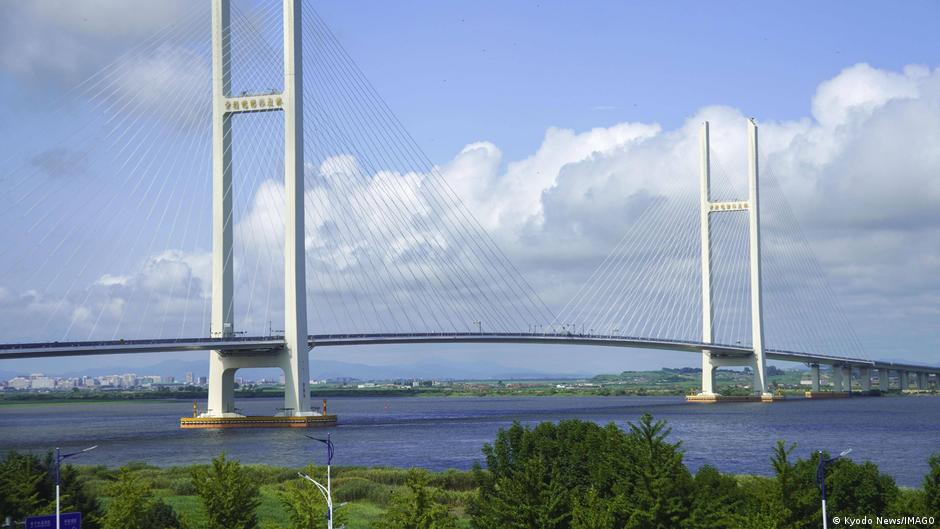
https://p.dw.com/p/5NSoPStretching 3 kilometers, the New Yalu River bridge can carry more traffic and ease trade Image: Kyodo News/IMAGOAdvertisementA long-delayed bridge linking North Korea and China could finally open in early October, more than a decade after its completion, as Pyongyang simultaneously expands transport links with Russia.
South Korean news outlets have reported that the New Yalu River Bridge, connecting China's northeastern city of Dandong with the trade hub of Sinuiju in northwestern North Korea, could formally open by October 6, which marks the 77th anniversary of North Korea-China diplomatic relations.
Analysis published by the 38 North think tank showed significant progress on customs, immigration and warehouse facilities on the North Korean side, where construction had remained largely unfinished for years.
The cable-stayed New Yalu River Bridge is located about 15 kilometers (9 miles) downstream toward the Yellow Sea from the older crossings connecting central Dandong and Sinuiju.
The four-lane road bridge stretches over 3,000 meters across the river, with a network of approach roads connecting it to the surrounding areas.
It was intended to ease pressure on the aging Sino-Korean Friendship Bridge, which carries both road and rail traffic and remains one of the most important routes between North Korea and China, Pyongyang's top trading partner.
The expected opening of the improved link with China comes after a road bridge crossing the Tumen River located across the peninsula was opened on September 7 connecting North Korea's Rason region with Khasan in Russia's Primorsky region.
Until then, the two countries' narrow land border had been connected by rail but not by road.
"North Korea allowed the Chinese bridge to sit unused for more than a decade, but North Korea hurried more than Russia did," Han Ki-bum, a former deputy director of South Korea's National Intelligence Service, told DW.
That difference, he argues, provides clues to Pyongyang's strategy, which appears to be deliberately managing the pace of its improving relations with Russia and China to avoid returning to excessive dependence on Beijing.
"If it depends too much on China as it did in the past, North Korea's autonomy could be undermined," Han said, adding that Pyongyang is seeking to take advantage of good ties with both China and Russia while preserving its independence.
The former Unification Ministry official added that Russia has an interest in expanding transport routes through North Korea toward the Pacific, including through the port of Rajin, while Pyongyang could benefit from increased trade, tourism and opportunities to send workers to Russia.
He added that Russia needs North Korean labor, arguing that North Korean workers are more diligent than their Russian counterparts.
China, meanwhile, has its own reasons to ensure that North Korea does not become excessively reliant on Russia, the former official said.
"From China's perspective, it needs to keep North Korea from leaning too far toward Russia," Han said.
Ties between Moscow and Pyongyang have grown since 2023, when North Korea began providing weapons and troops for the Ukraine war. As the Russia-North Korea strategic relationship has deepened, China has been taking steps to reassert itself as the North's primary partner.
Ahn Chan-il, a former North Korean soldier who now heads the World Institute for North Korea Studies in Seoul, said the bridges have added geopolitical implications.
"Pyongyang could now use its deepening ties with China and Russia, along with Trump's interest in engaging Kim, to strengthen its diplomatic leverage and take a more assertive approach toward South Korea," Ahn told DW.
Pyongyang virtually sealed its borders during the COVID-19 pandemic, sharply reducing trade and restricting even the entry of foreign diplomats.
Cross-border freight trains between Dandong and Sinuiju resumed in 2022. Passenger trains followed on March 12 this year, restoring rail travel between North Korea and China for the first time in six years.
Why a new Russia-North Korea road bridge worries UkraineTo view this video please enable JavaScript, and consider upgrading to a web browser that supports HTML5 video
Ahn described the prospective bridge opening as historically significant.
"The New Yalu River Bridge is effectively the first modern bridge between North Korea and China," Ahn said.
Plans for a new bridge date to 2009, when then-Chinese Premier Wen Jiabao and North Korean officialsagreed on the project to relieve the Sino-Korean Friendship Bridge, built in 1943.
Construction on the new bridge began in 2011, largely financed by Beijing, and the bridge itself was essentially completed in 2014. The opening was complicated by delays on building a customs center on the North Korean side.
Ahn added the opening could be interpreted as a signal that Pyongyang intends to move toward greater economic openness, even if that process proceeds slowly.
A former senior South Korean Unification Ministry official, who requested anonymity, told DW that renewed trade could also benefit China's northeastern provinces of Liaoning, Jilin and Heilongjiang.
Before sanctions and the pandemic disrupted commerce, businesses in the region imported North Korean goods, including seafood, while Chinese products flowed in the opposite direction.
North Korea needs Chinese goods and opportunities to earn foreign currency, while parts of northeastern China can benefit from renewed cross-border commerce, he added.
The official said the long delay also reflected Pyongyang's previous reluctance to build customs, logistics and other infrastructure required on its side.
"The fact that it is opening now means North Korea has built customs, clearance facilities and logistics warehouses," he said. "From that perspective, North Korea needs it more. It now needs goods coming in from China."
Former South Korean intelligence official Han expects the new crossing to accelerate trade recovery toward pre-pandemic trade levels.
"The opening of the Yalu River bridge will further stimulate trade between North Korea and China," Han told DW.
North Korea particularly needs imports for construction and industrial production, including factory components, he said.
But Han cautioned against expecting an uncontrolled trade boom.
He pointed to Pyongyang's increasingly centralized trade system, under which the state has tightened control over imports instead of allowing individual factories and enterprises to conduct commerce more independently.
A shortage of foreign currency could provide another constraint, Han said, pointing to the sharp rise in the unofficial exchange rate for the US dollar inside North Korea.