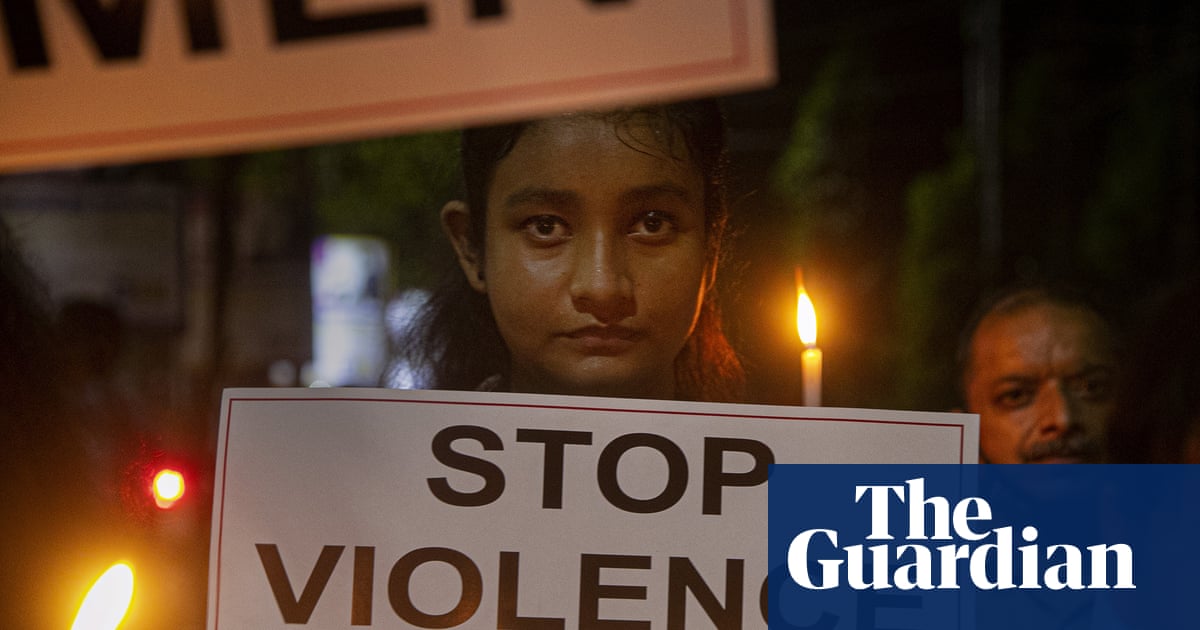
Indian women protest in 202 in Uttar Pradesh. Photograph: Anupam Nath/APView image in fullscreenIndian women protest in 202 in Uttar Pradesh. Photograph: Anupam Nath/APFrom Jamui to Delhi, the burden of safety from sexual assault cannot fall on womenAs outrage grows over cases of sexual violence, activists are demanding a shift from controlling women to confronting men’s behaviour. Plus, Tony Klor’s ‘hella dope’ city vlogs
As an Indian woman, I often feel myself oscillating between states of anxiety or anger. The anxiety is about doing the mental maths of how to stay safe – thinking about what I’m wearing, where I am going and how I’ll get there, and so on. The anger is at the sheer absurdity of this, and the stories of of sexual violence and harassment I read about every day. I am not the only one.
Last week, two particularly enraging incidents captured national attention. First, a video showing a group of men accused of harassing and molesting two teenagers at night in Bihar’s Jamui went viral. Then, a 17-year-old, out with a friend in Delhi, was allegedly gang-raped in a park by men posing as police. After, women in Bihar told Outlook how the incident in Jamui triggers greater controls and pressure on them. In Delhi, authorities curbed access to public parks and a premier women’s college, Lady Shri Ram College (LSR), briefly moved classes online.
I have noticed this pattern repeatedly: after incidents of sexual violence go viral on social media, the fallout further ensnares women. We are the ones who get told to avoid certain places, regulate our behaviour, dress modestly or be home earlier, thereby placing the burden of escaping this menace on us. Feminist activist Kavita Krishnan has described this phenomenon as “perhaps the most widespread form of gender-based violence in India”.
Instead of figuring out why sexual violence remains entrenched in our society, how patriarchal agency perpetuates such violence or what kind of social conditioning is needed for men, women are instead expected to take up less public space. (It is another matter that women might not be safe even inside their own homes.)
Regulating women is easy because “it does not require any institutional cost and, most of all, it sends the signal to concerned parents that the problem is being handled”, says Meena Kandasamy, a feminist author, whose latest novel, Fieldwork As a Sex Object, is about a woman’s life being upturned when a deepfake video using her face goes viral. “Their target audience is not the young women who feel unsafe but the rest of society.”
In my experience, this repression happens at three levels: first in the realm of family, then in broader society, and ultimately by the state. It begins at home, under the guise of protection, with arbitrary curfews or dress codes. It gets reinforced at a community level with institutions and social groups through moral policing, victim-blaming and the expectation that women should not put themselves in “unsafe” situations.
Then there is the response of the state. Restricting access to parks after sunset can surely reduce the number of people in those places, but it doesn’t address why women are unsafe there. Harassment and sexual violence are, unfortunately, not tied to timings or daylight. And further restricting women’s lives is not the solution to injustices foisted on them. All three, Kandasamy says, consider women as a “problem to be handled”.
“She’s not a citizen (for the state), a member (for the community), or an adult (for the family). She is treated like an inanimate but precious object – like a diamond that has to be locked up to prevent theft,” she said.
‘Moral policing’ of the wrong target
View image in fullscreenIndian women commuters board a women-only train carriage. Photograph: Divyakant Solanki/EPAWomen, however, are pushing back against this approach. In recent days, students from Delhi University have come out on the streets demanding safer public spaces including more street lighting, usable public toilets, more housing and scholarships for female students. Vedayana, 20, a student at Lady Shri Ram College (LSR), says locking up parks is not the solution: “If you are not putting up safety measures to make it accessible to women, then it is as good as saying that the park is only for men.”
The scale of the issue is devastatingly clear. A recently published survey of more than 4,000 women in New Delhi and Bengaluru, found that 65% of women in New Delhi and 29% in Bengaluru experienced harassment in public spaces in the past year.
Another 2024 study from India and Pakistan found that women’s overall mobility remains abysmally low, and what freedom they do have is almost entirely tied to education, employment or unpaid care work. Substantive mobility for leisure or pleasure is practically nonexistent.
Despite how widespread and urgent the problem is, the political response can further shake public confidence. A female minister from Bihar, commenting on the molestation video said: “Moral policing can be done in a more decent and elegant fashion.” Another minister from the state drew fire for describing it as an “isolated” incident”.
Minimising crimes against women reflects a political culture in which accountability becomes optional. Students such as Vedayana want this to change. Political parties, she tells me, should pledge to not give tickets or positions to anyone accused of sexual harassment. “We don’t want the leaders sitting at the top to perpetrate and preach rape culture,” she adds.
Parliament is not immune to accusations, either: the BJP politician Brij Bhushan Singh, who formerly headed the Wrestling Federation of India, was recently accused of sexual harassment by six female wrestlers – he denies the allegations, and was acquitted by a magistrate, in a case that is undergoing appeal. According to an analysis of 2024 parliamentarians by the Association for Democratic Reforms, 15 winning candidates declared cases related to crimes against women.
For Vedayana, changing the mentality has to begin early with families and the way boys are raised. “If you are in a position of authority, use it to influence people by speaking out against patriarchy and groom your sons first.”
View image in fullscreenThe Indian women’s cricket team triumphed at this year’s Asian games in Japan Photograph: Xinhua/ShutterstockGolden girls | Indian women’s cricket team beat Sri Lanka by 147 runs to win gold at the Asian Games last week. Smriti Mandhana’s smashing 79 off 45 deliveries helped India reach a formidable 216 in 20 overs. Deepti Sharma’s three-wicket haul helped India end Sri Lanka’s hopes with just 69 runs on board. Sri Lanka settled for silver, while Pakistan claimed the bronze after beating Bangladesh.
Moma | A solo exhibition by one of south Asia’s most distinguished artists, Nilima Sheikh, opened at New York’s Museum of Modern Art at the weekend. Fractured Skies, presented in collaboration with the Kiran Nadar Museum of Art in Delhi, will run until next June.
EC under fire | An explosive Indian Express investigation has revealed how two of the top three election officials objected at least 14 times over a period of 10 months to changes made by the Election Commission over its controversial exercise that has struck 130 million people from the voter rolls.
View image in fullscreenThe Ram temple, Uttar Pradesh. Photograph: Press Information Bureau/EPA105
An inquiry committee probing the theft of donations from Ayodhya’s Ram Temple has uncovered 105 instances of cash being removed or concealed. The thefts were caught on CCTV cameras.
According to a preliminary report, some of the accused allegedly hid the money on themselves during the process of counting donations and then walked out.
View image in fullscreenTony Klor showing India, and the rest of the world, the beauty of Satara. Photograph: InstagramTony Klor’s city vlogs from Indian towns are “hella dope,” to use his own words. The 32-year-old American has visited about 200 cities around the country, taking his Instagram followers to places that rarely feature on a travel itinerary.
It’s a treat to watch him having the time of his life. He marched with Anganwadi workers in Nashik chanting “pay my didis”, ribbed with middle-aged uncles sweating it out in a park, whom he christened “Nizamaddies”. Wandering through the mining town of Ballari, which he describes as “highkey vibey”, he films its temple, church and mosque.
“A lot of people who watch my videos are Indians and they have no idea about these magnificent places in India,” the tech professional-turned-content creator says. “India is like the easiest place to make a friend in the world. People invite me to their weddings on the street that I met five minutes before that. Hospitality is so, so next-level.”
Do you have any thoughts or responses to this week’s newsletter? Is there anything you’d like us to cover in the future? Share your feedback by replying to this, or emailing us at thisisindia@theguardian.com and we may include your response in a future issue.