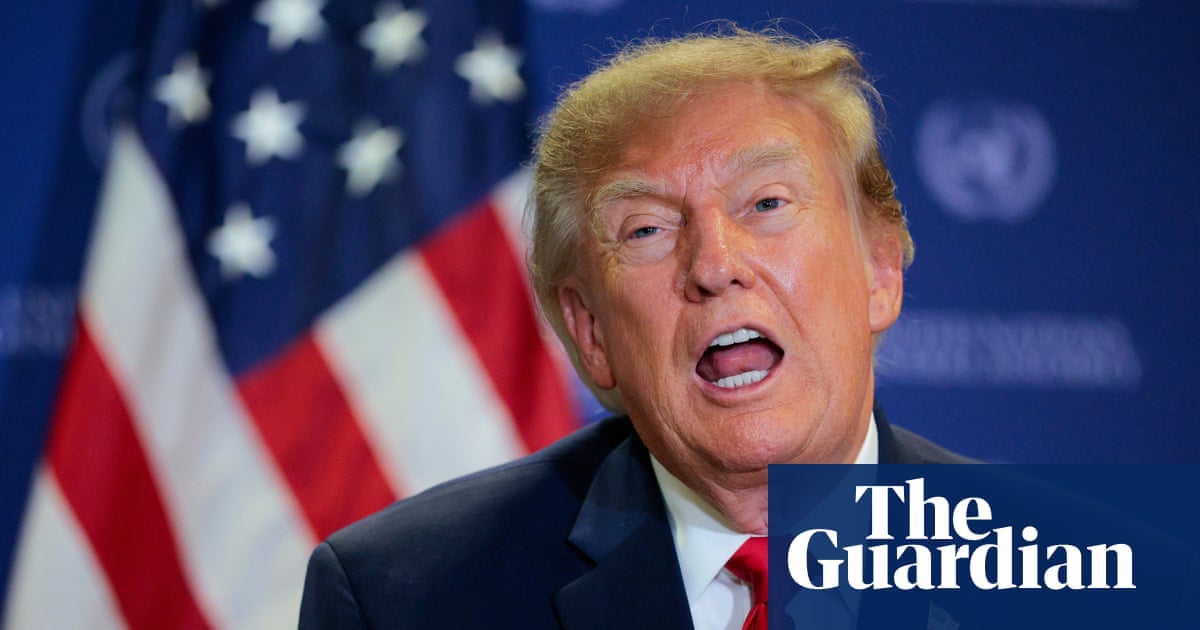
Donald Trump at the UN headquarters on 22 September 026 in New York, New York. Photograph: Chip Somodevilla/Getty ImagesView image in fullscreenDonald Trump at the UN headquarters on 22 September 026 in New York, New York. Photograph: Chip Somodevilla/Getty ImagesAs the US midterms approach, Trump’s boasts on the economy fall flat with votersTrump’s tariffs and his war against Iran caused prices to rise, but the US president continues to claim it’s ‘the greatest economy in history’
Donald Trump has taken to repeating a familiar boast: “We have the greatest economy in history,” Trump said recently at a White House press gaggle. The boast comes even though inflation is higher and economic growth lower than when Joe Biden left office, even though gas prices have jumped around 50% since the war against Iran started, and even though 73% of Americans think the economy is in fair or poor shape (48% say it’s in poor shape). What’s more, the Federal Reserve is so worried about inflation that it just raised interest rates.
“It’s bluster, it’s gaslighting for him to say the economy is the greatest ever,” said Darrick Hamilton, chief economist for the AFL-CIO, the nation’s main union federation. “The economy is trending down by many measures. A lot of that has been caused by Trump’s unforced errors.”
Hamilton said those errors include Trump’s tariffs and his war against Iran, both of which have pushed up prices – inflation is running at 3.4%, up from 3.0% when Biden left office. One unfortunate result is that prices have been rising faster than wages, worsening Americans’ affordability problems. A New York Times/Siena Poll found that 71% of voters disapprove of how Trump is handling the cost of living.
Over the past 12 months, according to the Bureau of Labor Statistics, fuel oil prices have soared 52%, while ground beef is up 7.2%, fish and seafood up 6.5%, coffee 6.1%, sugar and sweets 6.1% and electricity up 3.8%. The administration boasts that egg prices are down 23%, even as gas has soared to an average of $4.47 per gallon nationwide.
With the economy growing at a modest 1.5% rate in the second quarter, Trump stretches the truth when he boasts of a great economy, considering that under John F Kenndy, Lyndon Johnson and Ronald Reagan, there were full years when GDP growth – the broadest measure of the nation’s economy – averaged over 6%. (The economy grew at a 2.7% annual rate during Biden’s last six months in office).
Consumer sentiment has slid sharply in light of today’s stubborn inflation, mixed with slower economic growth, high interest rates and huge economic uncertainty about trade wars and AI. According to a University of Michigan poll, consumer sentiment fell in September to its second lowest level ever in the poll’s 74-year history. Only this past May was lower.
Kush Desai, a White House spokesman, said: “President Trump has always been clear about temporary disruptions as a result of the Iran conflict, but the Trump administration has remained laser-focused delivering on the president’s long-term economic agenda on the home front.” As good news, Desai cited “continued private-sector job growth” and “booming investments”.
The unemployment rate has been fairly low during Trump’s second term – at 4.1%, it’s about the same rate as in Biden’s last year. But the jobless rate has been lower under several previous presidents; it sank to 2.5 % at one point under Dwight Eisenhower and below 4% at times under Bill Clinton, Richard Nixon and Johnson. But in a not-so-great statistic, job growth has been mediocre since Trump returned to office – just 43,000 a month on average, less than one-third the 145,000 average during Biden’s last two years in office.
Although Trump said his tariffs were aimed at revving up manufacturing, the US has lost 35,000 factory jobs since he returned to office. Last month, however, there was good news on job growth – the nation added an impressive 162,000 jobs.
Desai said the Biden administration “padded employment growth” by “adding hundreds of thousands of government or government-adjacent jobs that relied on runaway federal spending”. He added, “President Trump is slashing regulations and taxes to create sustainable private-sector jobs – not juking the statistics by drumming up government spending.”
Michael Strain, director of economic policy studies at the American Enterprise Institute, a center-right thinktank, had an upbeat view, saying: “The economy is strong.” Strain added, “the unemployment rate is very low,” and “the economy is very resilient in the face of high energy prices, and consumers are resilient in the face of the trade war.” He noted that “investment spending is very strong”.
“Where we’re not doing well is inflation,” Strain added. “It’s eroding wages and income. Inflation is a headwind that households are facing.”
View image in fullscreenDonald Trump speaks about the economy in the Oval Office of the White House on 7 August 2025 in Washington DC. Photograph: Brendan Smialowski/AFP/Getty ImagesResponding to the widespread concerns about inflation, Desai said: “The last two inflation reports [show] dramatic month-over-month price reductions in beef, prescription drugs, and auto insurance.” He said this is “proof that the administration’s targeted policy interventions to lower costs are delivering”.
Responding to concerns about inflation, Desai said: “President Trump had always been clear about market disruptions as a result of the Iran conflict, but the last two inflation reports showing dramatic month-over-month price reductions in beef, prescription drugs, and auto insurance are proof that the administration’s targeted policy interventions to lower costs for American families are delivering.”
Lindsay Owens, president of the Groundwork Collaborative, a progressive thinktank, was far more downbeat about the economy. “I think it’s going pretty poorly,” she said. “The Federal Reserve just raised interest rates, when Americans were already concerned about high interest rates. That’s not going to do anything to help people who want to buy houses when mortgage rates are already high. Americans are feeling that things are pretty grim.”
“Trump’s approval rating on the economy was his superpower in his first term,” she continued. “But now it’s absolutely in the toilet.”
Just 28% of Americans approve of how Trump has handled the economy, according to a new Marquette Law School poll. Just 29% of Republicans say the economy is better than a year ago, down from last January when 72% of Republicans said the economy was better than a year earlier,
Owens said AI has been crucial for Trump’s economy, helping fuel GDP growth, business investment and repeated stock market records. “The pieces of the economy that are doing well are completely propped up by AI investment,” Owens said. “That’s the whole story. That’s what Trump has going for him.”
“But,” she continued, “that’s an increasingly precarious place for him to be right now,” considering the fast-growing worries about AI, including the fierce opposition to datacenters in many communities, the recent calls to slow AI development for safety reasons, and Wall Street’s increasing skittishness about AI stocks.
Owens pointed to a second factor that’s sustained the economy: the vast spending power of the richest 10% of Americans. She said they account for nearly 50% of consumer spending, and while the bottom 50% by income are feeling squeezed, it’s the top 10%’s buying power – whether on new cars, airline tickets, or home renovations – that’s kept consumer spending and the economy from faltering.
“It seems to me the president doesn’t care about how average Americans are doing,” Owens said, pointing to such Trump statements as “I don’t think about Americans’ financial situation,” which Trump said last May when asked about how the Iran war was affecting Americans. And last week, he downplayed consumers’ dismay about the surge in gasoline prices, saying, it’s “a little higher” and “it’s a very inexpensive price”.
Owens said responsibility for high gas prices and higher inflation rests squarely with Trump. “This is not a situation where the economic conditions are beyond his control,” she said. “He has made a deliberate series of choices that cut against his promises to reduce prices.”
According to the Yale Budget Lab, the average American household will spend $1,100 more this year due to Trump’s tariffs, while Mark Zandi, chief economist at Moody’s Analytics, says the average household will have to spend $1,000 more this year because of higher fuel, food and other prices caused by the Iran war.
“The biggest drivers of inflation are his tariffs and the war against Iran,” Owens said. “These are policy-driven price hikes,”
The White House sees it differently. “The hard data of actual consumer spending and retail sales has remained robust throughout President Trump’s term so far. American consumers remain resilient and are voting with their dollars,” said Desai. How consumers really feel will become clear in November, when the real voting takes place.