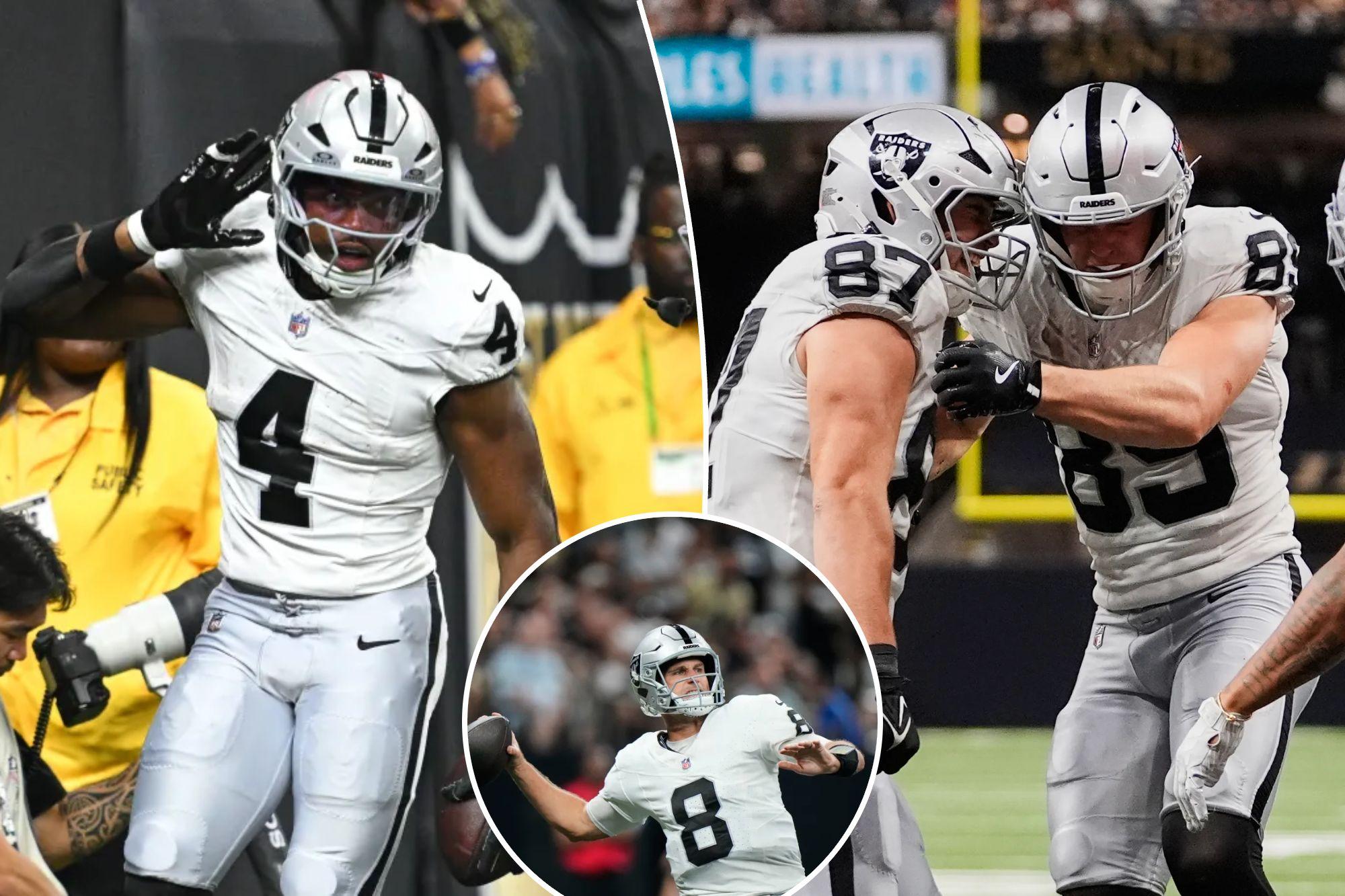
Make California Post a Preferred Source NEW ORLEANS – It didn’t take long for Brock Bowers to remind the Raiders what they had been missing in their 35-27 win over the Saints to move to 3-0.
Making his season debut Sunday against the Saints, the star tight end caught 10 passes for 116 yards and a touchdown, with several receptions worthy of the highlight reel.
The Raiders had managed to win their first two games without Bowers. That spoke to the foundation coach Klint Kubiak was establishing and quarterback Kirk Cousins’ ability to make it work without his most accomplished pass catcher.
But there is a difference between compensating for someone’s absence and taking advantage of everything he offers.
His seven catches for 87 yards in the first half helped fuel four scoring drives, giving Cousins a dependable connection and the Saints another problem to solve. And he kept adding to that production, showing how valuable his presence can be to an offense still discovering its potential.
His impact extends beyond the passes thrown his way.
Bowers’ ability to threaten the middle of the field forces defenses to devote attention that might otherwise go toward helping against Tre Tucker and the Raiders’ other receivers. Extra resources committed to Bowers can create opportunities elsewhere.
For Kubiak, that expands the possibilities. For Cousins, it provides another answer.
That becomes especially valuable when the running game struggles, as it did again Sunday. The Raiders still need to establish more consistency on the ground, but Bowers gives them a difference-maker capable of helping overcome those shortcomings.
The encouraging part is that he returned to an offense that had already found contributions from other pass catchers and helped deliver consecutive wins.
Now the Raiders can build on that foundation with their best offensive weapon back in the lineup.
Sunday offered a compelling look at how much more dangerous that can make them.
For most of Sunday’s game, the Raiders struggled to make Tyler Shough uncomfortable. And the takeaways were no where to be found
Then, on fourt traight fourth-quarter possessions, their pass rush helped turn the game as did their ability to take the ball away from opponents.
A forced fumble recovered by Maxx Crosby and an interception by Zeke Masses — his third in two games — gave the Raiders’ offense two opportunities to change the direction of the afternoon.
The offense cashed in both, converting the takeaways into touchdowns and turning a five-point deficit into a 35-27 lead.
A 13-point swing. And another example of the complementary football that is becoming an encouraging part of the Raiders’ identity.
Then, with the Saints driving to potentially tie the game late in the quarter, Jeremy Chinn forced yet another fumble while sacking, and then stripping the ball from Shough on a fourth and one from the Raiders’ 20. Cornerback Taron Johnson fell on it for the takeaway.
The Saints had spent much of the game limiting the Raiders’ pass rush by getting the ball out of Shough’s hands quickly. An imposing defensive front had been unable to consistently impose itself, leaving the secondary with little help against the New Orleans passing game.
But the Raiders kept coming. And when they finally created disruption, they made it count.
Crosby’s recovery gave the offense a chance to capitalize. Masses’ interception provided another, continuing a productive stretch for a defender developing a knack for finding the ball.
Takeaways create possibilities. Turning them into touchdowns changes games.
The Raiders had spent the first half settling for field goals on three of their four red-zone possessions, leaving themselves with a smaller cushion than their opportunities suggested they could have built.
The defense supplied the openings, and the offense supplied the points. Neither unit had been consistently sharp enough throughout the afternoon, but in that critical fourth-quarter stretch, they gave each other exactly what was needed.
That is how a team can overcome an uneven performance.
And it is how the Raiders put themselves in position to win another game.
Mike Washington’s 36-yard touchdown run showed what the Raiders’ ground game can add to their offense.
The rest of Sunday’s performance showed how far they still have to go.
Aside from Washington’s scoring burst, the Raiders struggled to generate a consistent rushing attack against the Saints, finishing with 113 yards on 27 carries. That included just 56 yards for Ashton Jeanty on 19 carries.
That was particularly disappointing against a New Orleans defense that entered the game ranked 26th in the NFL against the run. An opportunity to establish some traction instead became a second consecutive week of questions about a central component of coach Klint Kubiak’s offense.
The Raiders overcame those struggles against the Chargers. They did it again against the Saints.
But winning around a problem does not make it disappear.
And asking quarterback Kirk Cousins, the passing game and the defense to keep compensating for an inconsistent rushing attack is not a sustainable formula.
Washington’s touchdown was a reminder of the payoff when the Raiders get it right. They need more of the ordinary gains, too — the runs that create manageable second downs, make third downs less demanding and keep the offense from needing another difficult completion.
Those are the building blocks of the balance Kubiak wants.
Too often over the past two games, they have been missing.
Brock Bowers’ return gives Cousins another answer in the passing game, and the Raiders have shown they can produce points without consistently moving the ball on the ground.
But that should be a useful capability, not a weekly requirement.
The offensive line has to create more dependable running room, and the Raiders have to find a way to turn their commitment to the run into repeatable production.
A reliable rushing attack can change what an offense is capable of sustaining over a season.