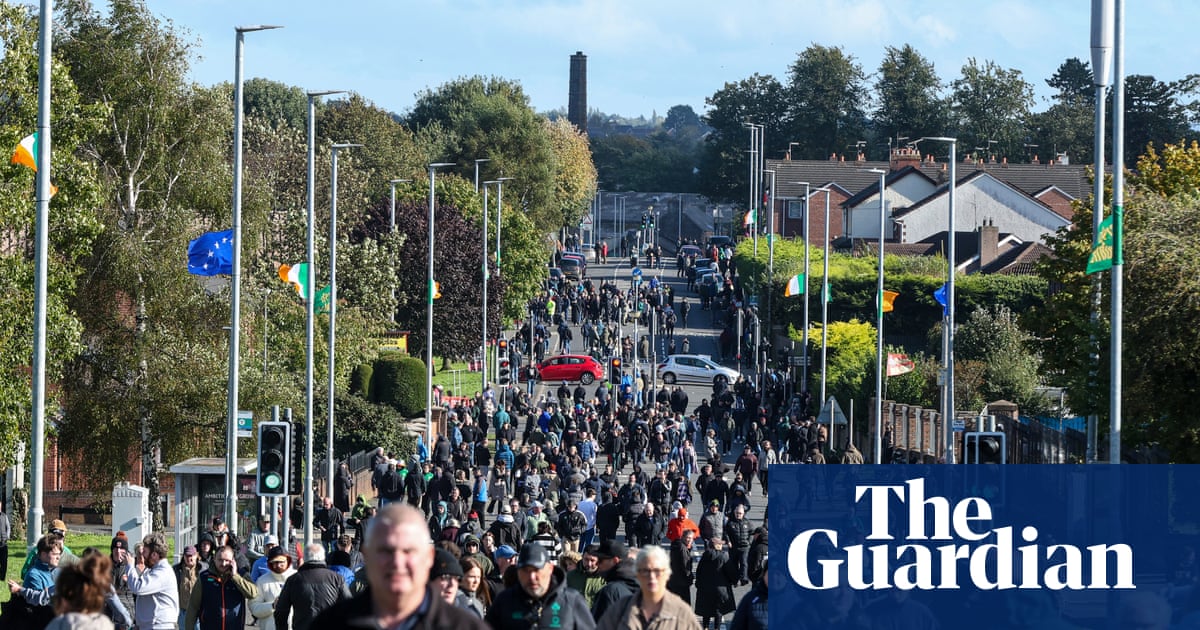
Protesters gather on Garvaghy Road after an Orange Order parade was given late-night clearance to march in Portadown, Northern Ireland, on Sunday. Photograph: Paul Faith/AFP/Getty ImagesView image in fullscreenProtesters gather on Garvaghy Road after an Orange Order parade was given late-night clearance to march in Portadown, Northern Ireland, on Sunday. Photograph: Paul Faith/AFP/Getty ImagesDrumcree standoff shows Northern Ireland’s troubled past still threatens its peaceGovernments will be hoping row over the contentious Orange Order march down Garvaghy Road can be defused
Like a ghost from its troubled past Drumcree has unexpectedly reappeared to remind people of how far Northern Ireland has changed in 30 years but also how easily history can undermine the present, if imperfect, peace and stability.
Three decades ago parts of Northern Ireland came to an almost annual standstill as Protestant Orange Order protesters blocked roads in support of members wanting to march down what they called its traditional route, the Garvaghy Road, on the Sunday before the annual 12 July parade.
Because the Garvaghy Road is a main thoroughfare in a predominantly nationalist area residents opposed the march. The standoff led to violence and murders at a time when Northern Ireland’s fragile peace process was in its infancy.
Read moreIn 1998, the newly formed Parades Commission was established to defuse tension around controversial marches and to regulate parades.
The commission, which was opposed by the Orange Order and unionist political parties, banned the Drumcree parade and has done so every year since, until 2026.
In August, the high court overturned a Parades Commission ruling preventing the march, saying the commission had erred in not following its own rules and procedures in its decision.
That ruling has been described by the taoiseach Micheál Martin as “incomprehensible and wrong”.
The decision then allowed the order to resubmit an application giving the statutory 28 days’ notice for this year’s controversial march, which was opposed once again by residents.
View image in fullscreenArmoured Police vehicles lined up in Portadown, Northern Ireland, after the high court ruled the Orange Order's march could go ahead on Sunday. Photograph: Charles McQuillan/Getty ImagesOver the last few days, the issue returned to the courts several times as those opposed to the parade sought to prevent it happening.
On Saturday Justice Patricia Smyth in the high court blocked the commission by means of an injunction, saying the “long-running dispute has the potential to escalate” across Northern Ireland.
She urged the parties involved to, “be big enough to step back from the abyss”.
The injunction had the effect of pausing the Orange Order’s notification of the parade; that was described by the order’s barrister as “rewriting history”.
But that ruling, which was described by Siobhan Keegan, Northern Ireland’s Lady Chief Justice, as “unfortunately” an error in law, was in turn appealed and led to the high court in the early hours of Sunday morning ruling the initial Parades Commission decision to allow the march to take place had to be respected.
But the ruling has not gone down well with residents, their supporters and political leaders who blocked any march by 35 Orangemen, saying that after 28 years there can be no return to the past.
Northern Ireland now is, however, very different from three decades ago.
Read moreNo longer is there a unionist majority; indeed the first minister, Michelle O’Neill, is from Sinn Féin.
After Brexit, Irish nationalism is more self-confident and is pushing – some would say, if not unrealistically, then certainly prematurely – for preparations for a border poll on unity with the rest of the island.
Changing demographics and the Brexit-inspired sea border on trading goods between Britain and Northern Ireland have made many unionists feel uneasy.
That and a barely functioning multi-party executive at Stormont ahead of Assembly and local elections next year are the background to the Garvaghy Road standoff.
And so we are treated to the spectacle of unionists who opposed the Parades Commission accusing nationalists of refusing to respect the law and those nationalists, who, in the past, called for respect for the commission’s rulings, refusing to comply with its latest.
The two governments will be hoping the standoff can be defused so the ghosts of the past can no longer haunt today’s still emerging Northern Ireland.