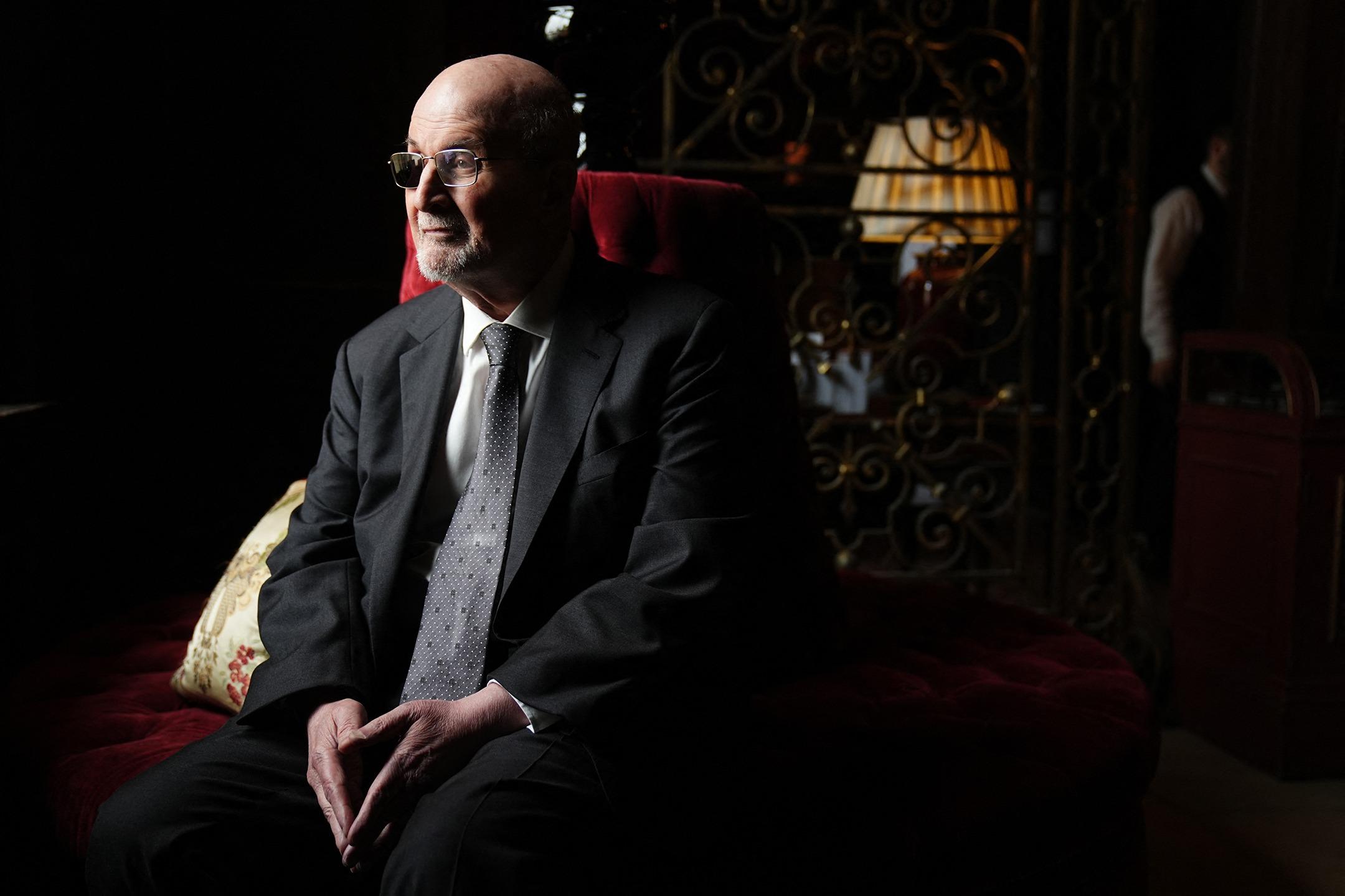
Make New York Post a Preferred Source Beginning on Valentine’s Day of 1989, the Booker Prize winning author Salman Rushdie had a sword hanging over his head. For a period of time, threats of death followed him everywhere. The bloody culmination of his life spent alternately on the run and in public — with near-lethal consequences — is captured in “Knife: The Attempted Murder of Salman Rushdie,” a new documentary about Rushdie, his marriage and the dangers of fanaticism.
Plagued by threats, Rushdie lived in hiding for some nine years, operated under the pseudonym Joseph Anton (cribbing the first and last names of two favorite writers: Joseph Conrad and Anton Chekov) and traveled by armored Jaguar.
This was for good reason: Islamist leader Ayatollah Ruhollah Khomeini had issued a fatwa against him, encouraging Muslims to murder Rushdie, who was born into a Muslim family himself. The mandate felt as serious as a mafia contract.
Followers of Khomeini cursed Rushdie and rioters burned effigies of the author. All of that was set off by his book “The Satanic Verses” (1988), which Khomeini believed blasphemed Mohammed.
“This was horrifying,” Rushdie told The Post about seeing his face set alight on international newscasts. “I was already reasonably well known as a writer. But suddenly, every taxi driver knew who I was. It felt like my character was being rewritten for me by this public hatred.”
Over time, however, Rushdie went back to living like a well-regarded novelist around town. He could be spotted living it up with his then wife Padma Lakshmi and even did a cameo on “Curb Your Enthusiasm” in which he gave Larry David advice on how to handle the fatwa that had been leveled against him. Clearly, Rushdie was comfortable with who he was and what he had gone through.
“I actually stopped thinking [anything] would happen,” he told The Post. “I’ve been living in New York since the year 2000 and I’ve done probably hundreds of public events in that time without there ever being any trace of a problem. So, you think, okay, that chapter’s closed.”
Then on August 12, 2022, that chapter reopened dramatically. Rushdie had just stepped on stage at the Chautauqua Institute, in Chautauqua, NY, to give a talk on the importance of protecting writers. About to begin, he was bum-rushed by a blade-wielding radical named Hadi Matar. The extremist stabbed Rushdie 15 times during an attack that damaged his liver, wrecked his left hand, took out his right eye.
This ghastly assault and its aftermath are unraveled in “Knife,” directed by Alex Gibney. Underscoring it all, the movie shows Rushdie’s lacerated eye with brutal gore. Rushdie said he cried after finding out the eye will remain unusable. Four years after, he told The Post, “I wake up every day and think about not having my right eye. Losing a quadrant of my vision makes everything more difficult.”
Ironically, Rushdie’s attacker admitted to having never read “The Satanic Verses.” In the movie, Rushdie expresses grave doubt that Khomeini had either.
As “Knife” unfolds, Rushdie refuses to give the would-be murderer any oxygen, opting to avoid his name and call him Ass, which is shortened to A. Rushdie, who spurns an eyepatch in favor of signature eyeglasses he designed with one lens tinted dark, said that a follow-up attack is far from his mind: “I worry more about someone bumping into me while talking on their phone.”
In directing “Knife,” Gibney was blessed with a trove of archival footage. For that, he can thank Rushdie’s wife, Rachel Eliza Griffiths. Soon after racing to see Rushdie in his room at the Pennsylvania hospital to which he was airlifted, Griffiths began filming. Her intimate videos, providing close-up views of pain and resilience, comprise the heart of the movie. She is credited as cinematographer and executive producer.
“The shock lifted a bit when my camera arrived,” Griffiths, a professional photographer for more than 20 years, told The Post. “It wasn’t a situation where we were, like, ‘we’re going to make a documentary.’ The camera became my diary, and I did not need to burden anyone with the complicated feelings I was having. I needed to focus on Salman’s survival and care. The camera helped remind me that we were not just powerless victims trapped in this trauma ward.”
For Rushdie and Griffiths, the documentary “is a way of taking command of the story. It is a way of saying that we get to tell the story.” As for the finished product, said Rushdie, “This is not just [an attempted] murder story. It’s also a love story.”
Last year, the hateful Matar was sentenced to 25 years in prison. Rushdie, on the other hand, is thriving, very much on the mend and writing his next book. He’s enjoying New York again and living the life of an esteemed author without worrying about “the one crazy kid” who took Khomeini’s bait and went for him.
Despite not being mentioned by name in the movie, A. does get a “Knife” cameo of sorts, with Rushdie imagining a meeting him for a sit-down in the prison where he is being housed. It begs the question of Rushdie’s desire to meet his assailant for real. “I had a brief fantasy about that,” Rushdie said. “But Eliza thought it was a terrible idea and I agree with her. I doubt that he would open his heart to me.”