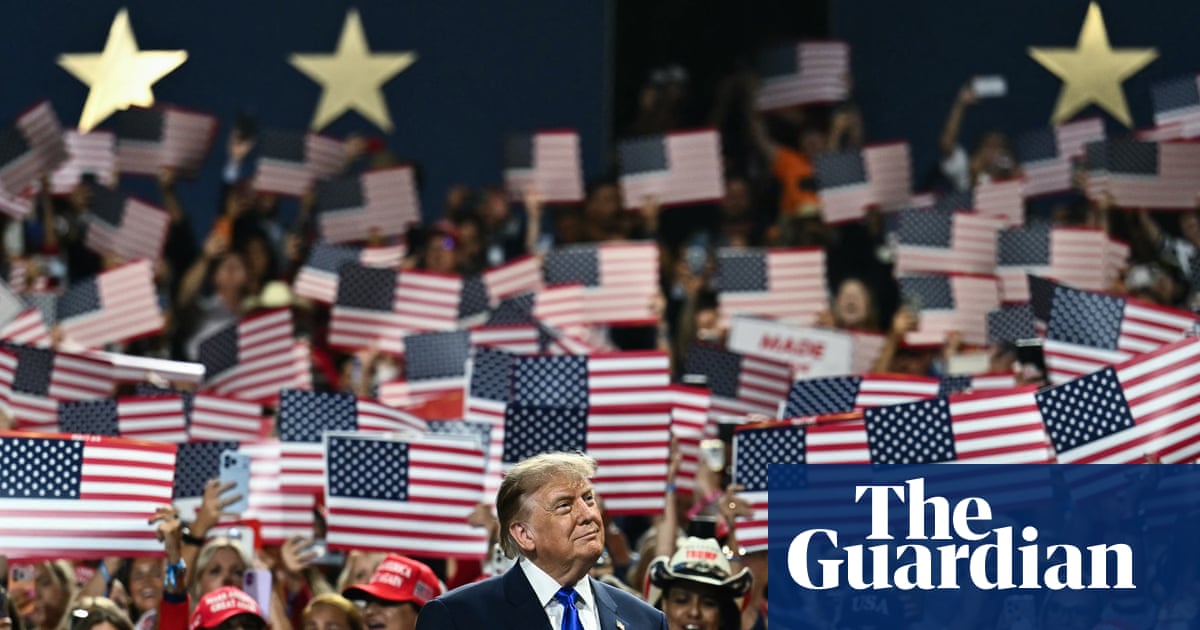
Trump at the Republican midterm convention in Dallas earlier this month. Photograph: Kent Nishimura/AFP/Getty ImagesView image in fullscreenTrump at the Republican midterm convention in Dallas earlier this month. Photograph: Kent Nishimura/AFP/Getty ImagesTrump allies could use midterms ‘counting window’ to disrupt results, experts warnFears grow that loyalists in key states could use critical period when votes are counted to amplify false claims
Election experts have warned Donald Trump’s administration could use the crucial hours and days after November’s midterm elections to disrupt the results after struggling to enforce a crackdown on voting.
With less than six weeks remaining until polls close, and control of US Congress in the balance, the post-election “counting window” is seen as as a particularly vulnerable moment by former US federal government officials.
While the US president’s bid to impose sweeping restrictions on mail-in ballots was rejected by the supreme court earlier this month, there is apprehension that Trump and his allies could use the period while votes are counted to amplify unfounded allegations in a bid to challenge results that don’t go their way.
Read more“I think because the administration has lost so many of their attempts to disrupt the normal process in court, that they are going to use the claim of foreign interference at the end of voting days to either seize equipment or to seize ballots, whether they’re legally justified to do so or not,” Caitlin Durkovich, a former deputy homeland security adviser for resilience and response on the national security council, told a briefing staged by the Brennan Center for Justice earlier this week.
Some states take days – even weeks, in California’s case – to complete a count of votes after an election. Control of the House of Representatives and Senate may hinge on results in states with a delayed result.
“That period, that waiting time, is where doubt begins to surface,” Durkovich said on Tuesday. “And when it is then amplified by foreign actors and, frankly, by domestic actors, it starts to cause distrust in the integrity of the process.”
State-level elections officials are trying to prepare the public to understand the process now, to head off a manufactured controversy later, said Larry Norden, vice-president of the elections and government program at the Brennan Center. “To me, this is the biggest threat right now,” he said.
“I think a lot of people may think just because they’re seeing all these headlines being thrown at them that things have changed – that it’s become more difficult to vote,” added Norden. “In the history of American elections in some ways, there have never been more options for the way that people can vote, and they are still in place going into this election.”
Early voting eliminates most of the threats voters apprehend ahead of an election, he suggested. “The earlier they vote, the more secure they can feel that their vote is going to count, and I think that’s a really important message for us to be delivering to people.”
The power of doubt about the validity of votes, and the risk of Trump unveiling “emergency” measures on ballots or voting machines around election day, looms large.
“Every state in the country now has live ballots out,” said Ben Hovland, former chair of the Election Assistance Commission. “That really means the election is here, and it means that needs to be taken into consideration for any court rulings we’re looking at.”
A supreme court decision this month upheld a lower-court injunction on the Trump administration using the US Postal Service and the Department of Homeland Security to vet mail-in ballot deliveries.
But groups such as the NAACP, the National Urban League and other rights organizations remain concerned about the Trump administration’s insistent claim – without evidence – that the 2026 midterm elections will be illegitimate unless the federal government intervenes.
Normally, the Department of Justice and the FBI enter a “quiet period” just ahead of elections, to avoid influencing the results. That has not been the case this year.
The Department of Homeland Security continues to pursue voter-roll lists in states that would not turn them over voluntarily. The federal government has asked states to retain their 2024 election documentation for later inquiries. And DHS is pursuing an independent “unlawful voter initiative” to find non-citizen voters on state rolls, one that an anonymous whistleblower told congress last week that is using “highly questionable data” and may be unlawful.
The federal government’s claims of illegally-registered voters – claiming numbers that do not bear up under scrutiny – and Trump’s rhetoric alleging fraud without evidence, “back up a narrative of fraud to undermine confidence in the elections”, Hovland said.
Much of the president’s election rhetoric revolves around foreign interference. Experts make a distinction between foreign influence – propaganda, essentially – and foreign interference , or directly manipulating vote counts.
“It’s very important for people to understand that we don’t have any examples of a country trying to interfere in the electoral process, in that technical process,” said Beth Sanner, a former deputy director of national intelligence who is now director for geopolitics and strategy at International Capital Strategies.
“It just didn’t happen,” she said. “It didn’t happen in 2020.”
Election security has improved across the country, partially as a reaction to false claims about Trump’s 2020 defeat.
“Every state audits its results,” said Geoff Hales, former chief of joint cyber defense collaborative partnerships at the Cybersecurity and Infrastructure Security Agency, or CISA. “Election officials across the country have really taken cybersecurity seriously.”
Despite the president’s insistence that the country faces a foreign threat to elections, Hale said the federal government has sharply cut staff and spending on elections security at CISA, and with it the technical assistance that once flowed to state election’s officers.
“The federal support that used to be there has pulled back sharply,” he added. “This means that cybersecurity services have been reduced, funding for information sharing environments have been cut, the threat briefings about nation-state adversaries that used to occur dozens of times a year are occurring rarely or not at all.”