Make New York Post a Preferred Source Something has gone seriously wrong with the way we have been teaching American history. The grand story of America has been shattered into a thousand pieces. And it has become loaded with ideological baggage that has alienated many of our young from their own past.
The textbooks assigned to our high-school and college students are part of the problem. They are turgid and unreadable, lacking in both conviction and literary flair. They do little or nothing to inspire in young Americans a sense of living connection to what has come before them.
What would it take to reverse this sorry state of affairs? To remind students that they live not in an evil empire, but a land of hope? A fresh retelling of the American story would be an excellent beginning.
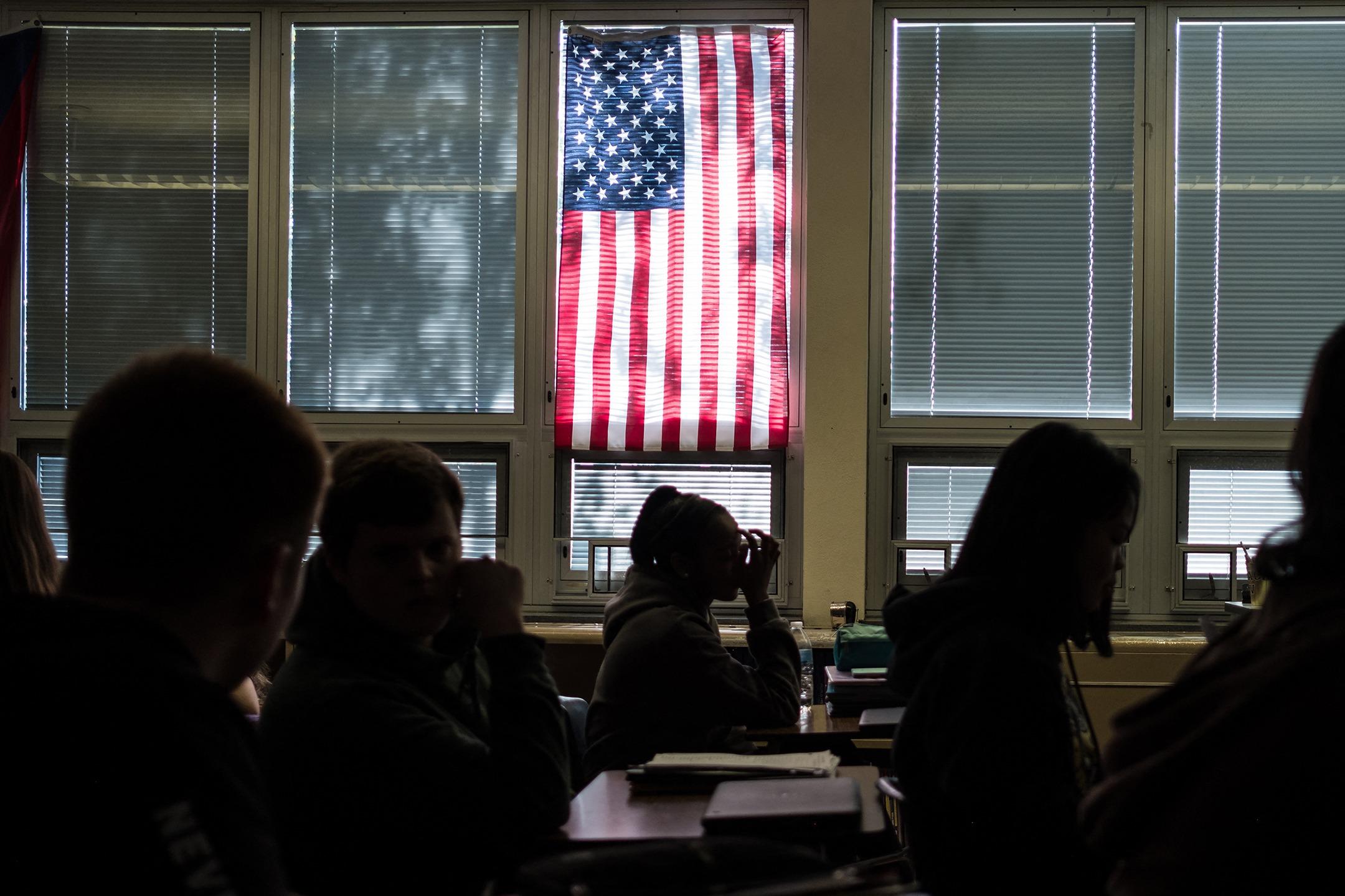
TOPSHOT – Sidney High School students sit through class under a US flag in Sidney, Ohio, October 31, 2019. At the entrance to Sidney High School in small-town Ohio, there… AFP via Getty Images I wrote “Land of Hope: An Invitation to the Great American Story” seven years ago to give American students that retelling, an alternative to the texts with which they were being taught. Now, we’re releasing a second edition of “Land of Hope,” in a dedicated textbook format — designed with the input of countless teachers and students in mind — that seeks to spread this message further.
In creating this book, we went against many of the prevailing currents. First, we made the decision to produce a physically beautiful book — not an ebook or a PDF. It is meant to be a pleasure to hold and read and to become a permanent part of young people’s libraries. A physical book is not only demonstrably better than a screen for reading comprehension, but it embodies permanence and stability in a way that a digital product cannot. The all-digital products that the publishing giants are pushing will leave nothing behind to fill the student’s empty shelves … or their minds.
We also refused to dumb down the reading level. The book is written with the conviction that we should aim high and never sell short the capacity of our young people. Such books are far more likely to fire their imaginations and convey the excitement of history.
Then there are the enduring themes of the book — we went against the grain with them too. Four of them are prefigured in the book’s title.
First, there is the declaration that America is a land of hope. It is not only an idea, although it is certainly that, but it is also a place, a people and a nation; a nation with a history, a great and very particular history, connected to a particular piece of real estate.
Second, I call America a land of hope, to emphasize our nation’s aspirational dimension. Americans have always sought to rise above the conditions into which we were born. That is precisely what has drawn so many immigrants to our shores over the centuries and continues to do so today: the promise of a second chance in life.
This points toward a third element, the element of story — the Great American Story. We humans are, at our core, remembering and story-making creatures. Stories are one of the chief ways we find meaning in the flow of events. A fragmented, convictionless rendering of our past gives us little to remember and little to aspire to.
A truthful telling of the American story must acknowledge the deeply aspirational aspect of a nation’s life, and particularly for so aspirational a nation as the United States — arguably the most aspirational nation in all of history.
And yet there is no denying the fact that we’ve often failed, and fallen far short of our ideals. That part of the story has to be told too. We have not been a land of hope for everyone. For a great many, but not for all. And so our very sense of hope has a double-edged quality about it. To be a land of hope is also to risk being a land of disappointment, even of disillusionment. That too is part of the story. But so too are our repeated efforts to rise above our faults, and correct them.
And finally there is the word invitation. This book is meant to usher its readers into a larger room, a larger gathering, a gathering of which they are already a part, even if they did not know it or feel it before. The story being told is not merely someone else’s. It is theirs too, if they wish to claim it. “Land of Hope” will help them to do so.
Wilfred McClay holds the Victor Davis Hanson Chair in Classical History and Western Civilization at Hillsdale College.