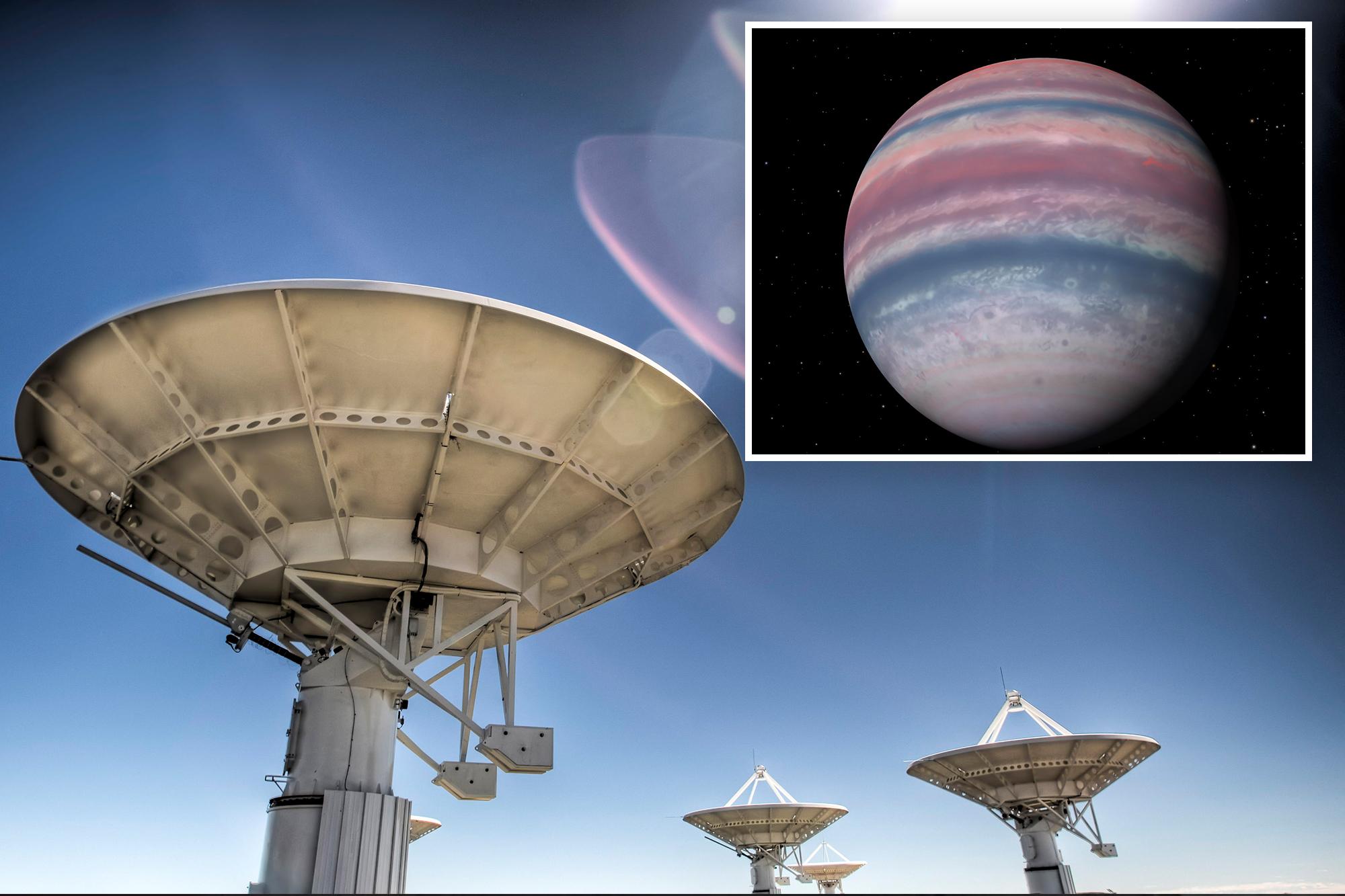
Make New York Post a Preferred Source A team of astrophysicists have detected a radio signal coming from a planet beyond the solar system for the first time in scientific history, according to bombshell new research.
The development is a major step toward discovering the types of planets within in the depths of the galaxy — and where life might be found.
The team of astrophysicists from Harvard and the University of Oregon, Eugene, determined that “bursts” of signal appear to be driven by massive auroras from the planet Beta Pictoris b, according to the not-yet peer-reviewed paper.
Beta Pictoris b is a gas giant exoplanet. NASA Auroras are created when high-energy particles enter a planet’s atmosphere near its magnetic poles and collide with molecules or atoms of gas.
Beta Pictoris b is a young and massive extoplanet — a planet located outside of the solar system — located about 64 light-years from Earth. The so-called “gas giant” is 12 times heavier than Jupiter.
The astronomers, led by Harvard and Smithsonian astrophysicist Kevin Ortiz Ceballos, used the MeerKAT radio telescope array, a powerful cluster of 64 interconnected satellite dishes in the Karoo semi-desert of the Northern Cape, South Africa, to make the discovery.
Once researchers nailed down that the signal was coming from the planet rather than its host star — the star it is bound to by gravity and orbits — they traced its origins to aural radio emission.
Auroras look like glowing rays of colored light the the poles of a planet.
They used the MeerKAT array to make the discovery. Getty Images The team found that the strength of the planet’s magnetic field is a whopping 1,250 gauss — nearly 291 stronger than Jupiter’s 4.3 gauss magnetic field.
This was also the first time the magnetic field of an extoplanet has been measured. They work as protective layers for planets to keep its atmosphere from stripping away.
The team hopes to use the same method on other giant extoplanets.
Ortiz Ceballos did not immediately return a request for comment.