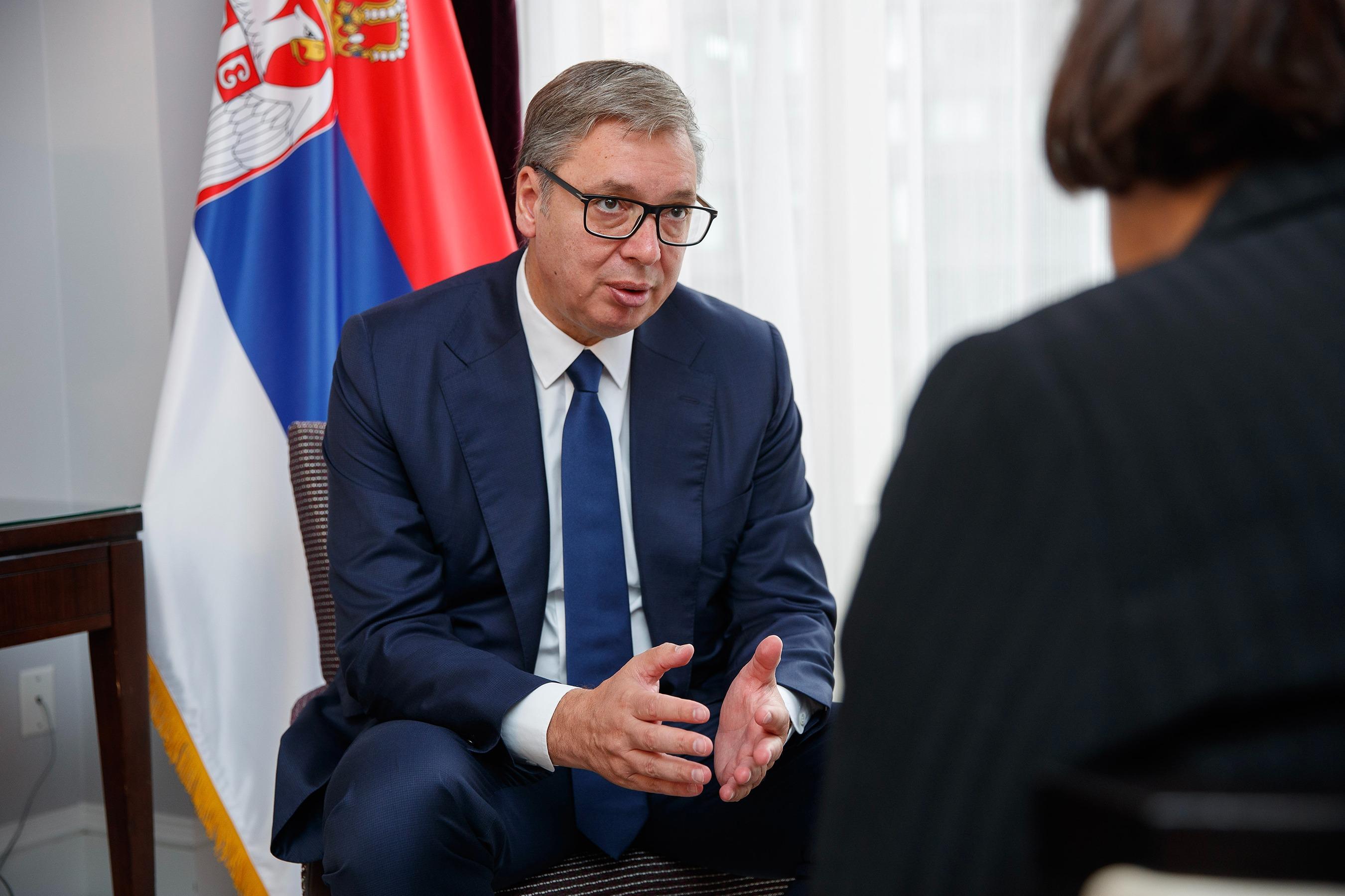
Make New York Post a Preferred Source It’s difficult to place Serbian president Aleksandar Vucic on any one side of the geopolitical divide these days — and that may be just the way he likes it.
The keen chess player, who keeps a board in his office in Belgrade, has forged strategic and rather complicated alliances around the world — a philosophy that guided Yugoslavia’s former longtime Communist leader Josip Broz Tito, who followed an independent international path, maintaining relationships with Western countries as well as rogue states amid his famous breakup with Soviet leader Joseph Stalin during the height of the Cold War.
Today, Vucic, 56, has managed to maintain close ties to Israel while remaining relatively neutral on the war in Gaza. In an exclusive interview with The Post this week, he said that the day after Hamas attacked Israel on Oct. 7, 2023, he received a personal call from Israeli Prime Minister Benjamin Netanyahu thanking him for fast-tracking critical military supplies and ammunition to Israel in a record three days at the urgent request of Israel’s President Isaac Herzog, who called him on the day of the attack that left 1,200 Israelis dead.
In New York City for the UN General Assembly this week, Vucic said he was meeting with everyone from European bureaucrats to African leaders and Middle Eastern heads of state. Despite his country’s close ties to Russia and China, he said he also had productive meetings with Trump administration officials, including US Deputy Secretary of State Christopher Landau.
“I believe this is a unique opportunity to get closer to the States,” Vucic told The Post at the Trump International Hotel overlooking Central Park Thursday. “There is a big window of opportunity, especially regarding energy sector cooperation.”
Still, it’s a tough geopolitical balancing act, he said, adding that his allies in Russia admonished him when he began speaking to the Trump administration. “There is no side in the world that is not criticizing me,” he said.
“There is no other way for us to survive,” he continued. “We are at a crossroads. We are getting Russian gas still although we are doing our best to diversify. What do you want us to do? To impose sanctions against Russia? I cannot. I have to take care of our people. At the same time people want us to start cursing Americans for what happened 27 years ago. I cannot do it because that would be very stupid and very harmful and I don’t want to see Serbia quarreling and brawling with the United States of America.”
NATO bombed the former Yugoslavia — Serbia and Montenegro — in 1999 over former Yugoslav leader Slobodan Milosevic’s brutal crackdown in Kosovo.
Serbia has since been considered something of a pariah state, slammed in the West for its close ties to Russia.
Traditionally, Serbia has bought most of its gas and oil from Russia’s Gazprom. Despite US sanctions against Russia, the US has not penalized Serbia for relying on Russian energy supplies, Vucic said.
“So far we haven’t felt the consequences from sanctions because Americans were taking care of us in a way that we don’t feel it,” he said.
But not everyone is on his side. US Rep. Joe Wilson (R-SC) is co-sponsoring a bipartisan bill to sanction Serbia for its relationships with countries hostile to the US, and has slammed Vucic’s government for corruption and undermining human rights and the rule of law — criticisms that Vucic strongly denied. “The people of Serbia deserve better,” Wilson said in a recent X post.
Mass protests erupted in Serbia following the death of 16 people after a railway canopy collapsed in Novi Sad in November 2024. The protests exploded into the biggest mass demonstrations in the country’s history and led to the resignations of a Serbian prime minister and the former mayor of Novi Sad.
Vucic said the protests were organized by his political opponents and foreign powers, such as Croatia and nongovernmental organizations in the US, to destabilize his government.
Despite Serbia’s close ties to Russia, Vucic said his country firmly supports Ukraine’s right to its territorial integrity. The issue is vital to Vucic: He has long maintained that many of the world’s leaders fail to uphold the UN’s own charter on territorial integrity when it comes to Serbia. Buoyed by the 1999 NATO bombing campaign against Serbia, and widespread condemnation of Milosevic, Kosovo declared independence in 2008. For Serbia, the move resulted in the loss of 14% of its national territory.
“These are double standards, duplicity that you cannot stand easily,” Vucic said. There are about 100,000 ethnic Serbs left in Kosovo, which has a population of 1.6 million and is considered the cradle of Serbian history and the site of numerous Eastern Orthodox monasteries. But they live as second class citizens, subject to violence and regularly denied basic rights, according to Vucic.
“The greatest problem of today is not a lack of rules or political principles, but the fact that they were not respected in the past or now,” Vucic said in his remarks to the General Assembly on Wednesday. While the US and Israel are among dozens of countries that supported Kosovo’s independence, more than 100 countries do not recognize it as an independent nation.
But things may be changing for Serbia, Vucic said. “I don’t believe that the US will change its decision on recognizing or not recognizing Kosovo, but I believe they will show a bigger readiness to listen to the Serbs,” he said.
Vucic said the country’s economy is growing by 4.5% and its GDP climbed from $32 billion in 2012, when he took power as first deputy prime minister, to $100 billion this year.
“We’ve changed the face of the country by attracting everybody from the Chinese to the Americans as well as the Arab world,” he said. “I see myself as a small leader. I just want to keep my country safe, secured and to enable it to progress well, to advance well, and that’s it.”