The computer hacker who tried to take down Man City
Image source, AFPByLaura ScottSports news correspondentMention Rui Pinto's name to Manchester City fans outside Etihad Stadium, and you mostly get blank faces.
But while they might not know his name, they are more than familiar with his work.
Pinto is the Portuguese computer hacker who tried to bring down City.
Through his website Football Leaks, he published a cache of confidential club documents, including internal emails about sponsorship deals and payments.
That ultimately led to the Premier League charges for breaching of financial rules and Friday's news that the club had been found guilty of the majority of the 115 counts.
For some, 37-year-old Pinto is no more than a criminal who stole information with sinister intentions.
To others, though, he is a bastion of truth who has shone a light on the darker side of the beautiful game.
BBC Sport has been on a journey across Europe to find out more about the mysterious figure who was the catalyst for so much controversy.
We spoke to one of Pinto's former teachers, a Portuguese politician fighting for him to be protected as a whistleblower, journalists who published the leaks, and a former financial adviser at Manchester City.
And we sat just a few feet from Pinto in the latest of his court cases.
To play this video you need to enable JavaScript in your browser.This video can not be played
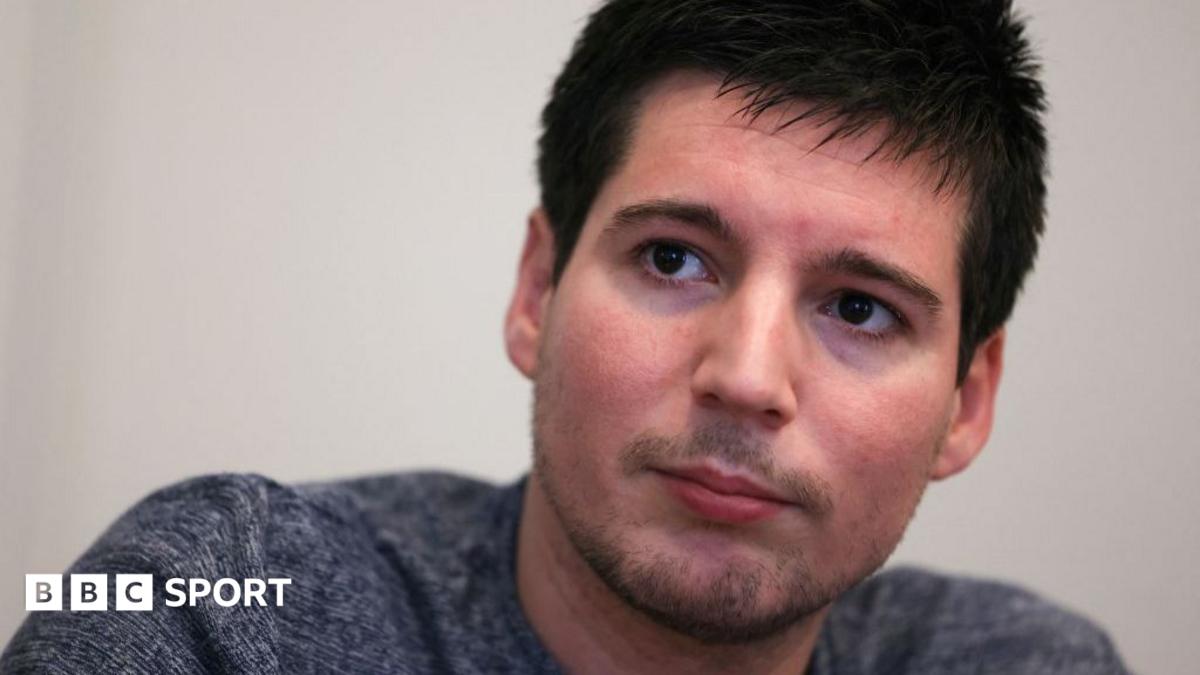
With his cherubic face and spiky hair, Pinto is instantly recognisable. And it seems he hasn't changed.
It is how Mario Falcao, his former geography teacher, remembers him.
In a small courtyard garden in Portugal, we got a glimpse of what Pinto was like as a boy.
"Rui was a perfectly normal pupil. He was nice, with his spiky hair, he was quite sociable but not extrovert," Falcao said.
"He had a good relationship with the teachers, although he did miss these classes quite often. His father was always on top of things, so in the end he passed quite easily."
Did he spot a strong interest in computers in a young Pinto?
"Certainly he was very good in computers. All the work that he did for various courses were very good, when he put his mind to it," his former teacher explained.
The now-retired Falcao speaks fondly of Pinto, who he says behaved just like his friends and would "go to the gym, go to McDonald's".
Pinto had a modest upbringing. He grew up in an area called Vila Nova de Gaia, just across the Douro River from Porto, Portugal's second-largest city. We visited the road where he used to live, which featured tile-fronted houses with terracotta roofs.
His school, Escola Secundaria Almeida Garrett, was well-regarded and was known by locals as 'the university'.
His father, Francisco, worked in a shoe factory and later as an antiques dealer. His mother had died when he was 11.
Falcao said he never predicted what was to come of his former pupil.
"We were very surprised," he said of the moment Pinto was named as the founder of Football Leaks in 2019.
"We weren't imagining anything like this could happen, that he could have problems with justice.
"I certainly wouldn't wish him and his family to be in this situation. Perhaps it was a question of the excesses of youth, his ability with computers, and maybe an excess of club-ism."
"So, you know, the fact that he supported FC Porto prompted him to commit some acts, but maybe he also felt the need for justice that young people very often do feel."
Clubs seek legal advice over Man City charges compensation
Pinto set up Football Leaks in 2015, to - in his words - expose "the hidden side of football".
Antonio Varela remembers the website's launch like it was yesterday. The Portuguese journalist was the first person contacted by Pinto, whose real identity would not be known for years to come, and was initially known by the pseudonym "John".
"It was a common day of September 2015. I was at the news room at [Portuguese sports newspaper] Record and I got an email from Football Leaks. It was strange. Then I immediately go to the site, and I can't believe there is lots of information that you never heard or read. We made the conclusion this is very, very important."
Re-publishing what had been leaked by Pinto brought legal and ethical conundrums.
"We realised that [Football Leaks] got the information illegally. But since the moment they publish the information on the site, that's public information," said Varela.
"You can't ignore that. Ethically, it's complicated, but the public interest is more relevant than the ethical issue. That was the conclusion."
It wasn't just eight-time Premier League champions Manchester City that Pinto targeted.
The early revelations on Football Leaks focused on matters closer to home, with leaks around Benfica and even the side he supported, FC Porto.
Later, there were leaked documents and communications relating to some of the world's most famous players, clubs and agents, including Cristiano Ronaldo, Lionel Messi and Neymar.
Pinto agreed to meet a journalist, Rafael Buschmann from the German magazine Der Spiegel. Once he knew he could trust him, he shared tens of millions of documents with him.
It was then up to a team of journalists in the Der Spiegel headquarters in Hamburg to meticulously go through it all, producing some of the most explosive articles the football world has ever seen.
Christoph Winterbach, a data journalist, was part of that team.
"In the beginning it was very much a fascinating feeling of like a child in a candy store," he said.
"If you're a football fan, if you're a sports journalist, it was amazing to see the actual documents, to see those emails where things are negotiated and to get a real look behind the curtain, how things work.
"It's very important when you have this type of documents, this type of data, that you make a lot of cross checks, that you use some software which we did that can put it all into context and you can see if there's any reliability issues.
"We always need to make sure that it's authentic material and whenever we publish something about it, it needs to be in the public interest to start writing."
Winterbach finally met Pinto in person in 2019, when he was being held in prison in Lisbon awaiting his trial. He conducted another interview with Pinto in witness protection, in a secret location with high security, describing the arrangements for getting there as being "like a Hollywood movie".
He said: "Rui Pinto is not very tall. He has very distinctive hair, like spiky hair. He usually has red cheeks and he's a youthful, cheeky, funny character. He's friendly and warm when you meet him.
"He's a very impressive character, he's very focused, he's very concentrated. He's very, very intelligent. He's very idealistic about the topics that he uncovered.
"He's one of the most important whistleblowers that we have in Europe or maybe the world."
In all, Pinto provided more than three terabytes - equivalent to about 3,000 copies of the Encyclopedia Britannica - of information to Der Spiegel and other outlets in the European Investigative Collaborations consortium.
We encountered stark contrasts in perceptions of Pinto wherever we went.
Former Portuguese politician and diplomat Ana Gomes has also met Pinto in prison and testified on his behalf at one of his trials. She is firmly of the view that he deserves to be protected, not prosecuted.
"What he has exposed is very important. In Portugal, definitely he is by far the most important whistleblower," the former Member of the European Parliament told us in Lisbon.
"He should be made an ally of our judicial and criminal investigative authorities. He has helped the authorities of other European countries in going after the corrupt and the criminals, instead of being the subject of this judicial prosecution by the choice of our public prosecutors."
When asked what she would say to Manchester City, who had their emails hacked by him, her answer is blunt.
"I couldn't care less. If they have nothing to hide, what's their problem?"
Jose Carlos Freitas, a retired journalist, said Gomes's sympathetic view is not a widely held one.
"For the majority of the people, they look at him as a thief," he said. "For some people, he is a kind of hero, a Robin Hood, you can say because he was exposing the dark side of the business of so many clubs, but unfortunately for the majority of the people, he is not a good person."
Varela is on the fence. "Nowadays, I think I put him in the middle [between whistleblower and criminal hacker] because he got the information illegally. But he gave us, all of us, a view, a dark view of European football, so he did a job to the society illegally."
Wherever you sit in the debate, he has faced serious consequences for what he did. As Winterbach puts it, Pinto "has powerful enemies through the work that he has done".
Image caption, Ana Gomes feels Rui Pinto should be protected and not punished
For the past six years, Pinto's life has been far from normal.
Having been arrested in Hungary in 2019, he was extradited to Portugal and has at various points been in solitary confinement, under house arrest and in witness protection.
Following his first trial in Portugal, in 2023 he received a four-year suspended sentence having been found guilty of attempted extortion, illegal access to data and breach of correspondence.
A separate trial in France resulted in a six-month suspended prison sentence a few months later.
And in January last year, Pinto's latest trial began in Lisbon. The opening day at the Central Criminal Court encapsulated the realities of his life and the difference in opinions of him.
Pinto arrived with members of his witness protection team, two of whom stayed in the courtroom throughout the hearing, along with an armed police presence.
He was dressed casually in a blue, long-sleeved top, jeans and brown boots, and had his distinctive spiky hair and some facial hair. He was fairly expressionless throughout, aside from the occasional shrug of the shoulders or glance at his team.
We sat just a few feet from him, as he conversed with his legal team in hushed tones and spoke to the judge purely to confirm details like his name and age. When asked for his address, he said he could not give this for security reasons.
Local journalist Miguel Dantas explained the security arrangements were scaled back compared with the first trial, when he wore a bulletproof jacket and there were snipers on the roof.
Rui Patricio, the lawyer representing Benfica, told the court Pinto was "no more, no less than a burglar", that he had obtained the information by "illegal and condemnable methods" and that the ends did not justify the means.
Outside court, Patricio added: "Our argument is very, very simple. He's a hacker, period, just like that. What he did is not allowed - it's a crime and there are no excuses. It's very, very simple. Very, very straightforward."
In his statement in court, Francisco Texeira da Mota, representing Pinto, accepted that his client was "not a hero and not a saint" but said he had brought "advantages for society".
Image caption, Journalist Miguel Dantas has covered Pinto's court appearances
The impact of Football Leaks is still being felt a decade on.
The Premier League's case against Manchester City has been one of unprecedented scale and significance.
From speaking to his legal team after the court hearing, it became clear Pinto has been closely monitoring that case from witness protection since the Premier League brought the charges in February 2023.
Asked if the outcome mattered, Texeira da Mota said: "I think it's important for him because it's very difficult to be like he is, living a very difficult life, more or less hiding, because he made some revelations, he whistle-blowed lots of important things, namely about Manchester City.
"So it would be important for him to feel vindicated that it was useful, that something happened, because what of what he said."
Speaking before the announcement of the decision in the City case, Stefan Borson, a former financial adviser to Manchester City, said: "I think for City, really, the whole of the Sheikh Mansour era is at stake if the core allegations are proven against the club.
"I think the consequences could be very far reaching for the club, and it would be a very difficult thing for them to deal with.
"Over time, clearly there would have to be some kind of reset. I think in many ways the Premier League is a loser either way."
Borson's view was that Pinto should not be seen as "some kind of warrior for freedom".
He said: "We know that what he carried out was a criminal act and he's been prosecuted for it.
"We also know that hackers of that nature do try and reframe themselves as part of the defence process as purveyors of freedom of speech. But, once those documents are in the public domain, then I think it's for the authorities to act."
For some, Rui Pinto is a criminal hacker who stole information with sinister intentions. To others he is a heroic whistleblower who shone a light on the darker side of the beautiful game.
What is undeniable is that one Portuguese man on his computer in Budapest has had a seismic impact on global football.
Latest Manchester City news, analysis and fan views
Get Manchester City news sent straight to your phone