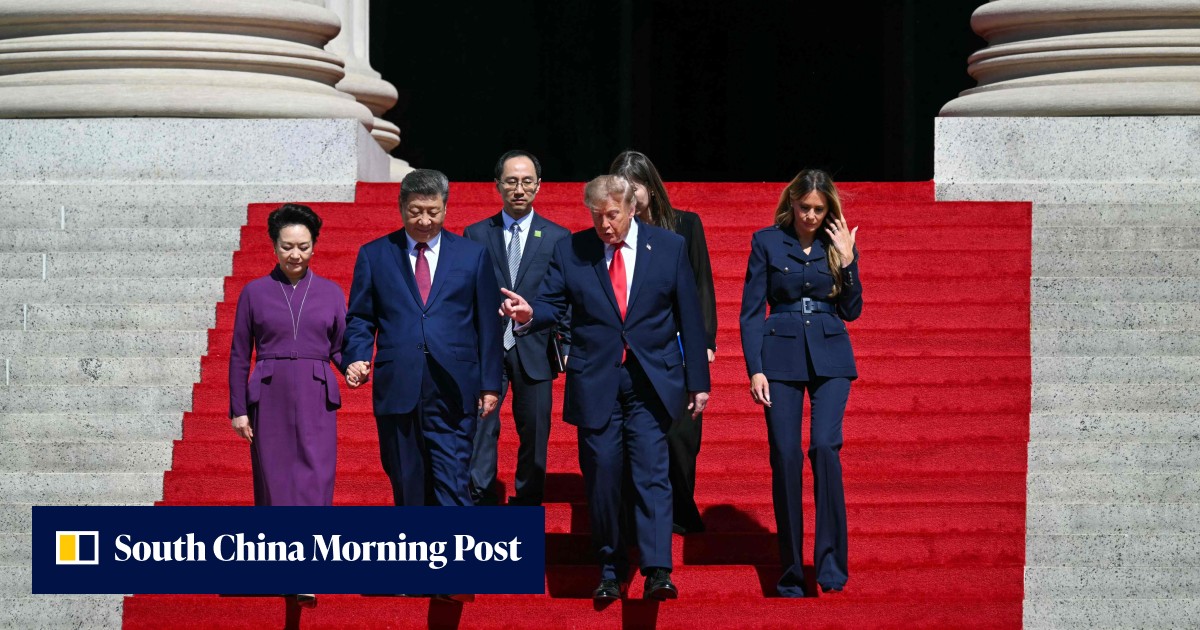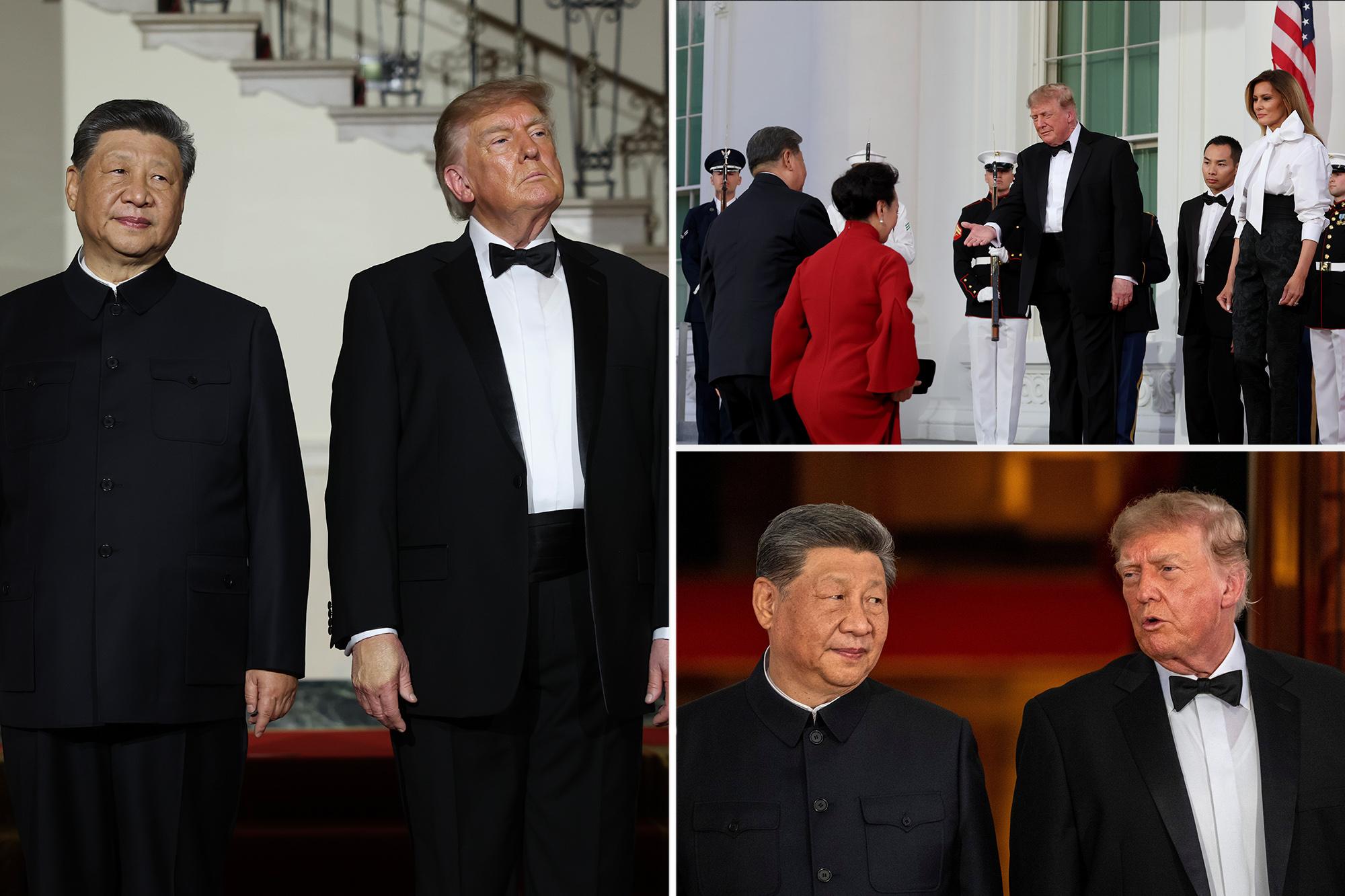
Make New York Post a Preferred Source President Trump was trying to “connect” with Xi Jinping, rather than “dominate” him, at the White House state dinner for the Chinese leader, according to a body language expert.
Sean Johns, who has 20 years of experience analyzing nonverbal communication and is the founder of the body language training company BodyLytics, told The Post that from Trump’s initial handshake with Xi and through the toast, the president appeared to be trying his best to make his Chinese counterpart feel welcomed and respected during the high-stakes visit.
Johns noticed the president “closed the distance” and “came towards” Xi during the arrival ceremony on the North Portico, which he found “not typical for Donald Trump.”
“Closing the distance between people is trying to kind of like connect. In a strange way, you’re connecting. So you’re closing that gap,” he explained.
“What we’re looking at with this handshake is what was not there,” Johns said. “Because Donald Trump is known for the aggressive handshake. He shakes for too long. He kind of grabs you by the arm often.
“And with President Xi, he didn’t do that.”
Trump’s approach to the handshake was “more of a sign of respect,” according to the body language expert.
“I think that he wasn’t trying to dominate, which he usually does,” Johns said, noting that Trump typically overdoes it with handshakes and aggressive pats on the back “depending on who he’s dealing with.”
“This showed that there was a lot of respect for [Xi]. And it was a very two-sided thing,” he continued, adding that both leaders “looked quite comfortable around each other … and there was no dominance play from either side.”
Johns pointed out that at the end of the handshake Trump forced “a little false smile,” which he would later deploy again during his toast for Xi.
At several points in his toast, Trump displayed what Johns described as “incongruence” between his remarks and body language.
“He emphasized that ‘We’re delighted to have you here,’ but there was no body language delight … the words were positive, but the body language was neutral,” the expert noted. “And he did this twice.”
“When he said, ‘We’re happily celebrating,’ It didn’t look like he was happy celebrating, it just looked like protocol.”
Another moment that stood out to Johns during Trump’s speech was when the president went off-script to invite guests to tour the new White House ballroom, which is still under construction.
“That’s the first time where you see a genuine smile,” Johns said, “and he almost came across like a naughty schoolboy.”
When discussing the ballroom, Trump became more expressive and aggressive than at any other point in his remarks or interactions with Xi.
“He makes his first hand gesture, bearing in mind that his hands have been down the whole time,” Johns observed.
“He points directly at the camera. Pointing, in body language, with the index finger, is considered aggressive,” he continued, noting that again, Trump’s words and body language were “not congruent.”
“You’re making a slightly aggressive gesture with a finger point, but you’re saying the ‘beautiful ballroom.’”
“There’s a disconnect there somewhere between the perception of perhaps the ballroom and all the drama that surrounded it,” Johns said. “There was a clear message from his body language.”
Based on his body language, the president was also genuinely pleased with the large, bald eagle statue he gifted Xi at the dinner.
“When they reveal the bald eagle statue, Trump does, kind of, two awkward steps … I think that was a closing distance gesture between him and the statue,” Johns said.
“It’s showing approval towards it almost. You get close to things you like. So he’s closed the distance and then, interestingly, he’s kind of does an exaggerated look at it and then looks back at Xi …. he’s trying to signal to him, ‘Look at the wonderful statue that we gave you.’”
Johns’ biggest takeaway was the “lack of physical, non-verbal aggression” throughout the dinner that Trump “usually shows certain people.”
“I think that what it shows to me is the amount of respect and perhaps the importance of the meeting and the fact that it was an important guest that had importance to even the economy, I would say,” he explained.
“So he took that very seriously, aside from the odd joke or two.”