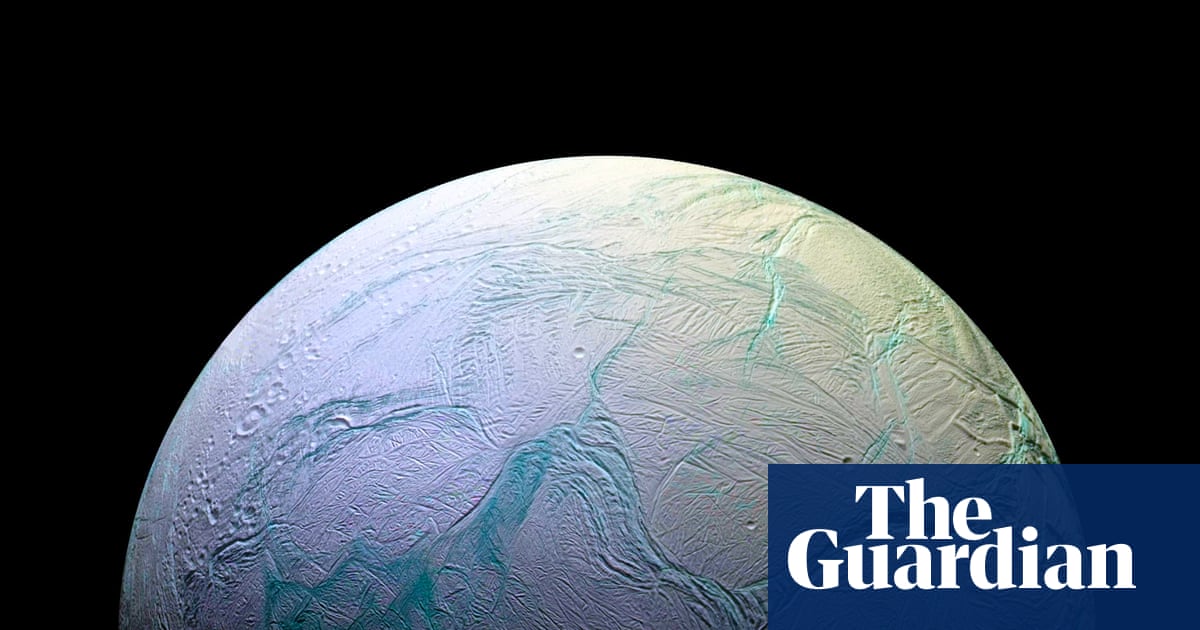
Observations of Enceladus have revealed it emits massive plumes of water vapour into space, suggesting a saltwater ocean exists under its frozen crust. Photograph: Universal Images Group/Getty ImagesView image in fullscreenObservations of Enceladus have revealed it emits massive plumes of water vapour into space, suggesting a saltwater ocean exists under its frozen crust. Photograph: Universal Images Group/Getty ImagesEarth microbes survive simulated conditions of Saturn moon’s oceanExperiment suggests organisms could live in harsh environment under Enceladus’s icy crust, strengthening possibility moon could support life
From the moment scientists spotted plumes of water erupting from Enceladus, one of Saturn’s moons, it became the most tantalising place in the solar system to search for life beyond Earth.
Now the case is even more compelling after researchers found that organisms that live in deep-sea waters off Japan can survive the harsh conditions expected in the briny ocean that lurks beneath Enceladus’s icy crust.
The microbes, which thrive near hydrothermal vents on the seafloor by converting hydrogen and carbon dioxide into methane, survived in a brine that mimicked the Saturnian moon’s ocean. The work suggests the distant world may be habitable, if not exactly hospitable, to at least some forms of life.
“If we use the cellular definition of life that we understand on Earth today, the experiments tell us that if this organism, or something similar to it, was on Enceladus, there’s a good chance it could survive,” said William Orsi, a professor of geomicrobiology at Ludwig-Maximilian University in Munich.
Saturn has more moons than any other planet in the solar system, with nearly 300 known to orbit the gas giant. For more than two centuries, Enceladus, a 300-mile-wide ice ball, did not seem particularly remarkable. But that changed with the arrival of robotic spacecraft.
Since the 2000s, observations from Nasa’s Cassini probe and, more recently, the James Webb space telescope have revealed gigantic plumes of water vapour and ice grains spewing from Enceladus and evidence for a huge saltwater ocean under its frozen crust.
View image in fullscreenAn illustration of water plumes on Enceladus, a 300-mile-wide ice moon of Saturn, as they vent into space. Illustration: Mark Garlick/Science Photo Library/Getty ImagesThe seafloor is thought to be dotted with hydrothermal vents that warm the water around them. Last year, scientists found organic substances in samples collected by Cassini as it swooped through one of Enceladus’s spectacular plumes.
Orsi and his colleagues wanted to see if they could concoct a miniature version of Enceladus’s ocean to study in the laboratory. By combining water with salts and carbonates and adding powdered rock, they recreated not only the extremely alkaline environment of the ocean but also crucial reactions that take place between the water and the rocky seafloor.
The rock-water reactions were active enough to start churning out hydrogen, a process that seems to happen in the ocean on Enceladus. It led the researchers to wonder whether Earthly microbes called methanogens, which survive by converting hydrogen and carbon dioxide into methane, could survive in the solution. “It was a long shot,” said Orsi.
To find out, the scientists turned to microbes originally found near deep-sea hydrothermal vents in the Okinawa trough between Japan and Taiwan. Hydrothermal vents are hot springs on the seafloor that release hot, mineral-rich water.
Surprisingly, the microbes grew in the simulated ocean despite its pH reaching 11, which is far more alkaline than the organisms’ known limit. The microbes even adapted their metabolism to cope with low concentrations of carbon dioxide in the water. Details are published in Science Advances.
David Rothery, a professor of planetary geosciences at the Open University, said that by showing that methanogenesis – the process that sustains the microbes – was possible in the simulated Enceladus ocean, the work “removes another barrier to the viability of microbial life there”.
View image in fullscreenA photo of Enceladus taken in visible light by Nasa’s Cassini spacecraft in 2016. Photograph: Nasa/ReutersOrsi stressed that if life ever evolved on Enceladus it could be radically different from that on Earth. Even if similar bugs did somehow arise, it is not clear if methane-making microbes would thrive in the moon’s ocean: his experiments lasted only days. “Could they survive for a year? Could they survive for a million years? We don’t know,” Orsi said.
In a second paper in the journal, some of the same researchers describe how ice grains in Enceladus’s plumes freeze and fragment in a way that separates the different constituents of the ocean. If ocean droplets contained bits of alien microbes, these might turn up in a small fraction of ice particles but be highly concentrated within them.
That would be “great news” for the search for life, said Frank Postberg, a professor of planetary sciences at the Free University of Berlin, who said it would be relatively easy to identify signs of life with today’s technology.
The tantalising science around Enceladus has fuelled interest in a return trip. The European Space Agency’s L4 mission aims to combine a Saturn orbiter with an Enceladus lander that would touch down at the moon’s south pole and hunt for biosignatures in the plumes erupting from its ocean. But scientists face a long wait: with a launch proposed for about 2042, it would not reach Saturn until the 2050s.
Dr Rachael Hamp, also at the Open University, who has worked on Enceladus’s plumes, said: “It’s fantastic to see new research pushing our understanding further and providing additional evidence for the potential habitability of this little icy world. I think this makes the European Space Agency’s proposed mission to Enceladus even more exciting.”