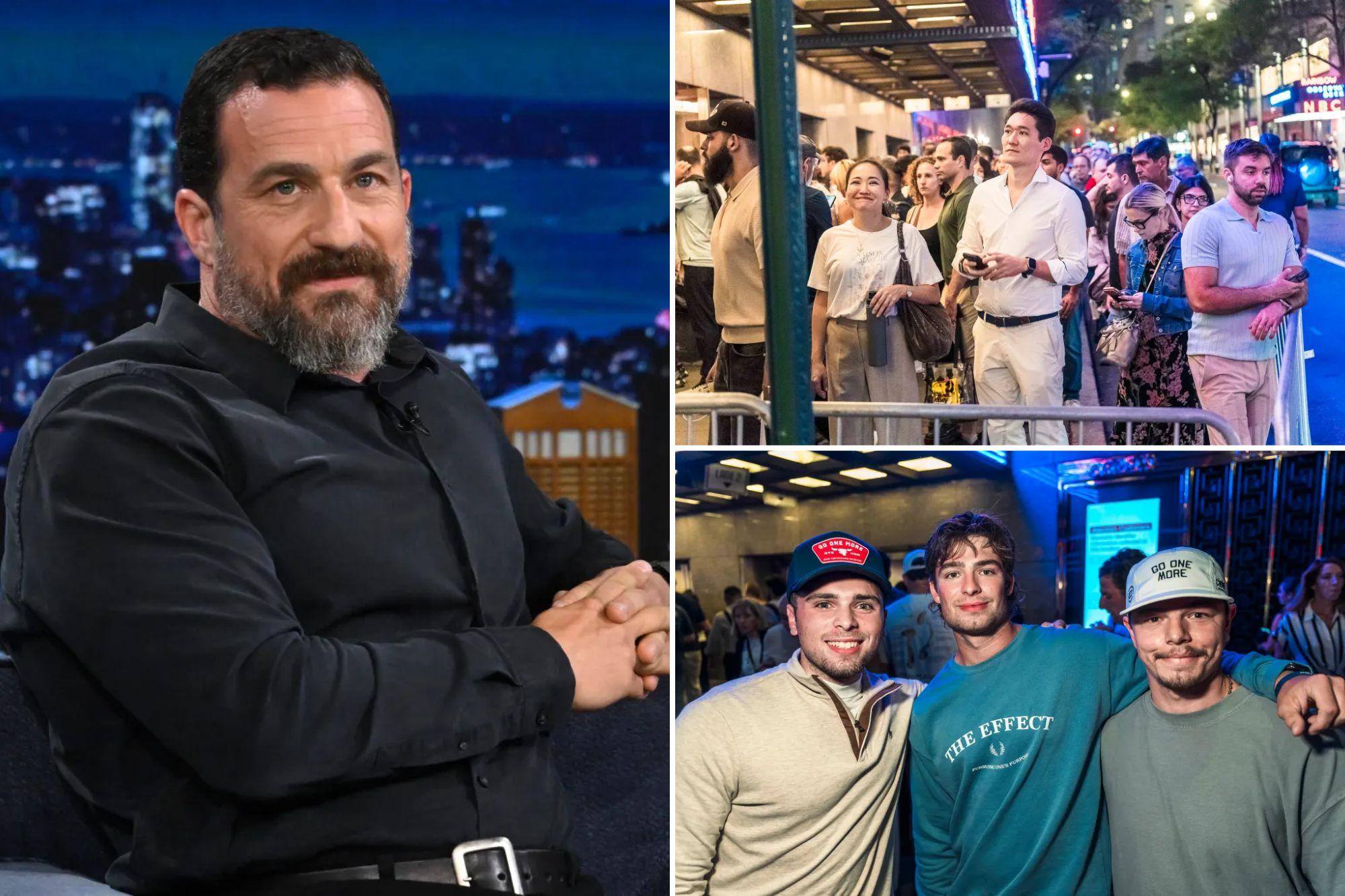
Make New York Post a Preferred Source Last week, nearly 6,000 superfans packed Radio City Music Hall — but not to see their favorite pop star.
Instead, wellness obsessives were there to worship at the altar of their hunkiest high priest — tattooed skateboarder, rock-music obsessive, Stanford neuroscientist Andrew Huberman.
They stood in the aisle of the esteemed venue, posing and taking photos with his long-anticipated book, Protocols: An Operating Manual for the Human Body, as a photo carousel splayed across the screens.
And when he finally took to the stage, the audience hung on his every word. Even though many of those words — personal anecdotes and pretty generic wellness advice — had been shared before, across multiple podcast episodes.
In a different era, he might have been dismissed as a science geek. But in today’s longevity-obsessed economy, he’s a demigod.
Call it revenge of the nerds, except the nerds got hot.
Thanks to his chronically online posting, Huberman is now one of the most influential modern-day “celebrities.”
The timing of his rise, rooted in the pandemic, coincided with people taking a genuine interest in understanding and having more autonomy over their health — so his advice on the importance of sleep, exercise, supplement protocols and, of course, neuroplasticity has gone viral time and again.
Searches for the scientist have surged 2,100% in five years.
He’s amassed nearly 16 million followers on YouTube and Instagram, over half a million on TikTok, and a 55,000-person Reddit community whose members call themselves “sungazers,” because, well, Andrew Huberman wants you to go outside.
Though his net worth isn’t public, his empire now includes a bestselling book, live events, merchandise, a paid Huberman Lab membership ($10 a month), major sponsors and compensated advisory relationships with health and wellness companies.
His Huberman Lab podcast has 3 million weekly listeners, but his influence extends far beyond his nearly 3-hour episodes.
Devotees have changed their lives based on his advice.
Some avoid caffeine until 90 minutes after waking to align with what Huberman explains is their natural cortisol rhythms.
Others have added explosive, high-intensity workouts to their routines not only for cardiovascular benefits, but because Andrew Huberman says it can enhance neuroplasticity (the reprogramming of your brain).
They are even experimenting with nicotine after he lauded its positive effects on cognition.
Some critics have questioned the neutrality and accuracy of his advice, arguing that he promotes supplements and brands in which he may not disclose a stake, and that he can broadly extrapolate and oversimplify studies.
And in 2024, a New York magazine exposé detailed allegations about complicated and overlapping romantic relationships — and a tendency for him to have angry outbursts and rages.
Would it bother his fans that a man who’s built a brand off self-regulation and optimizing life, offering advice on relationships and attachment style, had a very different private life?
No. His cultlike devotees don’t really care about cancel culture. They want to keep listening.
For Delphine Le Grand, a follower and founder of the membership peptide company The Protocole, Huberman’s intellect outweighs his alleged personal failings.
“It’s not ideal behavior,” she told The Post. “But I feel like one’s health knowledge is separate from being romantic.”
Twenty-four-year-old Gianni Rossitto was unbothered too. He arrived at Radio City with two friends carrying a black leather-bound notebook, ready to absorb every word.
Rossitto religiously follows one of Huberman’s most famous protocols: getting outside immediately after waking and exposing his eyes to natural light for several minutes to prepare him for better sleep that night.
Even during a New York winter, Rossitto said he gets outside as much as possible because of Huberman’s long-winded episodes on the benefits of sunlight.
His friends had incorporated Huberman into their lives too.
Ethan Libonati, 24, works night shifts in a neuro ICU and wears blue-light-blocking glasses at night to manage the disruption to his circadian rhythm.
He also follows advice on neuroplasticity through novel thinking, repetition, or high-impact exercise.
Another friend, 32, told The Post he was particularly drawn to Huberman’s discussions about the benefits of nicotine, which Huberman touts as a cognitive enhancer that helps with focus.
And 67-year-old Alie Zinnurova put her devotion more simply: “I practice what he says.”
Specifically, following his advice about hormone regulation and living in a way to avoid hormone replacement therapy.
Inside Radio City, Huberman understood his audience wasn’t accidental.
“I imagine none of you stumbled in here,” he told the crowd, who clapped and cheered as the 6 ‘1, strapping scientist took the stage in what he called a “pinch me” moment.
He spoke about finding purpose, painful memories, and not needing to be “good” at everything.
One woman translated his sermon-like discussion of how his new book came to fruition into Italian on her iPhone while he spoke.
Halfway through the show, the audience was invited to ask questions, ranging from brain health and trauma to what Huberman would tell his younger self.
“You’ve met an insane amount of brilliant people. What separates those operating at the very highest levels from other high performers?” one audience member asked.
Huberman responded that he didn’t fully understand how his own success happened, but described having a “compulsion” to be the highest-performing version of one’s essential self.
But he also argued that if your protocols pull you away from living a balanced life rather than the fullest version of yourself, then you’re missing the point.
“The appeal of Huberman is that he’s incredibly level-headed. He doesn’t get too excited about anything,” explained Dominic D’Alexander, a 30-year-old New Yorker, who works in the wellness space. He added that the elaborate tools often peddled by influencers are where biohacking can start to lose the plot.
“I don’t need a vibrating sound board to relax my breathing before bed,” he said. It’s just a lot of stuff that, if it were free and someone handed it to me, I’d probably try it, but it’s hundreds of thousands of dollars.”
That’s where Huberman stands out for his followers in a wellness world that can teeter on the fringe and is too gadget-focused.
“There’s a version of [biohacking] that is genuinely useful,” Le Grand said — one rooted in taking more control over your health. “But there’s also a version that becomes incredibly male, competitive, and obsessive where a complicated routine is seen as a flex.”
But the line has blurred, and Huberman himself hasn’t escaped questions about whether the controlled life he describes publicly matches the one he lives privately.
After the 2024 expose, Huberman stayed mostly silent, responding to these allegations for the first time in a recent Men’s Health interview.
“I’ve not made the best choices about relationships and partners in the past,” he said. “My biggest mistake was not telling people just how imperfect I was. I’m perfectly happy going on record — then and now — saying I’m an imperfect person. I struggle with all sorts of things. But I strive to be a good person.”
For fans like D’Alexander, it’s not entirely disqualifying.
“He’s human,” he added. “I don’t love it, and it does take away from his podcast, but it does not ruin it. Attias’ version of this sort of thing was egregious and effectively unforgivable,” he said, referencing the disgraced Jeffrey Epstein doctor who had engaged in sexually explicit emails.
And if the scandal was supposed to loosen Huberman’s appeal to his followers, instead it only expanded it.
“Our podcast grew,” Huberman said. “Our [audience] grew from that. It was wild.”