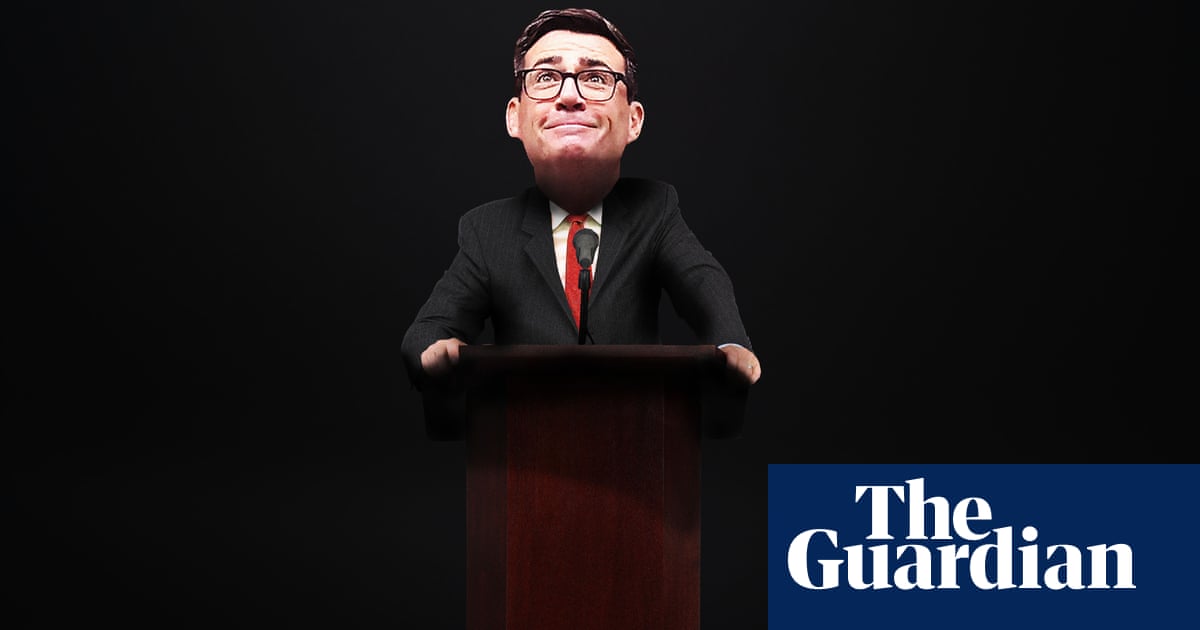
Burnham will emphasise again that he intends to deliver the biggest change to Britain in 40 years. Composite: Guardian Design/Getty ImagesView image in fullscreenBurnham will emphasise again that he intends to deliver the biggest change to Britain in 40 years. Composite: Guardian Design/Getty Images‘We will get stuff done’: Burnham seeks to banish ghosts of Starmerism at Labour conferenceThe PM returns to Liverpool, where he was mocked last year, with a promise that no one will be left wondering what he’s trying to do
Andy Burnham was not even in the audience for the prime minister’s speech at the Labour party conference this time last year. As Keir Starmer made the case for continuity to his restive party, Burnham was spotted slipping out over the bridge towards Liverpool’s Albert Dock.
The Manchester mayor had been vying for the spotlight throughout the party’s annual gathering, presenting the argument for change. But even he could not have envisaged the schism that would take place in the ensuing 12 months and would put him on the main stage as prime minister at this year’s conference, beginning in Merseyside on Sunday.
At the time, Starmer retained a tentative grip on the party, while Burnham was mocked for leaving Liverpool with his tail between his legs, awkward and abashed, especially over his controversial comments about being too “in hock” to the bond markets.
But below the surface, disquiet was starting to take shape. Several cabinet ministers confided privately in Liverpool last year that they believed Burnham would ultimately be seen as the party’s Cassandra: comically ham-fisted, but nonetheless telling hard truths about the party’s problems.
After he succeeded Starmer in the top job in July, Burnham has made “Hope Again” his conference slogan, with No 10 strategists pitching this year’s event as a definitive break with the past.
Burnham has been promising to defy the political and economic consensus of the last 40 years since he was elected as MP for Makerfield, in a byelection that proved to be the final domino for Starmer’s faltering leadership, and will use this conference to set out how he aims to do this.
View image in fullscreenBurnham at last year’s Labour conference. Photograph: Dan Kitwood/Getty ImagesIt will also attempt to break old habits in the Labour party’s way of doing business which has often been hindered by pessimism, fear and factionalism. Cynics in the party will wonder if this effort can withstand current economic pressures, given soaring borrowing costs.
Hayden Munro, Burnham’s new political director, has told cabinet ministers and special advisers they must defy such cynics, and every message they send must be about how there is renewed faith in Britain.
Munro, a former strategist for Jacinda Ardern, who colleagues say is the “in-house hype man”, told them the theme of conference would be how help was coming for ordinary working people.
Burnham’s government would put care of people as the first consideration, he told them, restoring “the right values” – a nod to the widespread fears in Labour about the rise of overt racism across the political sphere.
Ministers have been tasked with announcing policies that deliver immediate breathing room for families, but also long-term plans and investment to make everyday life easier and more affordable, with a particular focus on public control of essential services. Burnham will emphasise again that he intends to deliver the biggest change to Britain in 40 years.
But the other theme of the conference will be courage, that this will finally be a government which will fix problems long been thought to be intractable, rough sleeping, social care, and youth inactivity.
“‘It’s too hard’ will no longer be used as a justification for not acting. We will get stuff done,” Munro wrote in his note to advisers.
Addressing Labour conference in Liverpool is a kind of homecoming for Burnham, even though he is most closely associated with Manchester. He was born in its suburbs, it is where he had his formative political awakening on the Hillsborough injustice, and the area where he returned just a fortnight ago in tragic circumstances, after his father’s death from Alzheimer’s.
Burnham writes all of his own speeches and has spent the last few weeks in between meetings, and travelling by train between London and Manchester, working through his ideas. He told reporters at the United Nations general assembly in New York this week that his conference speech would be his own political philosophy spelt out in primary colours.
“I keep saying, ‘Nobody won’t know what I’m trying to do.’ People will know, you can make your judgment on whether it’s right or wrong. But people are going to know the direction I want to take this country in.”
This approach marks a definitive break with Starmerism. “If we achieve one thing at this conference, it will be that no one will ever say about Andy Burnham what they said about Keir Starmer,” one Labour strategist said. “You can never say ‘we don’t know what he stands for’.”
Burnham is the beneficiary of a gentler political landscape than Starmer was a year ago, when Reform and the rapid rise of far-right demonstrations had dominated the summer.Labour were sinking in the polls even before the scandal-fuelled resignations of Angela Rayner and Peter Mandelson just weeks before the event.
Going into conference now, Labour is in the lead with all pollsters for the first time since October 2024, partly thanks to Burnham’s own bounce, but also as a result of declining trust in Reform after a series of scandals.
There is also very little appetite for rebellion among the Labour rank and file who have often made it awkward for Labour leaders with votes on the conference floor. “It is going to be very boring,” one senior party figure said. “Everyone is desperate to make it work.”
Activists will be pushing for conference to commit to a commission on electoral reform, which Burnham has said he will put in Labour’s next manifesto but which strategists do not want to make a major topic of his first months in office. At least three dozen local parties have submitted motions on the subject, more than any single policy issue since conference rules were tightened in 2023, making it likely it will be one of the priority topics for debate.
The only other unwelcome surprise would be an emergency motion on Israel and Palestine. Ministers had hoped Ed Miliband’s announcement of sweeping sanctions against West Bank settlements would be an answer to calls for Labour to take a much more robust position on Israel.
But party staff believe something more could come when emergency motions are tabled this weekend. “There is always another demand, and conference will always vote for almost anything put in front of it on this,” another senior figure said. “The unions have very left policy mandates.”
Most of the exiled former cabinet ministers and Starmer loyalists are swerving conference this year – the exception being Darren Jones, the former chief secretary to the prime minister who will take part in some keenly watched fringes. But few have his inclination. One ex-minister said he did not feel welcome.
“No one wants a spectre at the feast,” he said. “Any appearance is going to attract some unwelcome attention. I do think more of us will start to speak out, whether on oil and gas, on the economy, maybe on Europe, but frankly doing that at conference is too unhelpful – even if it’s the kind of tactic that Andy himself has been doing for years.”
Read moreMany said they saw it as a chance for a break. One former minister close to Starmer compared himself to Arsenal’s Declan Rice, who played more minutes last season than any other English footballer but who will now sit out England’s matches over the international break. “I haven’t had a rest in about six years. I think it makes sense to miss the first Labour conference in about 15 years,” he said.
There will be time for interventions – helpful or otherwise – in the coming months. Conference is the first of four phases that No 10 views as opportunities for Burnham to seize public attention and set direction. After that will be the budget, his 10-year plan expected later in the autumn, and then the spending review next year.
But if conference gives Burnham another poll boost, it will add to the chatter in Westminster that he could decide to call a general election sooner rather than later.
“Conference could be make-or-break for that decision,” one MP said. “If the left looks united, if the polls continue as they are – and if we then beat Polanski in Holborn and St Pancras then there will never be a better time.”
Most cabinet ministers are wary. “Why are we here if not to use this majority we have got to improve the country?” one said. “If we are saying we are here to get things done, then let’s do them now.”