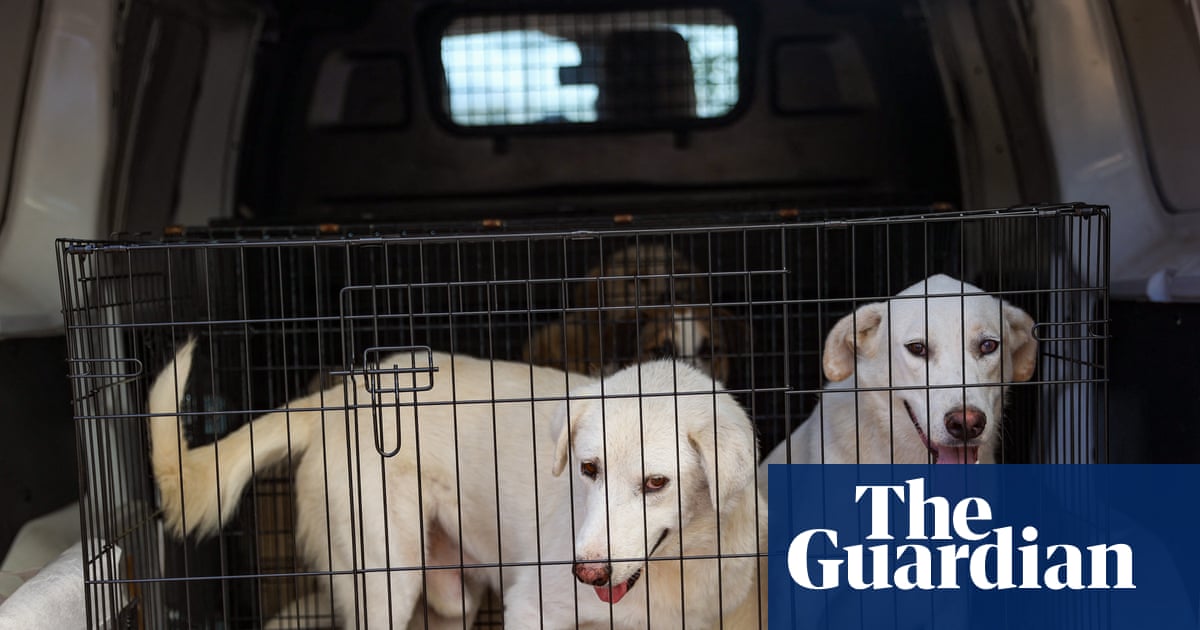
In one case, DNA analysis cleared one owner’s dogs of a sheep attack. Photograph: Aris Oikonomou/AFP/Getty ImagesView image in fullscreenIn one case, DNA analysis cleared one owner’s dogs of a sheep attack. Photograph: Aris Oikonomou/AFP/Getty ImagesDNA database of UK dogs could help police collar criminals Experts working on database that could identify particular breeds involved in crimes, or rule out canine suspects
From tracking criminals to sniffing out drugs, dogs have long helped police crack cases. Now experts are hoping a database of canine DNA could offer vital leads.
While hair, saliva and other canine material may be found at crime scenes, or on individuals connected to incidents, scientists say they are often not fully investigated.
Yet such traces could provide valuable clues, from the identity of a canine perpetrator to evidence a dog’s owner was present at a crime scene.
“You might have a human case, kidnapping, for example,” said Prof Denise Syndercombe Court, a forensics expert at King’s College London who is leading the work. “Lots of us have dogs. We live with dogs all the time. And so if you can identify canine material associated with a crime like that, then that can be very powerful in being able to provide intelligence to help solve a human case where there’s no other evidence.”
As a result, researchers at King’s College London and the Royal Veterinary College have teamed up to harness the potential of canine DNA.
“Forensically, we don’t have loads of DNA,” said Syndercombe Court. “You have a few cells that are left at a crime scene … So you’ve got to make something useful out of that.”
One approach is similar to that employed in the forensic analysis of human DNA, which is to focus on very small segments called short tandem repeats (STRs).
This technique involves looking at the number of times these small segments are repeated in the DNA, resulting in two numbers for each STR – one inherited from each parent.
Syndercombe Court noted the set of numbers provided a virtually unique profile – be it for a human or a dog. What is more, in dogs some sets of numbers are more common in some breeds than others.
By focusing on STRs the team has built a database covering 80 different breeds – the first of its kind in the UK. For the 10 most common breeds, including labradors, cocker spaniels and miniature schnauzers, samples were taken from at least 50 dogs of each breed.
The upshot is that canine DNA from a crime scene can be analysed and the results either compared with those from a particular dog – allowing that animal to be confirmed or ruled out as being linked to a crime – or screened against the database, potentially allowing experts to identify the breed of dog from which it came.
The latter could be particularly useful where the dog thought to be linked to a crime is unknown, or where samples cannot be taken from a canine suspect, or where the sample does not match the DNA of a dog under suspicion.
Syndercombe Court said her team now hoped to expand their database to include breeds such as pitbull terriers, American XL bullies and Japanese tosas that are banned in the UK.
While the STR analysis focuses on DNA from the nucleus of a cell, the team have also created a database using another approach: sequencing DNA from within mitochondria – the tiny structures that power cells.
With many mitochondria per cell, this approach can be useful where there is very little material to work with – although it is more limited as this DNA is only passed from mother to offspring.
The focus on doggy DNA has already offered insights for police investigations. In one case, the approach shed light on whether serious injuries sustained by a man were down to another person – as he claimed – or occurred when he tripped over his own dogs as they attacked the accused.
Forensic analysis supported the latter. “We looked at the T-shirt [of the accused] and there were holes in the T-shirt,” Syndercombe Court said, adding the team also found DNA from two different dogs on the garment.
In another case, the DNA analysis shed light on a sheep attack.
“We got some decent DNA from the crime scene, and the police thought it was a particular person’s dogs,” said Syndercombe Court.
However the DNA from those dogs did not match the DNA recovered from the crime scene.
“So we were not only able to exclude his dogs, which were of a particular breed, but also say the breed of dog that [did] this attack was very likely to be [another breed],” said Syndercombe Court.
Dr Nicholas Dawnay, an expert in forensics at Liverpool John Moores University – who was not involved in the work – said research assessing how best to use canine DNA collected from crime scenes was hugely important.
“Whether it is a dog attacking a human or livestock or wildlife species, the ability to match the individual dog back to the attack is the primary goal. Obtaining breed information at the early stages of an investigation may help narrow down the pool of possible dogs, which is exciting,” he said.
But Dawnay said a big challenge remained regarding the funding of canine forensic casework: “Police budgets are stretched and without effective funding, the benefits of this research may struggle to be realised.”