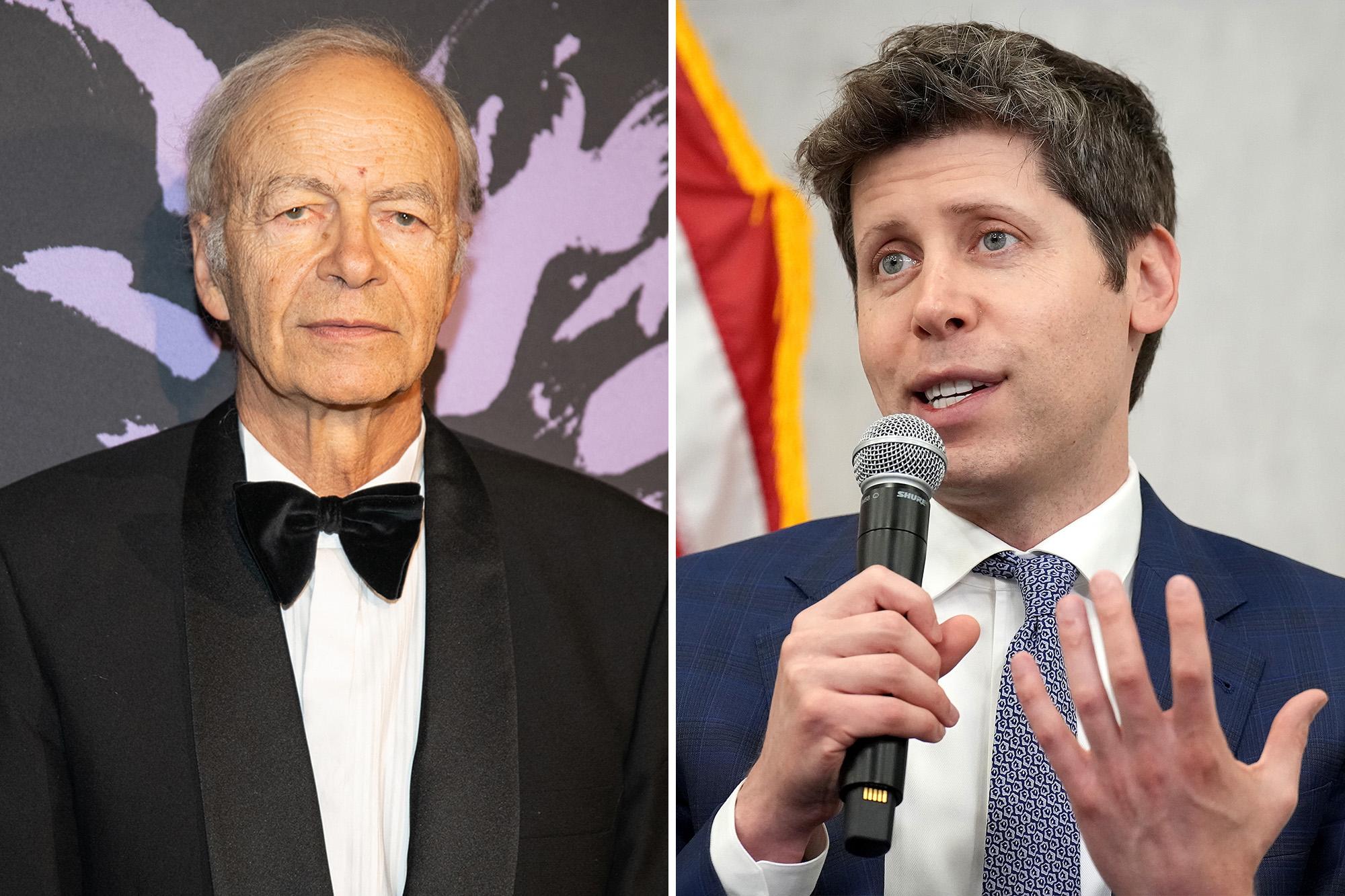
Add The New York Post on Google The nutty professor dubbed the “father” of effective altruism (EA), the theory beloved by AI doomers who want the power to police the technology, expressed support for bestiality and said the life of a newborn baby is worth less than a chimp’s or a hog’s.
Peter Singer is an Australian philosopher and bioethicist who argues that killing disabled infants is not morally wrong, that sex with animals is preferable to raising them for food and that even necrophilia can be moral.
Since the 1970s, he has suggested rejecting traditional concepts of right and wrong and replacing morality solely by calculating and maximizing interests.
Now 80, he could have disappeared like many other new-age 20th-century philosophers, if his theories hadn’t been picked up by the wealthy Silicon Valley masters of the universe, including AI bosses such as OpenAI’s Sam Altman and Anthropic CEO Dario Amodei.
But these apocalyptic theories have less to do with stopping Skynet and more to do with tech bosses seizing power and tightening ranks around their doomsday cult, critics warn.
“In Peter Singer’s universe, there are no rights for anyone,” Scott Walter, former Special Assistant for Domestic Policy to President George W. Bush, told The Post.
“In fact, there is no right and wrong. There are only the interests that are claimed or the goals that we set,” said Walter, who is now president of the think tank, Capital Research Center.
Taken to its logical extremes, this view has brought Singer to dark places.
“Killing a disabled infant is not morally equivalent to killing a person. Very often, it is not wrong at all,” Singer once wrote in his 1979 book, “Practical Ethics.”
In the same book, he questioned whether a newborn baby’s life was worth as much as a chimpanzee’s.
“If the fetus does not have the same claim to life as a person, it appears that the newborn baby does not either, and the life of a newborn baby is of less value to it than the life of a pig, a dog, or a chimpanzee is to the nonhuman animal,” Singer wrote.
Time hasn’t softened his views. In 2023, he shared a link to a previous interview comparing bestiality favorably in comparison to factory farming.
“Peter Singer is completely clear. Animals are often superior to humans or at least to the humans that he would be happy to have euthanized,” said Walter.
He added that Singer’s views on killing the disabled have parallels with Nazi Germany.
Walter compares the words of Hitler’s physician, who carried out the first act of euthanasia on a disabled child in the Third Reich, with Singer’s previous claim that even children with hemophilia don’t deserve to live.
“The passage from Singer says, ‘We’re going to kill the hemophilic kid, so that the next kid can have a better life,'” Walter said.
What makes the comparison all the more tragic is that Singer is a descendant of Holocaust victims, having lost three grandparents in the Nazi deathcamps, Walter points out.
EA grew out of Singer’s writings, as well as his 2013 TED Talk, but the term itself was coined by his former student, University of Oxford philosopher William MacAskill.
In its most basic form, it aims to reduce human suffering to numerical calculations and spreadsheets.
Its supporters assert that individuals should concentrate on maximizing getting rich, and then donating money to causes based on calculations of maximum impact.
That means prioritizing “the hungriest tribe in Sub-Saharan Africa … [over] the Salvation Army or your kid’s Girl Scout troop,” Walter explained.
“Postmodern atheist types are often in search of meaning; effective altruism gives them a way to find that meaning without actually defending the claim that right and wrong exist,” Capital Research Center investigative researcher Parker Thayer told The Post.
“That’s essentially, I think, one of the reasons why it was so appealing,” added Thayer, describing the movement as “reductionist” and a “doomsday cult.”
A classic example of EA application in the tech world was Sam Bankman-Fried, the founder of the defunct crypto exchange FTX, who started out wanting to help the world — but then justified accumulating billions in wealth by saying he could help even more people with the money later.
When EA’s mathematical calculations are extended into the far future, the potential lives of trillions of future human generations pale into insignificance, Thayer explained.
“Climate change was briefly a very big thing for the effective altruists. Also animal rights,” he said.
But after COVID, these models took on a more apocalyptic air, while also bringing in big-money figures, such as convicted fraudster Bankman-Fried.
“Bankman-Fried was one of the first people to introduce this from a funding perspective. He set up a whole organization that’s now already closed down, obviously, about preventing pandemics,” Thayer said.
Start your day with all you need to know Morning Report delivers the latest news, videos, photos and more.
That energy has now moved on to AI doomerism, he explained.
“It’s just another way that they think the apocalypse could happen.”
But while it is tempting to see these figures as cranks, or laughable would-be cult leaders with a messiah complex, Thayer believes that the implications are extremely dangerous.
With previous apocalyptic cults, “once the doomsday doesn’t happen, the cult dismisses itself,” he said. “However, in this case, it’s going to be harder, because the AI safetyists almost never make a falsifiable prediction on the record.”
“You’ll notice that they’re never willing to give a timeline or a sense of scope or even really describe the methods by which the AI is allegedly going to end the world,” he said.
Walter added that instead, the real danger lies in giving AI doomers “massive government power” over our lives.
“The idea that we should allow a partnership between Anthropic, OpenAI, and the Feds, now that would be a recipe for entrenching this wretched cult in a big bad way,” Walter said, arguing against a doomsday view of AI.
“All kinds of little people could be helped by AI. But somehow I really don’t think those billion-dollar corporations are super keen to have that kind of competition,” he said.
It comes after President Trump dismissed AI doomerism, calling fears of artificial intelligence destroying humanity a “hoax,” and insisting that “the robots will not be taking over,” during recent speeches.
Peter Singer, Sam Altman, and Dario Amodei did not respond to requests for comment on Thursday.