play Live Sign upShow navigation menuplay Live Click here to searchsearchSign upOPINIONOPINION, OpinionSwitzerland’s neutrality vote is asking the wrong questionThe referendum asks what Switzerland should do to remain neutral. The harder question is what neutrality can still do for Switzerland.
Senior Researcher at the Centre on Conflict Development and Peacebuilding (CCDP) at the Geneva Graduate Institute.
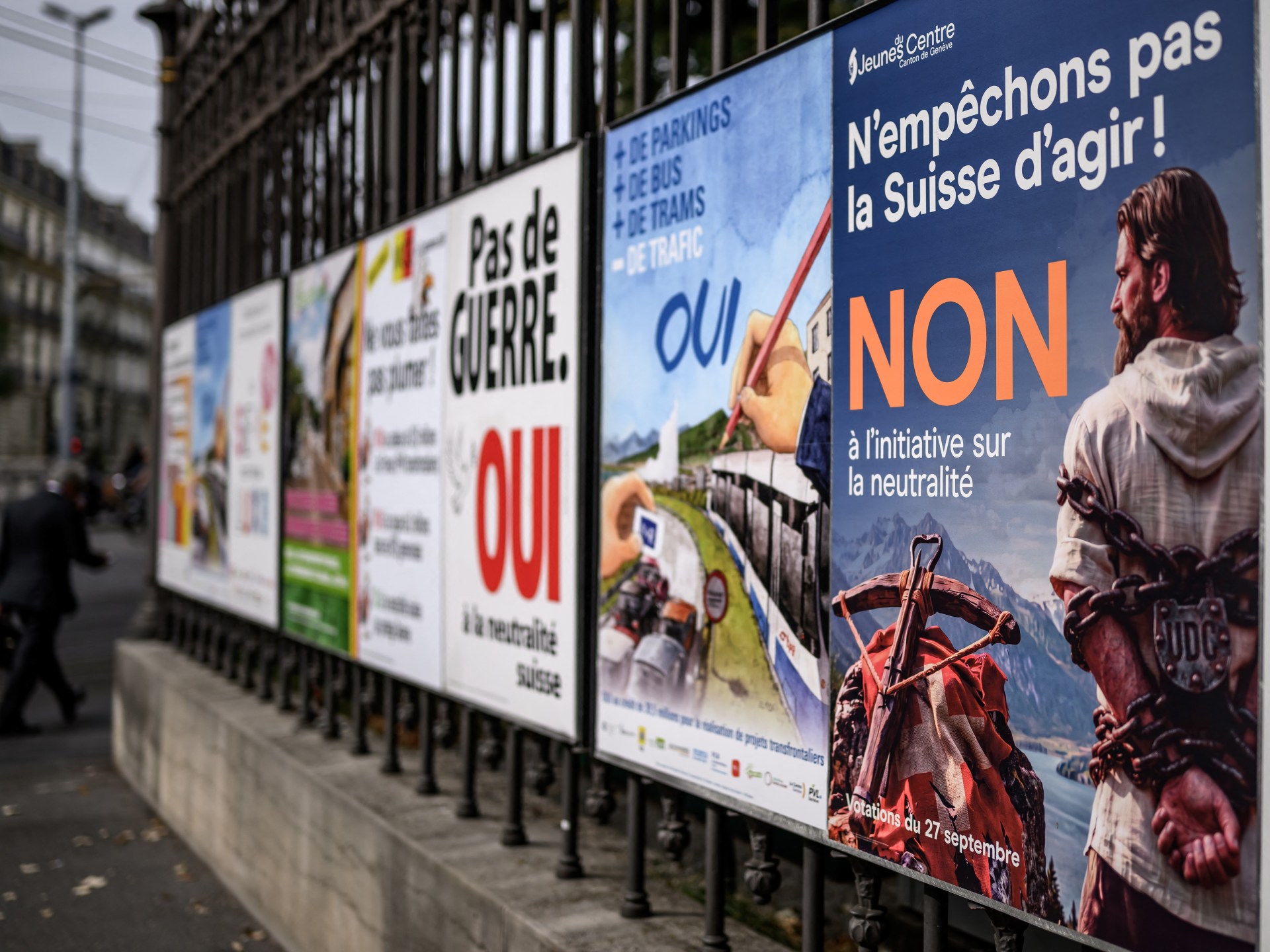
xwhatsapp-strokecopylinkgoogleAdd Al Jazeera on GoogleinfoAn electoral poster reading in French 'Let’s not prevent Switzerland from acting! No to the initiative on neutrality" representing the legendary Swiss folk hero William Tell is displayed alongside other campaign posters ahead of a nationwide vote, in Geneva, on September 17, 2026 [AFP]On September 27, Switzerland votes on whether to lock a stricter definition of neutrality into its constitution. The initiative would bar Switzerland from cooperating with a military alliance unless it were under military attack or such an attack were being prepared, and prevent it from imposing sanctions on a belligerent state unless those sanctions were mandated by the United Nations Security Council (UNSC). Polls suggest it will fail, with 63 percent intending to reject it. But that result says less about Swiss faith in neutrality — which remains overwhelming — than about how badly the vote and the surrounding debates miss the real issue: the vote asks whether to restrict sanctions and alliances; the real question is how neutrality can still deliver security and prosperity.
Neutrality has shaped Swiss identity since 1815, when the European powers recognised Switzerland’s permanent neutrality after the Napoleonic Wars. It survived two world wars and the Cold War on a basic premise: keeping foreign armies off Swiss territory would keep Switzerland out of other countries’ wars, while trading with all sides would keep its diverse economy connected to the markets on which its welfare depends.
The neutrality initiative grew out of Russia’s invasion of Ukraine in February 2022. Switzerland had adopted European Union sanctions before, but sanctioning Russia specifically — a major power Switzerland had long sought not to antagonise — cut deeper. It sharpened a question earlier cases had already raised: whether economic measures against a belligerent power were compatible with neutrality at all. The Swiss People’s Party and Pro Schweiz, or Pro Suisse, launched the initiative to preserve the stricter model they believed had served Switzerland well.
A “yes” vote would bring significant changes, while a “no” would largely mean a continuation of the flexible, case-by-case neutrality Switzerland practises today. A “yes” could force Switzerland to unwind its existing sanctions against Russia and would prevent it from joining future EU- or United States-led sanctions against belligerent states unless those sanctions were mandated by the UNSC. It would also constrain the bilateral cyber, air-defence and joint-exercise cooperation with its neighbours (that happen to be members of NATO) that Switzerland has expanded since 2022 — precisely the kind of cooperation it may need more of as the European security environment deteriorates. But whichever way Switzerland votes, the harder questions will remain, because the initiative answers a 2022 question, and the world has moved on in three ways it cannot address.
Three things have changed since 2022: the nature of the threat from Russia, the reliability of the US as a trading partner and the strategic implications of China’s economic weight.
The first is the threat itself. For two centuries, Swiss neutrality was designed primarily to protect its security in the context of a territorial war. Switzerland, a heavily armed state in the Alps, made invasion costly and denied foreign armies an easy route through Swiss territory. That model has much less to say about a new threat: a European war that indirectly yet significantly affects Switzerland.
Switzerland’s 2026 Security Policy Strategy warns of a “window of vulnerability” emerging in Europe around 2028 as Russia rebuilds military capacity while Europe rearms. In such a conflict, Switzerland could face missiles or drones crossing its airspace without knowing immediately who launched them or where they are headed. Switzerland is also deeply integrated into Europe’s financial, rail, electricity and data networks. A continental conflict would therefore reach it even if no foreign soldier crossed its border.
Russian hostility towards Switzerland has also increased since 2022. In 2024, Swiss authorities uncovered an alleged Russian effort to obtain sensitive military-related material in Switzerland. Cyberattacks also targeted Swiss government websites around the Ukraine peace summit that June. By 2025, Swiss intelligence was warning that the country faced growing risks of espionage, sabotage and operations involving critical infrastructure, specifically from Russia. Whether that hostility is payback for Switzerland’s sanctions or simply reflects Russia’s broader confrontation with Europe matters less than the practical conclusion: formal neutrality does not guarantee security, and security cannot be obtained in isolation.
The second change is US foreign and trade policy. In 2022, Switzerland could still assume a relatively stable relationship with its major trading partners. That is harder now. In 2025, Washington imposed a 39 percent tariff on many Swiss exports. The shock and disbelief remain, even after the tariff was reduced to 15 percent following negotiations and major Swiss investment commitments. The episode showed that neutral status buys no economic goodwill: Washington’s trade policy is driven by its own interests, not by Switzerland’s neutrality. And if neutrality cannot shield Switzerland from a partner’s tariffs, abstaining from sanctions will not shield it either. For Bern, the practical response should therefore be not stricter neutrality but greater economic diversification.
That makes China more important. Swiss-Chinese goods trade is worth more than 50 billion Swiss francs ($60.4bn) a year when gold is included, while trade with Russia was 4.7 billion francs in 2021, the last full year before the invasion, when Russia ranked 23rd among Switzerland’s trading partners. Bern and Beijing are also deepening their free-trade relationship, with negotiations on an upgraded agreement concluded in August 2026 that would make 99.8 percent of current Swiss exports to China tariff-free. Sanctioning China in a future crisis over Taiwan would therefore impose costs on Switzerland on an entirely different scale from sanctions against Moscow.
Ironically, both sides of the neutrality debate may eventually reach the same conclusion: supporters of stricter neutrality would oppose such sanctions on principle, their opponents on economic grounds. That convergence is the point. If Switzerland’s answer to the next great-power crisis is the same whichever way it votes on September 27, the constitution is not where the real decision is being made. The initiative regulates what Switzerland does — whom it joins and whom it sanctions. The new threats depend on what others do to Switzerland, whatever its posture.
Three questions will outlast the vote. The first is how closely Switzerland should cooperate with its neighbours, including NATO members, without undermining the credibility of neutrality. Modern air defence depends increasingly on shared radar, intelligence and coordination across borders. Switzerland’s accession to the European Sky Shield Initiative in 2024 is the live example. Switzerland argues that such cooperation can take place in peacetime without creating an alliance.
The deeper that cooperation becomes, however, the harder the distinction may be to sustain in the eyes of a potential adversary. Too little cooperation could leave Swiss airspace vulnerable; too much could make Switzerland appear functionally aligned with NATO. Neutrality depends not only on legal definitions but also on how other states interpret Swiss behaviour.
The second question is whether Switzerland can close its military capabilities gap fast enough for neutrality to remain credible. Defence spending fell from 1.4 percent of gross domestic product (GDP) in 1990 to 0.7 percent by 2021 and is set to reach only 1 percent by 2032 — still four years after Switzerland’s own warning of a “window of vulnerability” from around 2028. That gap matters: a country unable to defend its territory and airspace becomes dependent on its neighbours in a crisis, reducing the freedom of action neutrality is meant to preserve.
Nor is this only a defence question: the 1907 Hague Conventions oblige a neutral state to prevent belligerents from using its territory, while armed neutrality requires Switzerland to be able to defend that territory, so the capability gap is a neutrality problem in its own right. Real deterrence, not constitutional wording, is what makes neutrality credible.
The third question is how much taking sides costs, and when. The current debate often conflates the legal requirements of armed neutrality with the morality of foreign policy: whether Switzerland can legally condemn or sanction a specific aggressor becomes mixed with whether it has a moral obligation to do so in every case, with too little attention paid to how the consequences differ in peace and war. In peacetime, being perceived as partial may weaken Switzerland’s credibility and value as a mediator — a meaningful but ultimately manageable cost. In wartime, the consequences could be far more serious. If an adversary regards Switzerland as effectively aligned with its enemy, the country could lose much of the practical protection neutrality is meant to provide while still lacking the guarantees of a formal alliance. That would leave it with the worst of both worlds: treated as aligned by an adversary, without allies obliged to defend it.
The referendum outcome therefore risks turning a strategic problem into a legal one. Switzerland certainly needs to decide what neutrality means in the 21st century. But the decisive questions concern deterrence, defence cooperation, economic vulnerability and credibility, not simply whether sanctions and alliances should be restricted in the constitution.
Neutrality was never really the question. What Switzerland can still achieve with it is.
The views expressed in this article are the author’s own and do not necessarily reflect Al Jazeera’s editorial stance.